THAILAND · INSURANCE
This guide contains affiliate links. If you buy through them I may earn a commission at no additional cost to you, and I only recommend things I have used myself.
Currency: amounts I paid are given in the currency I paid them in. Conversions use the Bank of Japan’s official rate for August 2026 — ¥161 to US$1 and 100 THB to US$3.04, which puts 1 THB at about 4.89 yen — and are there for scale only. Ranges, quotes and future budgets are estimates, not payments.
The travel insurance on my two Japanese credit cards stops long before a DTV stay does. Both ran 90 days from the day I left Japan. Other cards use different limits and different reset rules, so check your own policy wording rather than borrowing my number. Either way, if you are moving to Chiang Mai rather than visiting it, that number is the single thing most likely to catch you out — it caught my own family out, on a date I can point to. Below: what happens when the cover ends, the four kinds of expat health insurance available to long-stayers in Thailand, roughly what each costs, and what we chose. This is one family’s decision with the numbers we were quoted, not a survey of the market. If you just want a number for your own age and dates, run a SafetyWing quote with your own age and dates before you take my word for any of this.
The 90-day wall, with real dates
Here is the problem in the most concrete form I can give it: our own calendar.
I hold two Japanese credit cards. Both include travel insurance, and both stop at 90 days from the day you leave Japan.
My clock started when I left Japan on 3 July. My wife and daughter’s started on 21 May. Those are not abstract policy terms — they are two dates in our calendar after which, if nothing changed, we would be living in Thailand with no health cover at all.
None of this was hidden from me. It is in the policy wording, in plain language, and I had simply never needed to read that part before, because I had never stayed anywhere for six months. The failure mode is quiet: you do not get an email at day 89. You simply stop being insured while your life continues exactly as before.
If you are moving rather than travelling, work out your own day 91 before you do anything else. Count from the date you left, not from the date you arrived.
90 days is my Japanese-card number, not a universal one
I wrote most of this article assuming 90 days was simply how card travel insurance worked. It is not. It is the number on the two Japanese cards I hold, and I had never had reason to look further than my own wallet.
I have only read my own two cards’ wording, both issued in Japan, and both stop at 90 days — shorter than our long stays. Cards issued elsewhere are written differently, and I have not read those policies. Go to your own issuer’s terms and find the actual figure. Everything below still applies either way; what changes between cards is the number.
What healthcare here actually looks like
Before the options, it helps to know what you are insuring against, because Chiang Mai is not one thing.
Most guides describe two options — cheap clinics, or expensive international hospitals — and that is not what it looks like on the ground. There are three layers, and knowing which one you are aiming at changes what you should buy.
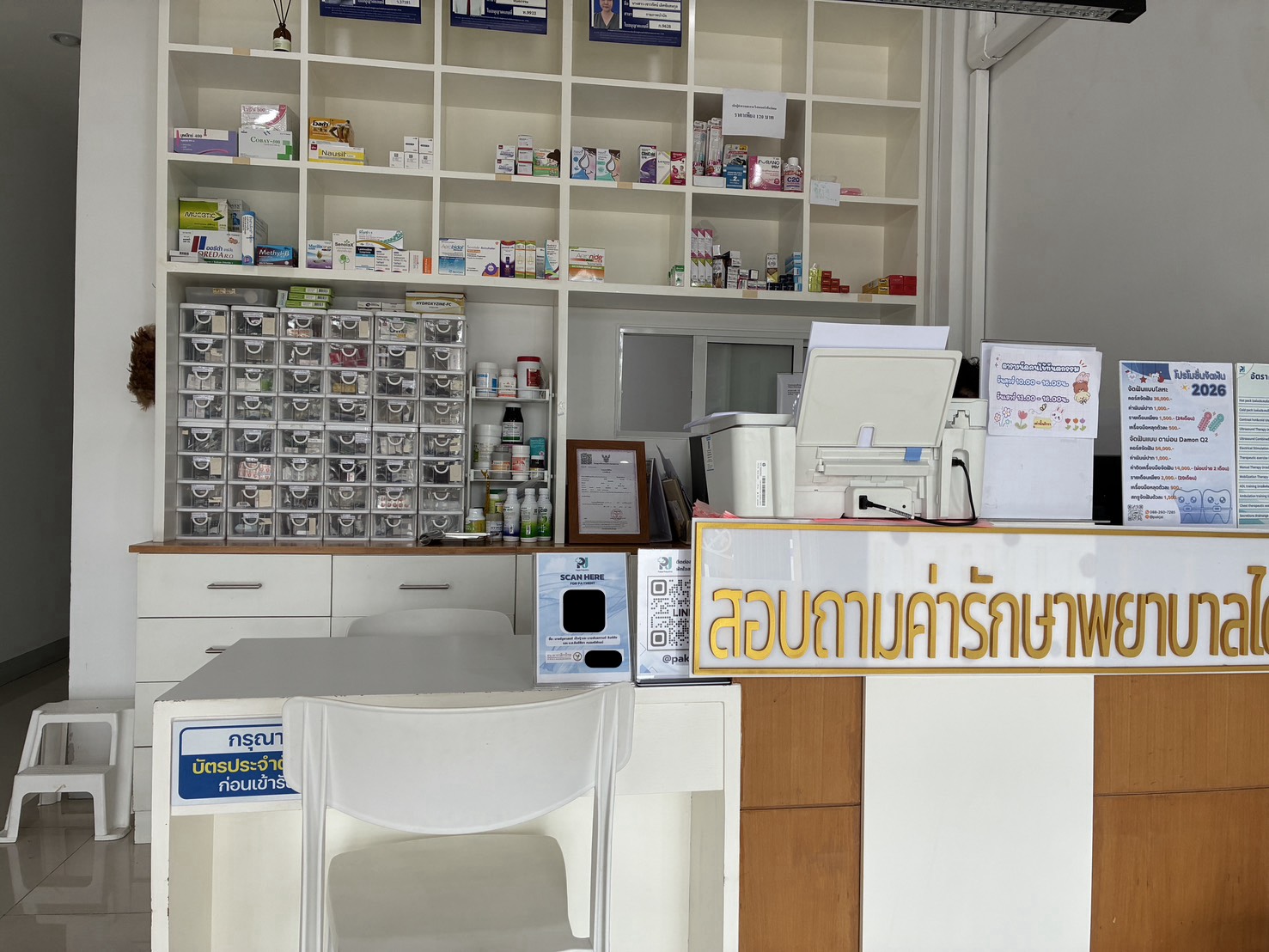
Neighbourhood clinics. The photo above is ours: a pharmacy counter, a GP, a dentist through the back. Prices are posted on the wall — orthodontic treatment was advertised at 36,000–54,000 THB while I was there. For a consultation, a prescription, a filling, this is where we actually go, and it costs little enough that insurance barely enters the conversation.
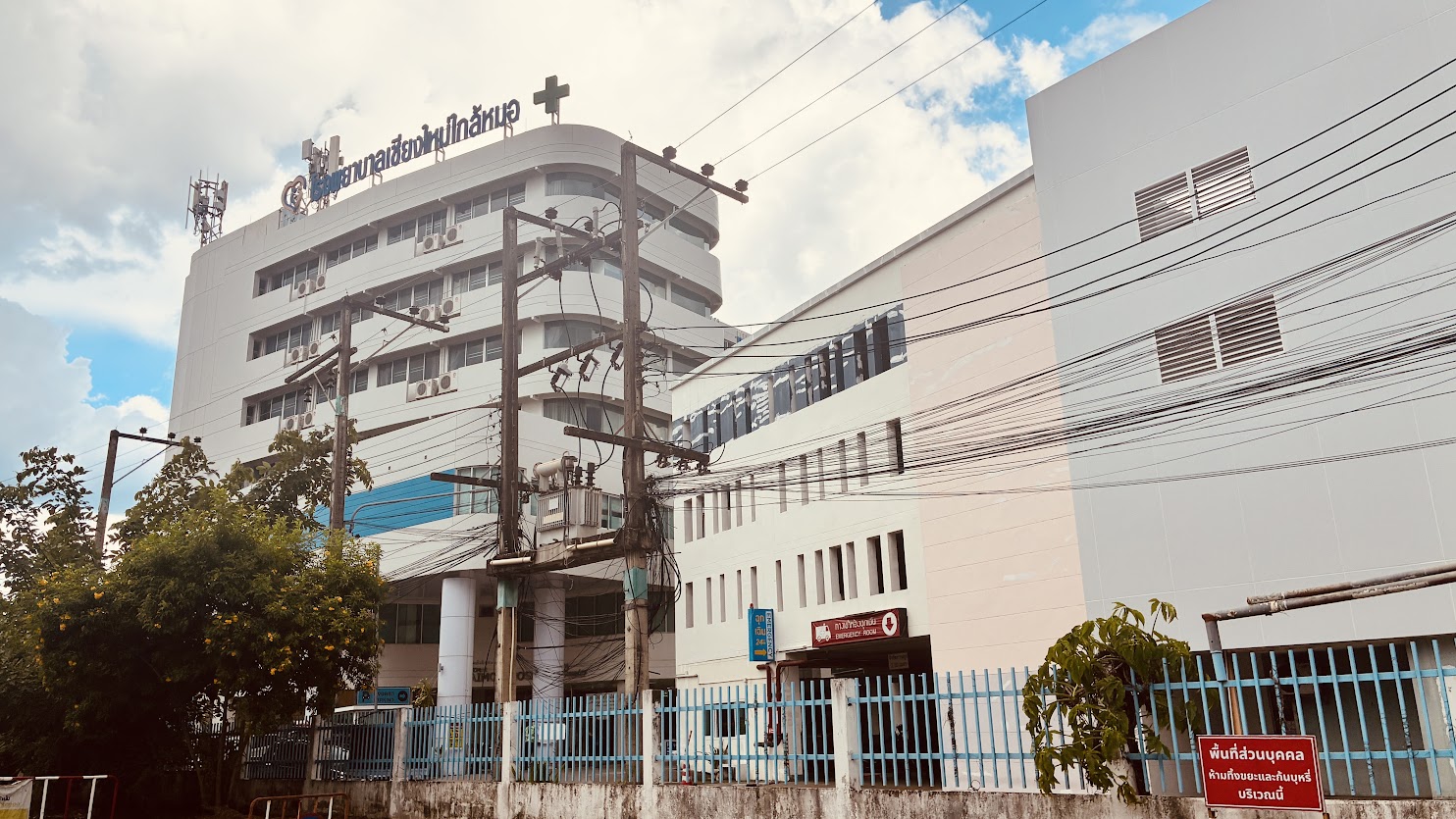
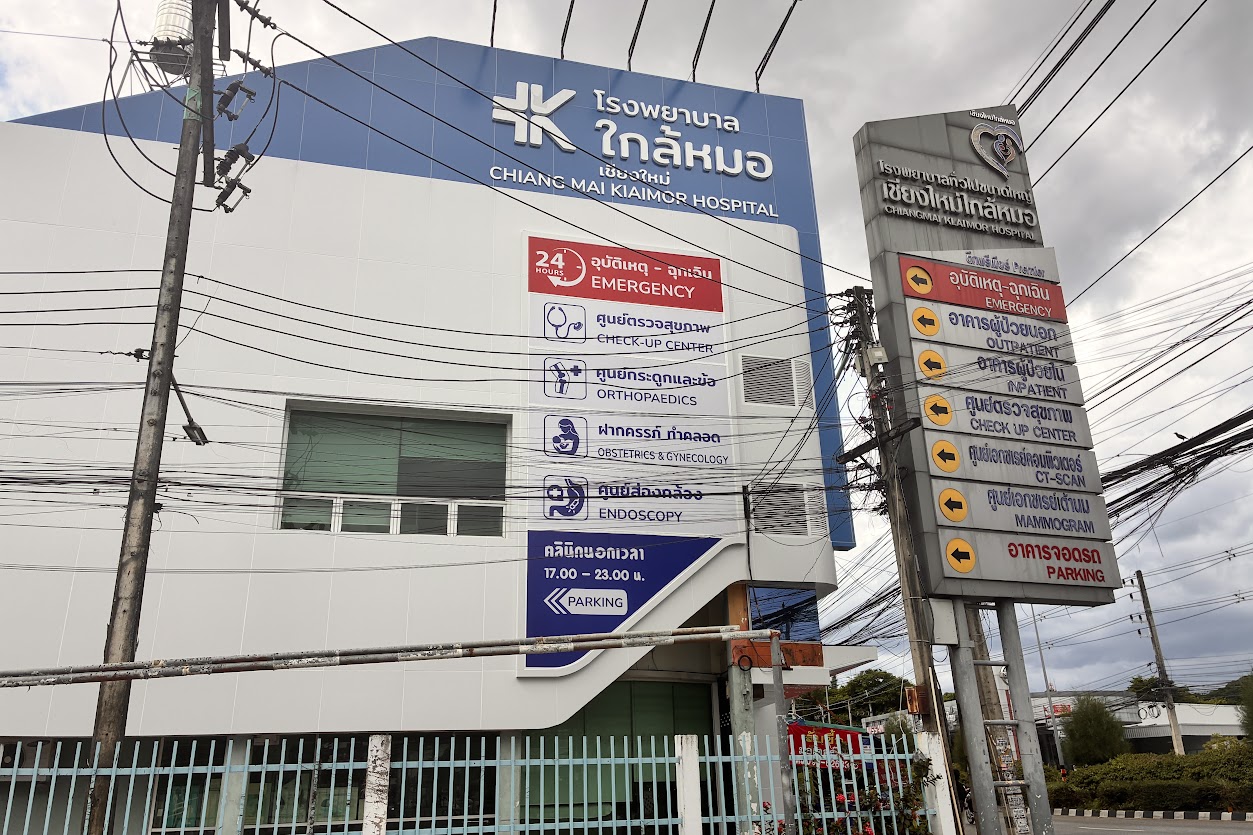
Mid-range private hospitals. This is the layer I had the hardest time finding written down, and it is the one we use ourselves. Ten minutes from us there is a private hospital with a 24-hour emergency room, an outpatient and an inpatient building, a check-up centre, CT scanning, mammography, endoscopy, orthopaedics and obstetrics — plus an evening clinic running until 23:00. Signage is in Thai and English. It is a real hospital, and it is not priced like an international one.
International hospitals. At the top sit places like Bangkok Hospital Chiang Mai and Chiang Mai Ram. The international hospitals I considered offer English-language care; prices and waiting times vary. This is where you would go for something complicated, or where an insurer’s cashless network is most likely to be useful.
That structure matters for how you choose. You are not insuring your daily life here. You are insuring the day routine care turns into a hospital admission — the day you move from the first layer to the third. I have never paid an uninsured admission bill here, so I cannot tell you what that costs.
The four kinds of expat health insurance we compared, and what they cost
| Option | Rough cost | What it is for |
| Credit-card travel insurance | Included with the card | Built for trips rather than for living somewhere. The cover on my two Japanese cards stops well before a DTV stay does — 90 days from departure; other cards use different limits |
| Nomad insurance (e.g. SafetyWing) | From around $60–110 per 4 weeks per adult, by age | Long, flexible stays; paid every 28 days or as a single 364-day plan; can be started after you have flown |
| Thai local health insurance | 98,154 THB a year for my wife and daughter (real quote, July 2026) | Living here full-time, serious cover, treatment inside Thailand |
| Japanese expat cover | Well over ¥1.2 million a year for a family | Broad cover with Japanese-language support; compare the actual benefits and exclusions |
Those are ranges on purpose. Insurance pricing moves with age, family size, dates and the specific plan, and any number I print here will be wrong for you. They are here so you can see roughly what separates the tiers before you go and get your own quote.
A note on the third row. That is not an estimate. It is the annual premium on a quote we took out in July 2026 with Allianz Ayudhya, for my wife and our four-year-old, on a plan with a 5 million baht ceiling per hospitalisation and worldwide cover outside the US. Two details in that document are worth more than the headline number.
Outpatient care was not included. It is an optional extra, and without it the policy does not pay for the ordinary GP visit at all. Even a serious local policy assumes you will handle everyday medicine yourself — which is exactly why the clinic economy above exists.
Children under 11 carry a 30% co-payment. Our daughter’s own premium was 34,502 THB for the year, and on top of that we would still pay 30% of any covered expense.
That second clause matters more than it looks, because of what sits next to it. An adult on this policy can cut their premium by as much as 60% by accepting a deductible — a child under 11 cannot choose one at all. For the child it is a floor, with a 30% share of every claim on top. If you are pricing family cover anywhere, that is the pair of clauses to look for. Neither is hidden. They are just in footnotes nobody reads until afterwards.
And a note on the fourth row. We also hold formal quotes from two Japanese insurers for our family, an order of magnitude above the nomad plans. I am not going to summarise those in one line, because the comparison deserves every number side by side — that is the next article.
Why we ended up with SafetyWing
Two things decided it for us, and neither is price.
Essential renews every four weeks, not annually. Annual expat policies want a decision and a payment for the whole year. We were still working out how our two-base year would actually split. Being able to start after we had already flown, and stop at the end of a four-week period, was worth more than a discount. This applies to Essential only — the Complete tier is a twelve-month commitment, with cancellation limited to the first fifteen days or at renewal. (Checked 6 August 2026.)
A child can be added to an insured adult’s plan at no extra premium. For our policy, this is the difference between one premium and two. The terms are narrower than that sentence sounds, so here they are as SafetyWing publishes them: Essential only; the child must be older than 14 days and younger than 10; one child per adult, or two per family or group; and — the one that catches people — the child can only be added at the point of purchase, not later. Complete has no free-child rule at all: every family member pays their own age-banded price. These terms have changed more than once, so confirm them on your own quote. (Checked 6 August 2026.)
On price, the only thing worth saying is that paying for 364 days in one go is 10 per cent cheaper than renewing every four weeks. Our quote matched the published discount exactly: $102.76 per four weeks rolling, $92.48 on the annual. The trade-off is the commitment. The rolling plan you can stop next month; the annual one you have already paid for.
Cover in your home country is limited, and the limit depends on how the plan is paid for. SafetyWing publishes the day counts: on a single 364-day payment it is up to 90 days per visit and 179 days in total per 364 days; on any other payment mode it is 30 days per visit within a rolling 90-day period. The plan must have been active for at least 90 days before home-country cover can be used at all. If you stay longer than the allowance, cover pauses until you leave your home country again. For someone who leaves and does not come back for a year, that is irrelevant. For a two-base life it is tight. This is the clause to watch if the insured person goes home often.
- Essential renews every four weeks — and you can start it after you have already left. Complete is a twelve-month contract.
- Continues past the 90-day limit on my two Japanese cards.
- 10% cheaper if you pay for 364 days in one go rather than renewing every 4 weeks.
- One child under 10 can be added free to an insured adult’s Essential plan — at the point of purchase only (two per family; confirm on your quote).
Reader offer: new SafetyWing members can get 8 weeks of electronics-theft cover free with the code CROSSSHORECHIANGMAI. Click the pink camera icon on the Nomad Insurance page and apply the code before you create your account. It works on 28-day or annual Nomad Essential subscriptions, for new members only. Worth knowing: after the eight weeks, the add-on renews as a paid extra unless you cancel it — set a reminder if you do not want to keep it. Offer terms and code validity are SafetyWing’s to change; I confirmed the code on my ambassador dashboard on 10 August 2026 and cannot promise it still holds when you read this.
What I actually pay
Published prices start at around $62 per 4 weeks, but that is the 18–39 bracket. Here is the quote we were given for my wife and daughter, rather than the headline.
| Plan | Our quoted price |
| Essential, 4-week rolling | $102.76 per 4 weeks |
| Essential, 364-day | $92.48 per 4 weeks |
That is the published 10 per cent discount for paying in full, and you can check the arithmetic: 102.76 less ten per cent is 92.48. The trade-off is the commitment. The rolling plan you can stop next month.
Both are the Essential plan, and Essential limits cover in your home country. On the 364-day payment that is up to 90 days per visit and 179 days per 364 days; on the four-week cycle it is 30 days per visit within a rolling 90-day period. The 364-day plan is billed once and is cheaper than paying every 28 days. Compare both before choosing.
There is also an electronics-theft add-on available on subscription plans, including the 28-day recurring plan, covering up to $1,000 per item. If you work from a laptop in cafés, price it in.
Essential is built for emergencies, not for managing an existing condition — pre-existing conditions, pregnancy and cancer treatment all sit outside it. Complete covers cancer tests and treatment, up to its annual limit. Maternity care on Complete is capped at US$2,500 with a ten-month waiting period — so it is not a substitute for planning a birth around. And it does not cover pre-existing conditions either: SafetyWing’s own wording is any illness or injury you have been treated for or diagnosed with in your life, plus anything you have had symptoms of in the last two years. If you are looking for cover for something you already have, neither tier is the answer. (Checked 6 August 2026.) And nomad cover is not a substitute for a real expat policy if your plan is to be here permanently with a family. Know which one you are buying.
Does the DTV require insurance?
In my case, no. I applied for the Destination Thailand Visa through the e-Visa portal, processed in Tokyo, and was never asked for proof of cover. Insurance is not part of the headline DTV requirements.
I was not asked for proof, and I could not find a published DTV insurance requirement. Do not buy insurance because you think the visa demands it. Buy it because the DTV is built around 180-day stays and my card stopped well before that.
→ The full story of how I applied and was approved: the DTV visa, first-hand. What our two-base life costs each month is here. For everything else about the move, start with my Chiang Mai relocation guide.
How to decide, in four questions
How long is your longest single stay, and what is your card’s actual cap? Being under the cap answers only the time-limit question; check the benefits and exclusions too. Over it, you need something else. Find the number before you compare anything.
Where will you be treated? If you will be treated mostly in Thailand, a local policy may make sense. If you move between countries, compare nomad cover as well.
Who is with you? Children change the maths sharply, in both directions — check what each option charges for them before comparing adult premiums.
What are you actually afraid of? A broken arm and a hospital stay is priced differently from a condition managed over years. We chose cover for the first. I am aware that is not the same as being covered for the second.
FAQ
Does credit-card travel insurance work if I live abroad?
Only up to a point. My two Japanese cards cap cover at 90 days from departure. That is not a universal rule. Fine for travel, not enough for a long stay. Go to your own card issuer’s terms rather than any article, including this one.
How much is health insurance in Chiang Mai?
From effectively free with a credit card, to roughly $60–110 per 4 weeks for nomad cover, to 98,154 THB a year for the local Thai policy we were quoted for two people, to over ¥1.2 million for Japanese expat cover.
Do Thai health insurance policies cover children the same as adults?
Not always. On the policy we were quoted, insured members under 11 carry a 30% co-payment on covered expenses and cannot take a deductible. Check this clause before comparing premiums.
Is SafetyWing enough for living in Thailand?
It depends entirely on what you are insuring against, and I am not in a position to tell you it is enough for you. It is what we use, for emergencies and a stay whose length we could not fix in advance. Read the exclusions before you decide: Essential leaves out pre-existing conditions, maternity and cancer treatment; Complete covers cancer and caps maternity at US$2,500 after a ten-month wait; neither covers pre-existing conditions. For permanent residence with a family, look at a proper expat policy instead.
Are children covered free on SafetyWing?
On Essential, yes, within limits. SafetyWing publishes “one child (older than 14 days but younger than 10 years old) per adult, or 2 children per group/family can be included in the insurance without added cost”, and “a group member can be added to the plan only at a purchase point”. What alternative is available if you need to add a child later is not published, so ask before you buy. On Complete, SafetyWing says family members “pay the regular price according to their age bracket”. These terms have changed before, so confirm them on your own quote. (Checked 11 August 2026.)
Does the Thai DTV visa require health insurance?
I was not asked in Tokyo, and I could not find a published DTV insurance requirement. A 180-day DTV stay exceeds the 90-day limit on my two Japanese cards.
What do doctors actually cost in Chiang Mai?
Routine care at a neighbourhood clinic has cost us little enough that we have paid cash each time. Whether that is cheap depends on your household, not on mine. I use insurance for the risk of a private-hospital admission, but I do not have a verified uninsured cost.
Is this financial advice?
No. I am not an adviser and I am not qualified to be one. Everything above is what I was quoted and what I decided for my own family, with dates attached so you can see how old it is.
Next in this series: the actual quotes, side by side — what two Japanese insurers, a Thai local insurer and SafetyWing each came back with for our family of three.
Last updated: August 2026. Insurance terms and prices change — confirm current details before you buy.
→ More on this: all our money guides — what we pay, how we move it, and what our insurance covered.