THAILAND · VISAS
This guide contains affiliate links. If you buy through them I may earn a commission at no additional cost to you, and I only recommend things I have used myself.
Currency: amounts I paid are given in the currency I paid them in. Conversions use the Bank of Japan’s official rate for August 2026 — ¥161 to US$1 and 100 THB to US$3.04, which puts 1 THB at about 4.89 yen — and are there for scale only. Ranges, quotes and future budgets are estimates, not payments.
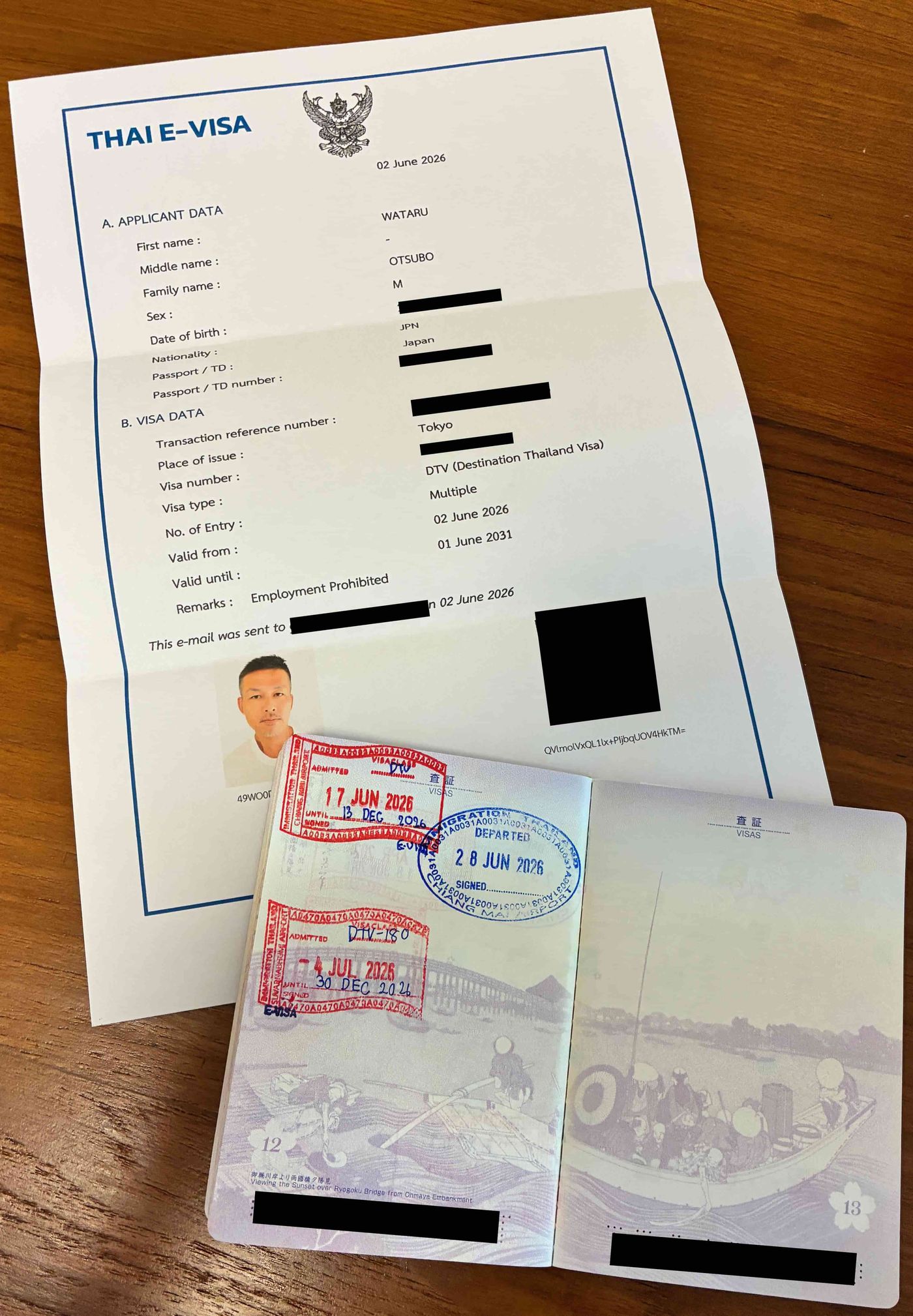
The DTV is a five-year, multiple-entry visa that lets remote workers stay in Thailand for 180 days at a time. Officially it is the Destination Thailand Visa; most of the English-language coverage calls it Thailand’s digital nomad visa, which is not the name on the document. I applied through the Royal Thai Embassy in Tokyo and was approved on 2 June 2026 — about six months after I first contacted an agent. It cost me 45,000 THB all in. This is what actually happened, including the parts the official pages do not mention. If you are planning the whole move rather than just the visa, start with my first-hand guide to moving to Chiang Mai.
What the DTV actually is
Three names for one thing. Destination Thailand Visa is what appears on the paperwork, DTV is the shorthand everyone uses, and digital nomad visa is what most of the English-language articles call it. They are the same visa, and I use DTV throughout.
The Destination Thailand Visa was introduced for people who want to be in Thailand for months at a time without working for a Thai employer: remote workers, freelancers, and people here for “soft power” activities such as Muay Thai training, Thai cooking courses, traditional massage study, meditation, or medical treatment.
The headline terms, as of July 2026:
| Item | Detail |
|---|---|
| Validity | 5 years, multiple entry |
| Stay per entry | 180 days |
| Extension | Once per entry, +180 days, at an immigration office (confirm the current fee) |
| After that | Leave and re-enter — the 180 days resets |
| Funds | 500,000 THB or the equivalent, with about three months of account history |
| How to apply | Online only, through the official Thai e-Visa portal, while you are outside Thailand. The portal asks for your current location and the post you submit to |
| Government fee | 10,000 THB as the headline figure. The Royal Thai Embassy in Tokyo publishes 52,000 yen for a DTV application, and Tokyo is where mine was processed. Check the fee published by the post you are applying to. |
| Dependants | A DTV holder’s spouse and children under 20 can apply on the holder’s visa. Tokyo’s published sheet sets no minimum age for the main applicant — the under-20 figure is the cut-off for children, not a floor for you. |
| Listed activities | Workcation (remote work, freelance, foreign talent), Thai soft-power activities such as Muay Thai or Thai culinary training, and medical treatment. Thai language study is not on Tokyo’s list of examples, but I found no published statement that it is excluded. Ask the post. |
Tokyo publishes the requirement as bank statements for the past three months showing a balance of no less than 500,000 THB. These were the two points that mattered most in my application: the word equivalent, and the account history. I will come back to both.
One more point that trips people up: since January 2025, Thailand has moved every embassy and consulate onto the e-Visa system, so there is no paper or walk-in route any more. Everything is filed online. That leads a lot of people to assume the whole process is remote. It was not, in my case.
A note on accuracy: everything about my application below is a record of what happened to me. Everything about the rules is correct as far as I can establish in July 2026, but visa policy in Thailand changes often and is applied differently by different embassies. This is not legal advice — confirm current requirements with the embassy you will apply to, or the official Thai e-Visa portal.
What changed in 2026
Three things moved this year, and much of the coverage runs them together. Here is what each one is, and which of them actually touches a DTV. (Checked 7 August 2026.)
First, what did not change: the DTV itself
Five years, multiple entry, 180 days per entry, one extension of 180 days at an immigration office, 500,000 baht or the equivalent with about three months of history, and an online-only application through the e-Visa portal. I went looking for a published change to any of those in 2026 and did not find one. That is not the same as saying nothing changed — embassies apply the same rules differently, and I only have my own file from Tokyo to go on — but if you have read that the DTV was tightened this year, I could not find the announcement behind it.
Where I did find published changes, none of them is about the DTV. They are about the alternative to holding one, about how you register on arrival, and about what an officer can ask you for at the desk.
Visa-free stays are being cut from 60 days to 30 — but not yet
The Thai Cabinet approved replacing the 60-day visa exemption with a tiered scheme. The Tourism Authority of Thailand’s update of 16 July 2026 puts it at 65 countries and territories, of which 59 move to a 30-day exemption. Mauritius and Seychelles go to 15 days; Azerbaijan, Belarus and Serbia move to visa on arrival. The stated principle is one country, one entry category, and it brings all 27 EU member states onto the same footing. None of it has taken effect yet. TAT says the five Ministry of Interior announcements are “pending publication in the Royal Gazette and will take effect 15 days after publication”, and that until then “current entry conditions remain in place”. (Checked 11 August 2026.)
Anyone who enters before the change keeps the stay they were given. Five Ministry of Interior announcements are still waiting on publication in the Royal Gazette, and they take effect 15 days after that. As I write this, TAT’s most recent notice is still the one from 16 July, and I have not found a later announcement saying the Gazette has published. Do not plan around a date until it has.
This belongs in a DTV article because of who it hits. Plenty of people run a life here on repeated visa-exempt entries rather than on a visa, and the whole calculation is how often you have to leave.
| How you are staying | Days granted per entry | Exits to cover about a year |
|---|---|---|
| Visa exemption, as it stands today | 60 | about 6 |
| Visa exemption, once the change takes effect | 30 | about 12 |
| DTV | 180, plus one extension of 180 | one, and one trip to an immigration office |
Doubling the number of exits changes what a year looks like, and it is the reason someone who was comfortably ignoring the DTV last year might not be by the end of this one.
There is now an immigration app, and it does not replace TDAC
The Immigration Bureau opened pilot access to THIM, the Thailand Immigration Management app, on 11 June 2026, with the full launch expected in August 2026. You photograph your passport and it reads the details, then you add your accommodation, travel details and purpose of entry — the same information TDAC asks for. Registration is expected to take under three minutes, and one submission can cover up to ten travellers, which is the part that matters if you are arriving as a family. It launches in English, Russian, Japanese and Chinese, with more languages planned, and registered users can reach the Tourist Police hotline through the app.
The important part is what it is not. TAT’s wording is that THIM is optional, that it is not an additional arrival-card requirement, and that it does not replace TDAC at this stage. Travellers should keep completing TDAC as the Immigration Bureau requires; THIM is a route into TDAC-linked registration rather than a substitute for it. Longer term the Bureau describes it becoming a wider platform — submitting documents digitally, booking appointments with officers, having some requests considered without attending in person — but those functions are described as still under development.
I have not used it. I fly back into Thailand later this month and I will write up what actually happens at the desk rather than what the announcement says. Until then, everything above is the Immigration Bureau’s account and not mine.
Proof of funds at the border: an old rule, newly repeated
On 6 July 2026 TAT reminded visitors to have evidence of sufficient funds ready for entry screening. The notice says plainly that this is not a new measure. The requirement comes from a Ministry of Interior announcement of 1980, with the current amounts set in 2000. The published figures are 10,000 baht per person or 20,000 per family for transit, certain visa-exempt cases and visa on arrival, and 20,000 per person or 40,000 per family for a tourist visa or a non-immigrant visa. It is not applied to children under 12, and it can be met with baht, the equivalent in another currency, or documents evidencing payment.
The published list does not name the DTV, so I cannot tell you which figure applies to it. I have not been asked at the border, on the DTV or before it, but “I have never been asked” is a weak thing to plan around. If you want a definite answer before you fly, the Immigration Bureau’s call centre is 1178 with an English-language service, and its site is immigration.go.th. The decision at the checkpoint belongs to the officer standing there.
Keep evidence of funds or equivalent payment documents readily accessible; the checkpoint officer decides what is sufficient. The figure is small next to what the DTV itself asks you to show.
My application, step by step
The official summary makes this sound linear. Mine was not.
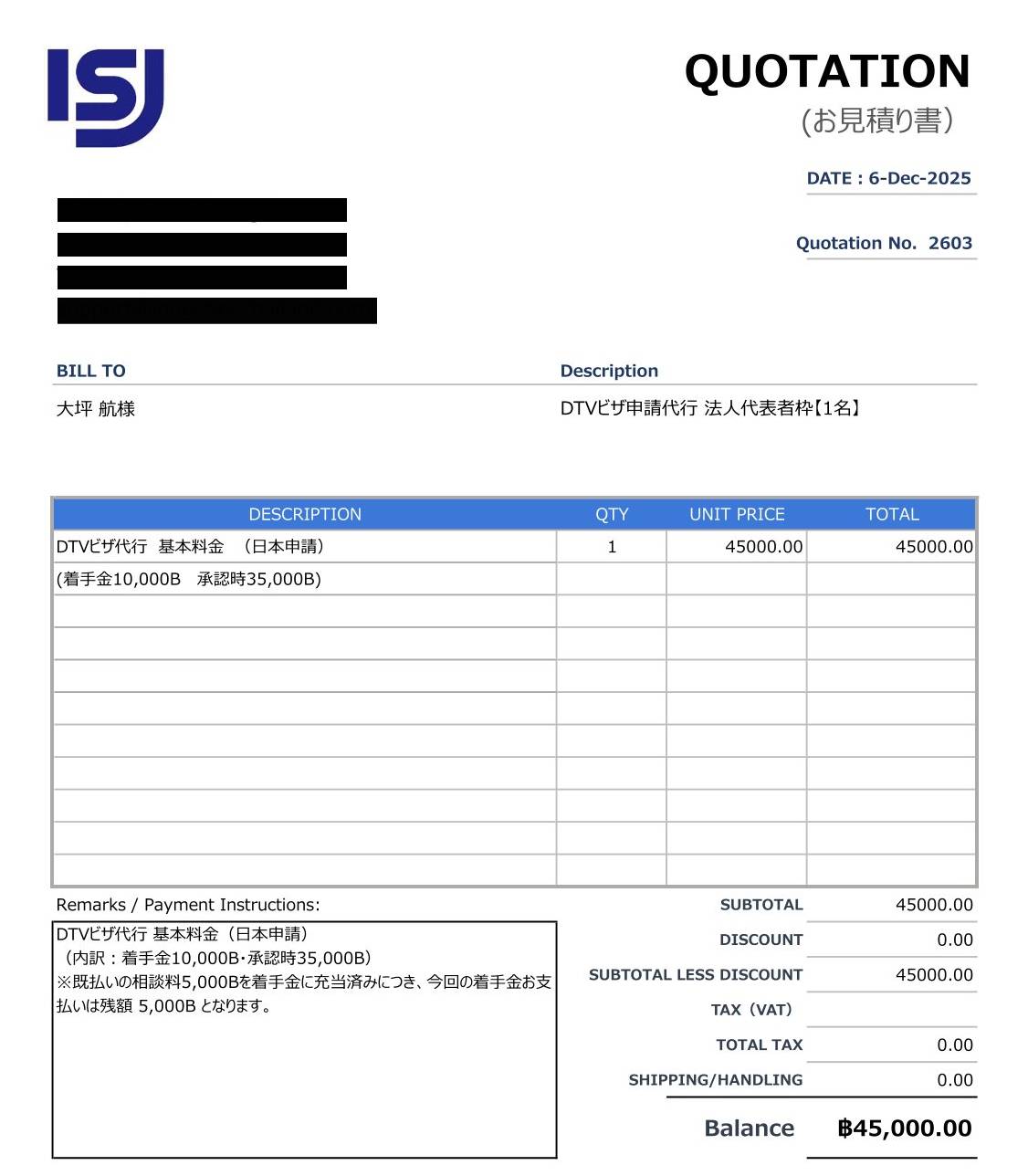
I contacted a Thailand-based agent, ISJ Longstay Thailand, in October 2025 and received a written quotation on 6 December 2025. I was already travelling in and out of Thailand as a tourist at that point.
To apply, I had to be outside Thailand, so I went back to Japan. The application itself was filed online through the Thai e-Visa portal — there is no paper option — and I selected the Royal Thai Embassy in Tokyo as the post that would process it.
Online filing does not mean the process is remote. Tokyo called me in for an in-person interview.
My agent told me Tokyo required an interview and Fukuoka did not; I did not verify Fukuoka independently. That was my agent’s comparison; I verified only Tokyo.
So do not budget your time and flights on the assumption that a DTV can be completed without showing up somewhere. Check what the specific post you are applying to actually requires, and plan for an interview being needed.
Then I flew back to Thailand and re-entered as a tourist, because the visa had not been issued yet. Approval came through on 2 June 2026, while I was already in the country. My e-Visa shows the visa as valid from 2 June 2026 to 1 June 2031, multiple entry, place of issue Tokyo.
That timing raised an obvious question, so I put it to the interviewing officer directly: would the visa still be valid, granted while I was inside Thailand on a different entry? It would. I simply could not use it until I left and came back. On my next trip out and back, I entered on the DTV itself.
From first contact to approval: about six months. If you are planning a move around a start date, build in that buffer. I would not assume the visa is in hand until it is.
Here is what actually caused the delay, and it is smaller than you would expect. The embassy rejected my application photograph twice. Not the bank statements, not the company paperwork — the photo. Each rejection cost days, and the final approval landed after the departure date I had originally planned around. Check the photo specification on the e-Visa portal to the letter before you upload anything.
Which post handles your file, and why I could not choose
This is the part I would most want to know in advance.
The form asks for your current location and the post you submit to; I could not choose freely within Japan. That field decides who reads your file, and posts do not read them the same way.
My agent’s advice was blunt: Tokyo is one of the stricter posts, and if I had flexibility, applying from Vietnam would be easier.
I did not have that flexibility, and the reason is the part worth understanding. They told me that applying inside Japan means applying to the post whose jurisdiction covers where you live. The dropdown is not a menu you pick from for convenience. For me it resolved to Tokyo, so Tokyo it was, and it worked.
At first that sat oddly next to the Vietnam suggestion, so I looked into it. The two are not actually in conflict. I applied in Tokyo, where I live, and I have not verified which posts accept applications from non-residents. The ones repeatedly named in forums are in Vietnam, Laos, Cambodia and Myanmar. Check the requirements published by the post you intend to use before planning a trip around it.
I should be honest that accounts of this differ, including between people who have recently been through it, and requirements have moved before. Treat the above as what I was told and what happened to me, and confirm the position with the specific post you intend to use before you plan a trip around it.
Everything in the last few paragraphs came from one place: my agent. I am flagging that rather than dressing it up, because a single source is a single source, however experienced. They handle these applications constantly, so I took it seriously. I have not verified it independently, and you should not treat it as established.
What they told me: Tokyo is strict but fair, and usually processes inside one to three weeks. They had seen applicants refused the DTV and offered a six-month tourist visa instead. And the posts in Southeast Asia — Vientiane, Phnom Penh, Ho Chi Minh City, Kuala Lumpur — tend to be faster and more predictable.
My own file does not confirm the timing, and I want to be straight about that. I filed on 23 April 2026 and was approved on 2 June — roughly six weeks, not one to three. My agent called that a slow one, and part of it was my own doing: the photograph was rejected twice. So I cannot tell you the typical figure from experience. I can tell you mine, and who told me the rest.
Prepare for the requirements of the post that will process your file, and confirm them before planning a trip.
The 500,000 THB question — “equivalent” is the key word
Almost everyone reads “500,000 THB” and assumes they need a Thai bank account with baht in it. You do not.
I kept 2.5 million yen in my Japanese bank account, in yen, for more than three months before applying. That is roughly 500,000 THB at 2026 rates, and it was accepted. No Thai account, no currency conversion, no moving money abroad.
What actually matters is the history. My agent warned that recently deposited money could draw questions, so I kept the balance in place for more than three months. Three months of statements showing the balance sitting there is what I was told to prepare, and it is what I did.
If you are planning to apply, get that balance in place now and then leave it alone. The bank-history requirement was the only part of my Tokyo file that needed three months of records.
How I framed my application: as a company director
My quotation describes what I bought as “DTV application service — corporate representative slot.”
That description is doing real work. I applied under the remote-work category, but not as a loosely defined freelancer: I applied as the director of my own company, Cross Shore LLC, with company documentation behind me. Company registration papers, a business an officer can look up, and income that plainly arrives from outside Thailand.
The DTV asks you to prove that your work is genuine and that it is based outside Thailand. Anything that makes that easier to verify — a registered company, long-term contracts, an employment letter from a foreign employer — makes the file stronger. In my case, the company documents made the work easier for the officer to verify.
If you are a freelancer, expect to show a portfolio
Applying under the remote-work category is not just a tick box. Freelance and self-employed applicants are asked to evidence the work itself — a portfolio, client contracts, invoices, a website. “I work online” on its own is not an application.
Two specifics from my agent that I have not seen written down anywhere:
On income. Their working guidance was roughly 200,000 yen a month (about $1,240) sustained over about three months. That is a recommendation, not a published rule. For the record, my own income over that period ran between 100,000 and 200,000 yen a month — below their guidance — and it was not a problem. Consistency and documentation appeared to matter more than hitting a specific number.
On what counts as income. My agent did not count my rental income toward the working guidance. The category is built around work you actively perform for clients or an employer outside Thailand, not passive returns. If your income is mostly from property, this is worth clarifying before you spend money on an application.
Sole proprietors: registration is the dividing line
You do not need a company. My agent said registration made a sole-proprietor file easier to verify; the post decides what evidence is sufficient. In Japan, that means having filed the notification of business opening with the tax office. My agent was clear about the flip side: if you have never formally registered your business, the application gets much harder.
The principle runs through the whole application. An officer is looking for something they can verify independently. A registration document does that. A description of what you do does not.
What it cost me
| Item | Amount |
|---|---|
| Consultation fee (paid up front, credited to the retainer) | 5,000 THB |
| Balance of retainer | 5,000 THB |
| Success fee, payable only on approval | 35,000 THB |
| Total, including the 10,000 THB government fee | 45,000 THB (~$1,370) |
The total was all in — the agent’s quote listed a 10,000 THB government fee inside the package, so there was no separate bill at the embassy. I did not pay the embassy directly, so I cannot confirm what was actually remitted to the post on my behalf.
The structure is the part I would look at: 35,000 THB of the 45,000 was only payable if the visa was approved. That is a success-fee model. It changed how I felt about the risk while I was waiting, though I have no way of knowing whether it changed how the agent actually worked.
You do not need an agent, and the difference is stark. Filing the DTV yourself through the e-Visa portal costs roughly 55,000 yen once you add the government fee and the incidentals. Going through an agent cost me about 220,000 yen — four times as much.
I paid it because I was moving a family and a dog on a fixed schedule, applying as a company director with a thick file, and I wanted someone who had seen a hundred of these to look at mine before it went in. In hindsight I could have done it myself. If your situation is simpler than mine — one person, straightforward remote income, no deadline — do it yourself and keep the 165,000 yen.
What the DTV does not get you: a Thai bank account
Every branch I approached declined my DTV.
The reason is a classification mismatch. The DTV is a five-year visa, which makes it feel like a long-stay permit — but under the Immigration Act it sits in the tourist category, and Thai banks apply their know-your-customer rules to that classification, not to the length of the visa. Krungsri’s foreign currency deposit page excludes Tourist VISA customers, but other banks, branches and account types may differ. The broader tightening followed a wave of scam operations run through accounts opened by short-stay foreigners.
It goes further than new applications. Some DTV holders did open accounts in 2024, before the rules tightened. Through 2026 there have been reports online of those accounts being frozen or flagged during compliance reviews. I have not seen this happen to anyone I know, and I am passing it on as an unverified report rather than as a fact.
You will hear that it can still be done with the right local connection. I have heard it too. I have not verified it, and given that banks are actively reviewing existing accounts, I would not build a financial plan on it.
What makes this concrete in our house is that my wife can open one and I cannot. She and our daughter are here on education (guardian) visas, and that visa type has to be extended against a Thai bank balance — so holding an account is a precondition, and the bank opens one. The DTV asks for its 500,000 THB once, at application, in any country’s bank.
So the practical lesson is not about banking. It is about sequencing: if you will need a Thai account, choose your visa with that in mind before you apply. In the same family, on the same day, two visas produce two completely different financial setups.
What I do instead. I have no Thai account, so money comes in through Wise — roughly 100,000 yen every three weeks, out of a Japanese balance. It does not replace what a Thai account does. There are still no local direct debits in my name and no counter I can walk into. It solves the narrower problem the DTV leaves you with, which is getting money into the country at all.
In practice, you manage your money from abroad — an international account or a multi-currency service — and withdraw cash here. It is less convenient than a local account and entirely workable — I cover what I actually use, and what each transfer and conversion cost, in how we send money to Thailand without a Thai account.
“Employment Prohibited” — the line that worries everyone
My visa has a remark printed on it: Employment Prohibited. Every DTV holder sees it, and it causes a predictable moment of panic. If work is prohibited, what exactly am I allowed to do here?
Here is what I can and cannot tell you. The Thai Ministry of Foreign Affairs lists the DTV’s purpose as workcation for remote workers, freelancers and foreign talent, which is why the visa exists at all. What I have not found is a published statement from the Thai labour authorities drawing the line between income from foreign clients and income from Thai ones. The distinction is commonly described as working in Thailand versus working from Thailand, and that is the reading I have acted on — but it is a reading, not a rule I can cite, and I am not qualified to give you a legal opinion on it. If your situation is anywhere near the edge, ask a Thai lawyer rather than a blog.
I would not treat that line as ambiguous or try to test its edges. Keep your clients and your invoicing outside Thailand, and keep it documented. If your plan involves earning from Thai customers, the DTV is the wrong visa and you want proper work-permit advice, not a blog post.
180 days, one extension, and the border-run trap
Each entry gives you 180 days. Before it expires, you can apply once for an extension of up to another 180 days at an immigration office. Confirm the current fee and required documents with Immigration. That is up to roughly a year of continuous stay.
You cannot extend twice in the same entry. What you do instead is leave the country — anywhere, including a neighbouring one — and re-enter, and the 180-day clock resets. You do not have to use the extension at all if leaving is cheaper or more convenient.
Here is the caution I was given, and I will name where it came from. My agent’s read was that immigration has become less tolerant of people using the DTV as a rolling residence permit with quick hops across the border. Short, repetitive exits invite the question of whether you are actually living here without an appropriate visa, and re-entry sits at the officer’s discretion. I have not tested this and cannot confirm it from my own entries.
TAT says visitors may be asked to show funds during entry screening, and lists 20,000 THB per person for a Tourist Visa or a Non-Immigrant Visa. The published list does not name the DTV, and TAT says the final decision rests with the officer at the checkpoint. I have never been asked, across every entry I have made.
None of this is a problem if your travel is genuine. It becomes a problem if your pattern looks like it exists purely to reset a stamp.
Before and after you land: the things people forget
TDAC. Since May 2025 every arrival in Thailand must submit the Thailand Digital Arrival Card online. The official guidance is to submit it within three days before arrival, counting the arrival date itself. It replaced the old paper card you used to fill in on the plane. It takes a few minutes and it is free, but it is easy to forget on a route you have flown many times.
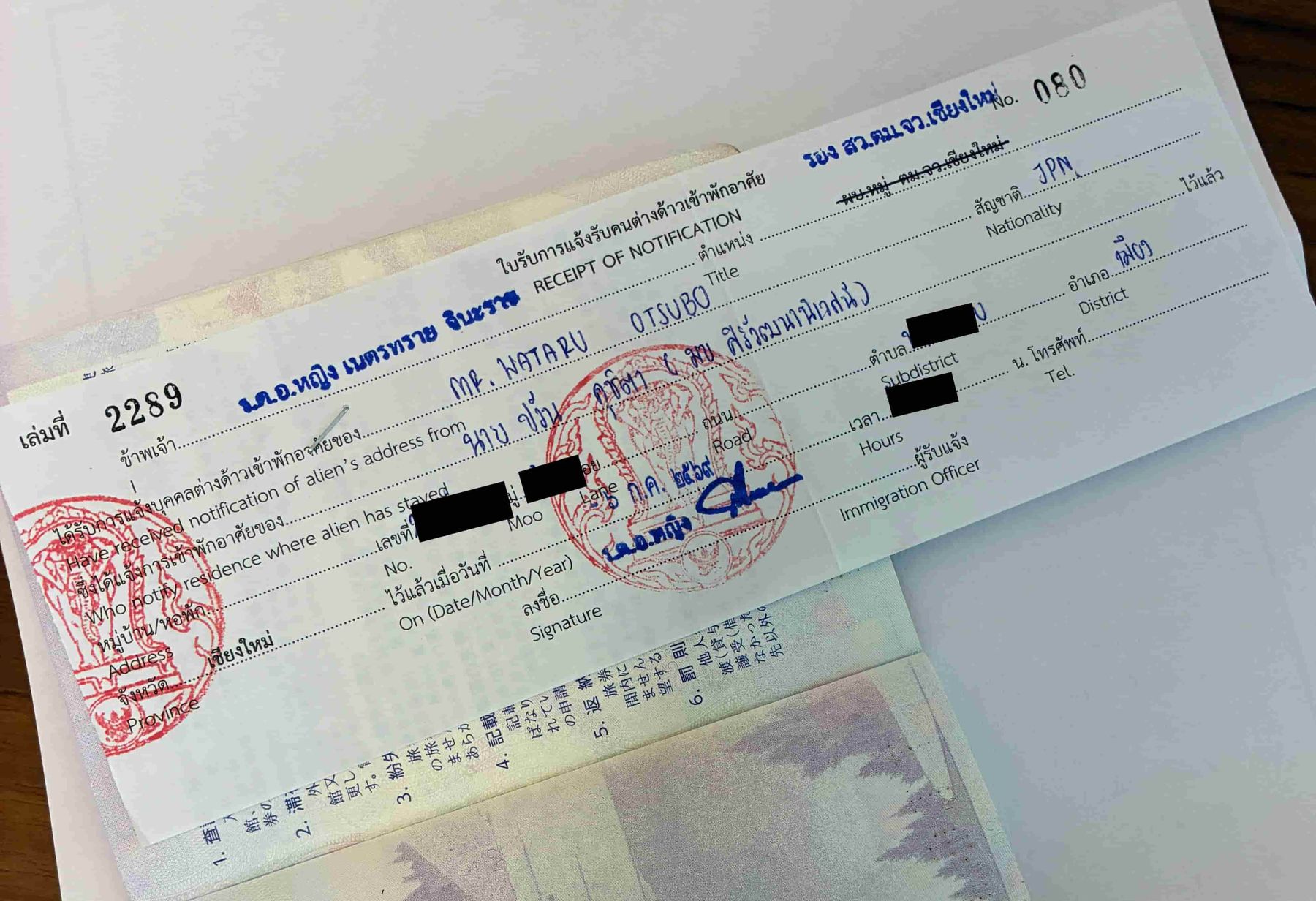
TM30. Thailand requires a notification of where a foreign national is staying. Section 38 names four kinds of person: the house master, the owner or the possessor of the residence, and the hotel manager. It does not say which of those categories a tenant falls into, and I am not going to decide that for you. In our house the first notification was made by our landlord, and I hold the receipt from Chiang Mai Immigration. I have never been asked to produce that receipt anywhere, so I cannot tell you which counters ask for it and which do not.
The 90-day report. If you stay more than 90 consecutive days, you must report your address to immigration. It is not a visa renewal and it does not extend anything; it is a check-in. Miss it and you pay a fine.
What none of that tells you is what the office is actually like, so here is the version I wish someone had given me.
Whether you have to file again after every trip abroad has two official answers, and they do not agree. The regulation made under Section 38 and published in the Royal Gazette on 16 June 2020 says that once the notification has been made, and the foreigner later stays elsewhere and returns to the same place within an accommodation period that has not ended, it does not have to be filed again — and it states that this includes holders of multiple-entry visas who leave the Kingdom and return within the validity of the visa. Material from Immigration Division 1 dated 2025 lists “re-entry into the kingdom and stay at the previously reported residence” as a case where the notification must be resubmitted. I have not found anything that reconciles the two.
I file mine every time I come back, because that is what I was told to do. I have never tested not filing, so I cannot tell you what happens if you rely on the 2020 regulation and your office takes the 2025 view.
Updated 20 August 2026. This section previously said a fresh TM30 was generally not required when you return to the same address, citing a law firm’s summary of the 2020 relaxation. I have replaced that with the two official documents themselves, because they conflict and a reader deserves to see both rather than one tidy answer.
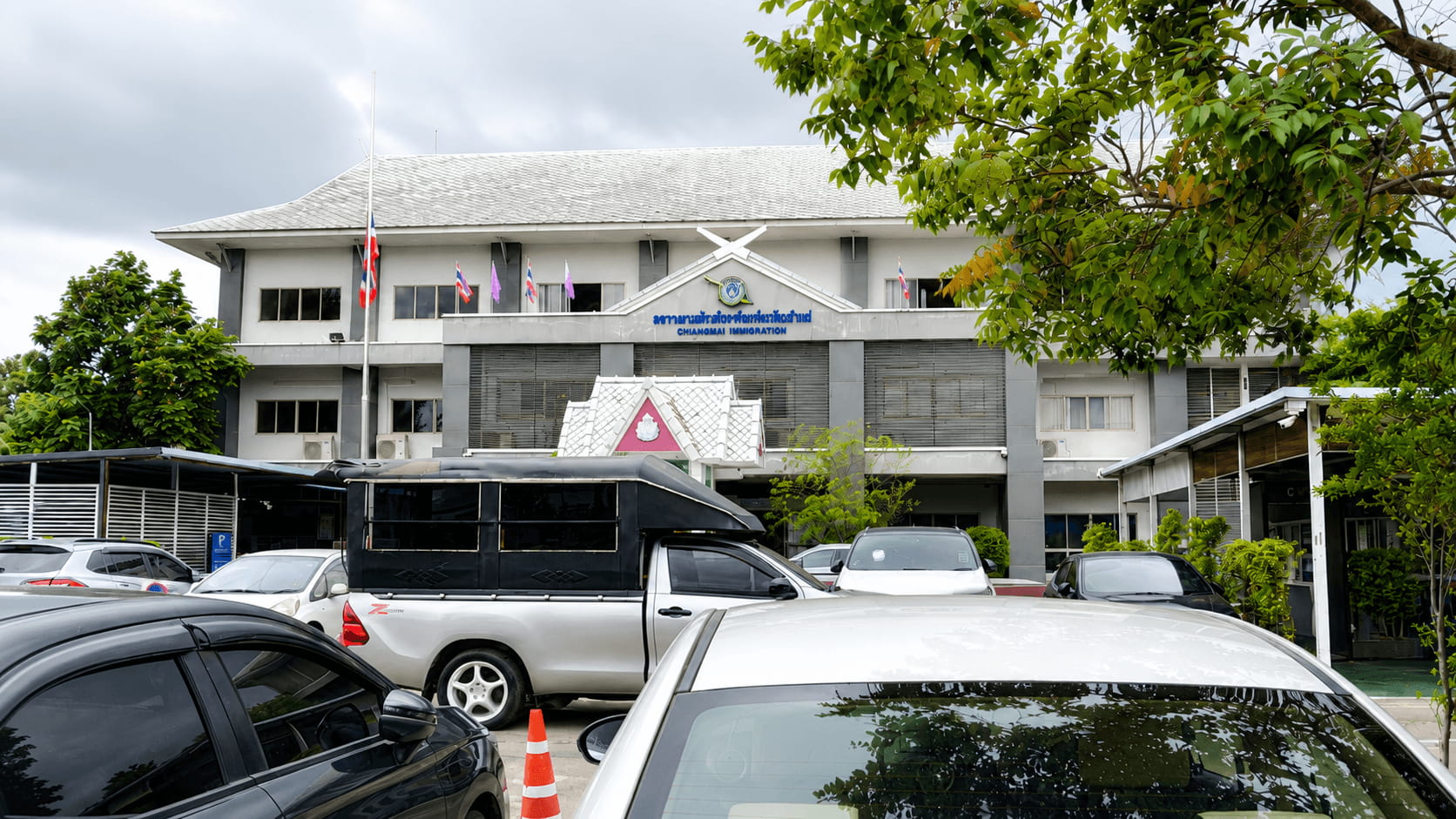
Three things make it survivable at the Chiang Mai office. Ask for a queue number the moment you arrive. There are four counters, but the numbers are handed out by a woman standing near the entrance, and nothing tells you this. I once walked in, waited, and only then discovered I had needed a ticket — I was number 47 and they were calling 32.
Go first thing in the morning. Of those four counters, only two actually handle foreigners; the rest are for Thai nationals or admin. The posted hours run to midday, but when it is busy they close the morning queue early — I watched people arriving at 11:30 be told to come back after 1:30pm. On a Monday there were twenty people ahead of me.
Go by motorbike. Bike parking is immediate and free; car parking is neither.
Two pieces of good news to finish. A TM30 can be filed in person, by post or online, subject to the local office’s process. And the 90-day report has a drive-through at Chiang Mai immigration, with separate lanes for cars and pedestrians. The bureaucracy is real, but it is quietly getting easier.
None of these is difficult. All of them are easy to overlook until someone at a counter asks you for a document you have never heard of.
Does the DTV require health insurance?
In my case, no. I was not asked for proof of insurance at any point in my Tokyo application, and insurance is not part of the headline DTV requirements.
I was not asked for proof; my own Japanese cards stopped at 90 days, so check your own card’s terms. The DTV is built around stays of 180 days, and that gap is real. It is the one that caught my own family out.
- Essential can continue beyond day 90, subject to its terms and exclusions.
- One eligible child can be added at no extra premium at sign-up. Confirm the current age limit and number allowed on your own quote.
- Essential is paid every 28 days and future renewals can be stopped. You can start it after you have already flown out.
Reader offer: new SafetyWing members can get 8 weeks of electronics-theft cover free with the code CROSSSHORECHIANGMAI. Click the pink camera icon on the Nomad Insurance page and apply the code before you create your account. It works on 28-day or annual Nomad Essential subscriptions, for new members only. Worth knowing: after the eight weeks, the add-on renews as a paid extra unless you cancel it. I confirmed the code on my ambassador dashboard on 10 August 2026; SafetyWing can change the offer or code validity.
→ More on this: the insurance section of my Chiang Mai relocation guide, including what long-stay cover actually costs.
What I would do differently
I would put the money in place earlier. The three-month balance requirement is the one thing you cannot fix quickly. The three-month statements were the only part of my Tokyo file that required a three-month history.
I would ask about the embassy sooner. I was told Tokyo was strict early on, and I still applied there. It worked, but knowing that my agent said Tokyo interviewed and Fukuoka did not — I verified only Tokyo — would have changed how much documentation I prepared, not just where I filed.
I would build a longer buffer. Six months was my total from first contact to approval; the embassy stage took about six weeks. I built our moving schedule around that timeline, and it left less room than I would have liked.
I would not treat the visa as certain until it is issued. I re-entered Thailand as a tourist while my application was still open, and that turned out to be the right call rather than a problem. Do not book anything that depends on a visa you do not yet hold.
→ Related: what living here actually costs us each month, and what I found when I read my own insurance policy properly.
FAQ
How long does a DTV visa take to get?
About six months from first contacting an agent to approval, but the number you probably want is the embassy stage: I filed on 23 April 2026 and was approved on 2 June — about six weeks. My agent said that was a slow one, and that one to three weeks is more typical. Part of my delay was self-inflicted: the embassy rejected my photograph twice.
Can I apply for the DTV online?
Yes — since 2025 the Thai e-Visa portal is the only route, and there is no paper application. But the embassy processing your file may still require an in-person interview, as Tokyo did with mine.
Do I need 500,000 THB in a Thai bank account?
No. I kept the equivalent — 2.5 million yen — in my Japanese bank account. Tokyo publishes the requirement as bank statements for the past three months showing a balance of no less than 500,000 THB; other posts may differ.
How much does the DTV cost?
The MFA headline figure is 10,000 THB, but each post publishes its own price: Tokyo publishes 52,000 yen. I paid 45,000 THB all in through an agent, with 35,000 THB only payable on approval.
Can I open a Thai bank account with a DTV?
Every branch I tried declined. Krungsri’s FCD page excludes Tourist VISA customers, but I found no rule covering every bank or account type. There are unverified reports online of accounts opened in 2024 being frozen since.
How much income do I need for the DTV?
There is no published figure. My agent’s guidance was around 200,000 yen a month for three months; my own income ran below that and was still approved. My agent did not count my rental income toward the working guidance.
Can I get a DTV as a freelancer?
Freelancers can apply, but evidence varies; my agent advised using registration, contracts, invoices and a portfolio. In Japan, that meant a filed notification of business opening.
Can I work on a DTV visa?
The DTV is intended for workcation by remote workers and freelancers, but I could not find labour guidance defining the line. The visa is marked “Employment Prohibited.” Get legal advice before taking Thai employment or Thai clients.
How long can I stay on a DTV?
180 days per entry, and you can apply once for an extension of up to another 180 days. Confirm the current fee and required documents with Immigration. After that you leave and re-enter, and the 180-day period resets.
Can I study Thai on a DTV?
Thai language study is not on the list of examples Tokyo publishes, and I could not find a published statement that it is excluded either. I have seen it widely reported that it no longer qualifies, but I could not verify that in Thai government material. Ask the post you are applying to rather than taking my word or anyone else’s.

I split the year between Kamakura, Japan and Chiang Mai, Thailand, and write these guides from our own records, our own experience, and named sources. More about me.
Last updated: 20 August 2026. The TM30 re-filing paragraph was corrected on that date; the note in that section explains what changed.