THAILAND · COST OF LIVING
This guide contains affiliate links. If you buy through them I may earn a commission at no additional cost to you, and I only recommend things I have used myself.
Currency: amounts I paid are given in the currency I paid them in. Conversions use the Bank of Japan’s official rate for August 2026 — ¥161 to US$1 and 100 THB to US$3.04, which puts 1 THB at about 4.89 yen — and are there for scale only. Ranges, quotes and future budgets are estimates, not payments.
Almost every guide to the cost of living in Chiang Mai is written by someone living alone. This one is not. We are two adults, a five-year-old and a dog, and living here costs us 330,000–350,000 yen a month — roughly $2,050–2,170. That is far more than the figures you usually see, and school fees explain a large part of it. The full cost of our year is higher still, because we still pay tax, pension and a mortgage in Japan. If you are weighing up the whole move rather than the budget, start with my first-hand guide to moving to Chiang Mai.
The bill that changed how I think about this
In our first full month here, the electricity came to 2,374.33 THB. The next month, in the same house, with the same family in it, it came to 676.97 THB.
Not a typo. A 71% drop, one month apart, and nobody moved out.
That single pair of bills is why I distrust the phrase “cost of living in Chiang Mai.” It is not a number you can look up. It is a range, and you sit somewhere inside it depending on the season you arrive in and the habits you bring.
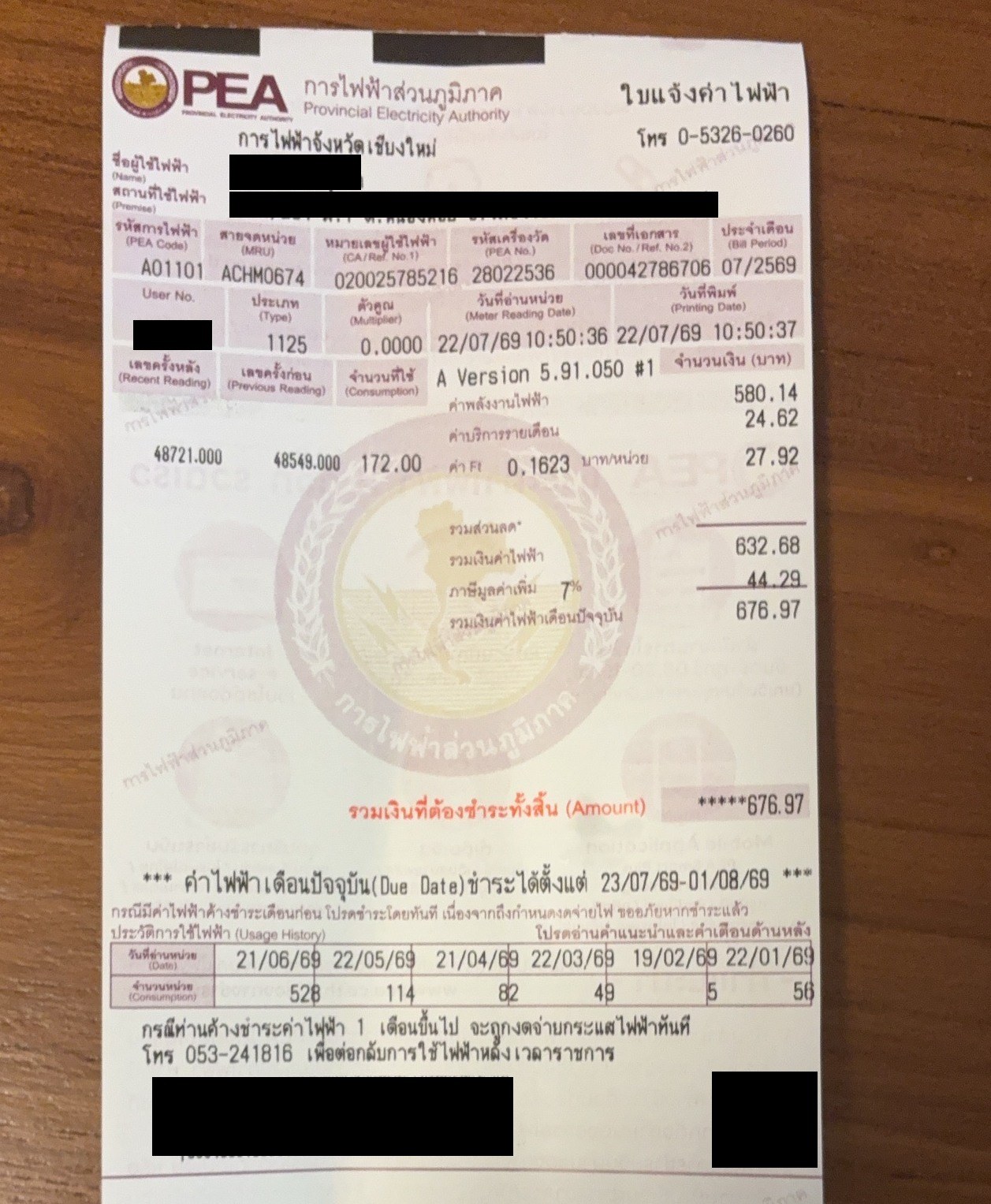
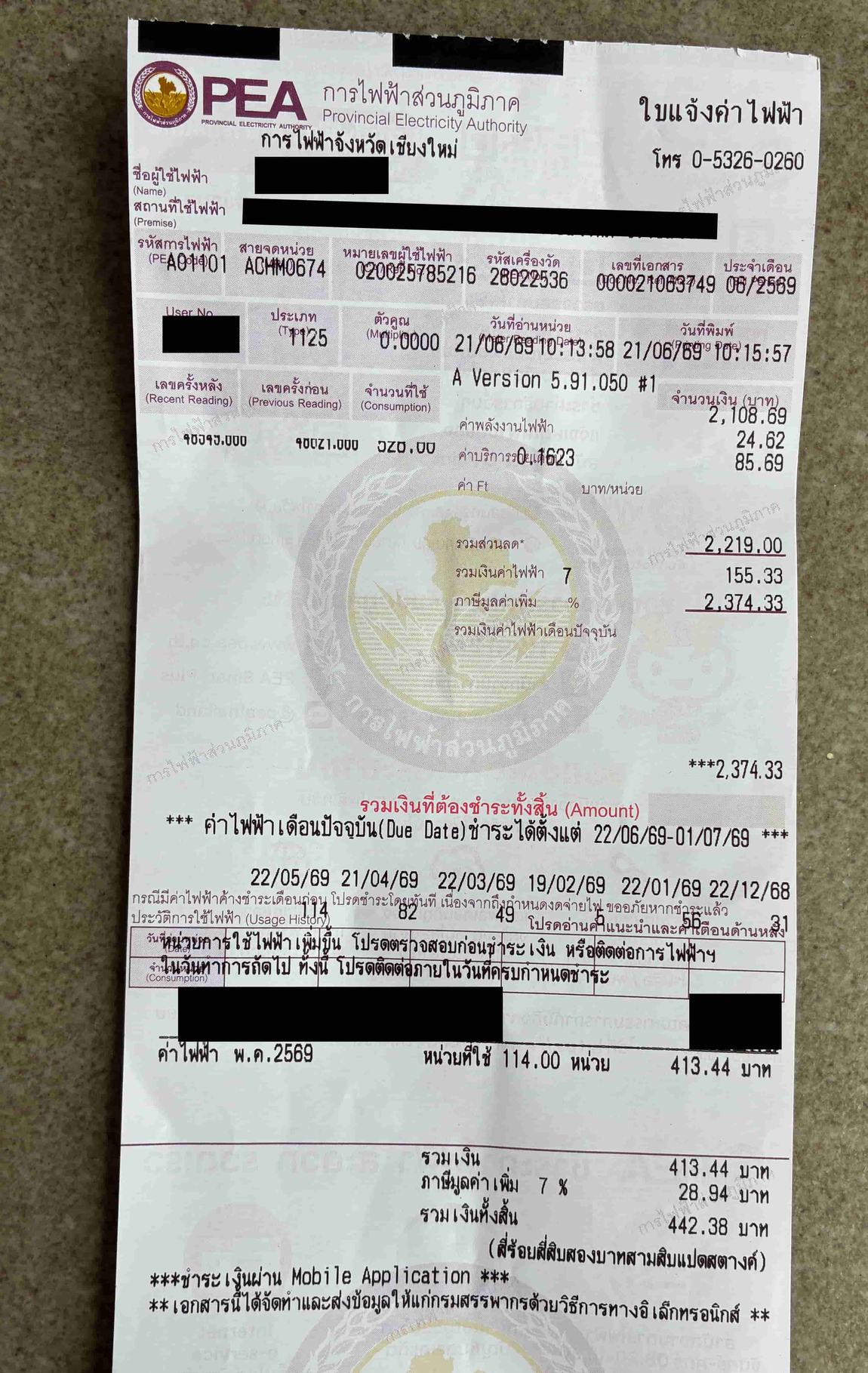
Two things caused it. We moved into a house with a large commercial-grade air conditioner in the living room at the end of the hot season, and we ran it constantly — including while we were out, because the dog was home. Then the rainy season started. Mornings and evenings turned genuinely cool, and we stopped needing it. Now we run it only in a small room for the dog when the house is empty.
528 kWh in June. 172 kWh in July. Same house, same people.
If you arrive in March or April, budget for the June number. If you arrive in July, do not assume the July number is what next April looks like.
Cost of living in Chiang Mai: what we actually pay each month
These are our household’s bills, not a citywide average.
| Item | Monthly |
|---|---|
| Rent (three-bedroom house with a garden, suburbs) | 25,000 THB (~$760) |
| Electricity | 677–2,374 THB, depending entirely on air conditioning |
| Water | 180–295 THB |
| Home internet (True, cheapest plan) | 552 THB |
| Gas | 0 — we have no gas contract |
| Drinking water (bottled) | ~650 THB |
| Bilingual school fees | ~75,000 yen (~$470) |
The last row is the one I did not expect before we moved.
How much is rent in Chiang Mai for a family?
We pay 25,000 THB a month for a three-bedroom house with a garden in Nong Hoi, a suburb about twenty minutes from the old city. That is one house, found through an introduction rather than an agency, so treat it as a data point and not a market rate.
Two things about renting here caught me out.
The move-in cost was 125,000 THB. That was a 50,000 THB deposit — two months’ rent, returnable — plus 75,000 THB of rent paid up front. There was no key money. The landlord had only asked for one month in advance; we offered three. As a foreigner with no rental history and no local bank account, the fastest way to be taken seriously was to remove the landlord’s risk before he raised it. I would do the same again.
Rent is the one thing that did not get cheaper. At about 4.89 yen to the baht, 25,000 THB is roughly 122,000 yen — which is almost exactly what our mortgage costs on the house we still own in Kamakura. People arrive expecting housing to be the big saving. For us it was flat. The saving came from everything we buy day to day, not from the roof.
The number nobody warns families about
Our daughter’s school costs 900,000 yen a year — around $5,600. It is a bilingual school, roughly 70% English and 30% Thai, which is the cheaper of the two main options here; a full international school costs more.
Three things about that figure surprised me.
The current fee schedule is flat from primary through to the end of high school. On today’s schedule, whatever you are paying at five is broadly what you pay at fifteen. Ten years at today’s fee would come to nine million yen — but that is arithmetic on a schedule that can be revised, not a price anyone has guaranteed me for a decade. It is still a decision you make once and live with.
It includes breakfast, lunch and snacks, which quietly removes a chunk of the food budget.
And it is the cost that did not exist before we moved. Everything else on our list either fell or stayed flat. This one appeared from nothing, and at 75,000 yen a month it is larger than our entire food bill and utilities combined.
Chiang Mai is cheap. Educating a child here in English is not.
What is genuinely cheap
Everything below is what we actually pay, not a survey.
Food is the biggest win. In Japan our monthly food bill ran 80,000–100,000 yen. Here it is around 20,000 — a quarter to a fifth of what we used to spend, and the single biggest saving on this list. A skewer of grilled chicken from a street stall is 10 THB. Two prepared dishes from a market stall, bagged, cost 30 THB. Five kilos of rice is 80 THB. A food court meal runs 50–70 THB. We ate katsu curry for 100 THB, and an all-you-can-eat shabu-shabu — including drinks — for 239 THB a head.
Veterinary care. Our dog needed an X-ray: 2,800 THB. Grooming, which cost about 8,000 yen in Kamakura, is 400 THB here — a quarter of the price. On one follow-up visit the vet decided nothing needed treating and refused to charge us at all. (Human healthcare is a separate question, and mostly a question about insurance — I have written about what long-stay cover actually costs here.)
Transport, if you do not own a car. A shared songthaew ride is 20–30 THB. A Grab car from our house to the airport is 110 THB, dropping us inside the terminal. The direction matters more than the distance here: coming the other way, ordered from inside the airport, the same trip is quoted higher — walk a few hundred metres out to the road first and it drops sharply. A local train to the next town cost 5 THB for an adult and 3 THB for a child.
Water, coffee, gyms, clothes. A six-pack of 1.5-litre drinking water bottles costs 39 THB at Big C, the cheapest of the four supermarkets we compared. Chain coffee starts at 55 THB. A gym visit is 60 THB, versus a 7,000–8,000 yen monthly contract in Japan. Second-hand clothes sold by weight run 60 THB a kilo; on Sundays the discount reaches 80%, and we once walked out with ten items of children’s clothing for about 60 THB.
What is not cheap
These are the costs I had not budgeted for before we came.
Children’s activities. Swimming lessons cost us 8,000 THB for twelve sessions — about 666 THB for 45 minutes, and not one-to-one. That is roughly double what we paid in Japan. Muay Thai is better value at around 300 THB a session, though the gym we tried was full of adults and our four-year-old was too intimidated to enjoy it.
Petrol. E20 was 30.69 THB a litre the day I checked, gasohol 91 was 35.32. A full tank of our Mazda 2 is roughly 1,150–1,340 THB depending on grade. We drive about 50 km a day — a tank lasts us a bit under a week on E20, about ten days on 91. For anyone coming from a city with good public transport, this is a new line in the budget.
Alcohol. Not cheaper. It costs us about what it did in Japan, which stands out on a list where almost everything else fell.
What actually happened to that line in our budget is more interesting than the price. We have stopped drinking altogether, and not for any virtuous reason. We eat out more here, and we usually get there by motorbike, which settles the question before it is asked. And the water and the fruit juice are good enough that I stopped wanting the other thing. A line that was fixed in Japan simply left our budget, and it left because of how we live rather than what things cost.
Anything imported or Western-branded. KFC cost 300 THB. An elaborate iced latte is 120 THB — the same as a Tokyo chain. As a local put it to us: the things you need are cheap, the things you want are not.
Adding it up — and what the total leaves out
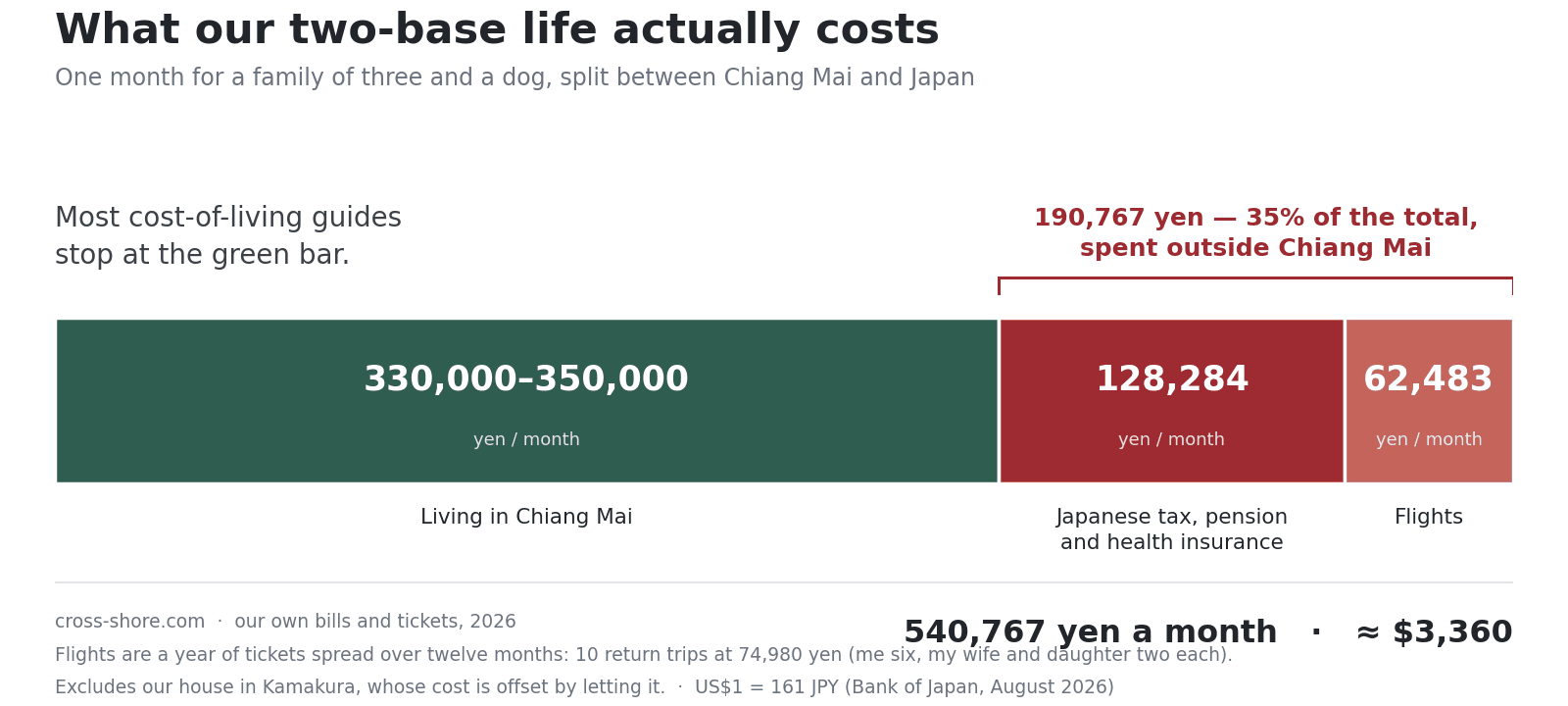
Here is the whole thing in one place. Baht are converted at 4.89 yen.
| Category | Rainy-season month | Hot-season month |
|---|---|---|
| Rent (25,000 THB) | 122,360 | 122,360 |
| Electricity, water, internet, drinking water | ~10,000 | ~19,000 |
| School | 75,000 | 75,000 |
| Food and household shopping | ~20,000 | ~20,000 |
| Car, petrol, lessons, everything else | ~104,000 | ~115,000 |
| Total | ~330,000 yen | ~350,000 yen |
The bottom row is the one I track least precisely — it is the residue between our recorded outgoings and the bills I can produce a photograph of. Everything above it is a real invoice.
Note what the 20,000-yen swing between the two columns is not. Electricity accounts for about 8,200 yen of it. The rest is us: a hot month is one where nobody wants to cook and the car does more air-conditioned trips than it needs to.
But this table is what it costs to live here. It is not what our year costs, and this is where most cost-of-living guides quietly stop. Three things sit outside it.
The house in Japan. We still own our home in Kamakura, and the mortgage, utilities, property tax and insurance come to about 180,000 yen a month. Added on top, that would take us to roughly 510,000–530,000 yen — a 50% increase for a house nobody is standing in. It does not, because the house is currently let to a housebuilder as a show home, and the rent roughly cancels the cost of keeping it. That arrangement is what makes our own numbers work. It is specific to our contract, and it does not remove the repairs, tax, interest and management costs that come with the property either way.
Tax, pension and health insurance back home. We kept our residence registration in Japan, so we still pay into the Japanese system. Here is what that actually costs us every month:
| Japanese obligation | Monthly |
|---|---|
| National pension — flat rate, 17,920 yen each for two adults | 35,840 yen |
| Residence tax (514,800 yen for the year) | 42,900 yen |
| Health insurance — continued employer scheme, covering all three of us | 49,544 yen |
| Total | 128,284 yen |
Three of those deserve a warning.
The pension line covers two people, not one. It is a flat 17,920 yen per adult, and my wife pays it as well. We had assumed she would not, because she is still a dependent on my health insurance — but health insurance and the pension are separate systems, and dependent status in one does not carry into the other. A spouse qualifies for the pension’s dependent category only while the other spouse is enrolled in the employees’ pension through a company. The day I left my employer, that stopped applying, and she began paying in her own name. This is set out on the Japan Pension Service’s page covering what happens when a spouse changes or leaves a job (checked 7 August 2026).
Residence tax is charged on the previous year’s income, so the bill for your last salaried year arrives after you have already gone. Mine was 514,800 yen for a year in which I earned nothing in Japan at all.
The health insurance is the one I would explain properly, because I have never seen it written down in English and the arithmetic is not obvious. When you leave a Japanese employer you can either join the national scheme or stay on your company’s for a while longer. I stayed. Here is exactly what that costs and how it is worked out.
| Component | Rate | Monthly |
|---|---|---|
| Health insurance | 92.7 / 1,000 | 40,788 yen |
| Child-rearing support levy | 2.3 / 1,000 | 1,012 yen |
| Long-term care insurance (payable from age 40) | 17.6 / 1,000 | 7,744 yen |
| Total | 112.6 / 1,000 | 49,544 yen |
Those rates are applied to a “standard monthly remuneration” figure, and the rule is that they use the lower of your own final salary grade and your scheme’s average. Mine was assessed at 560,000 yen; my scheme’s average was 440,000. So I am charged on 440,000 — which is the one piece of good news in the letter, and the reason two people leaving the same job can pay different amounts.
Three details that saved or will cost me money:
Paying in advance is discounted at 4% a year. Six months up front is 294,848 yen instead of 297,264. A full year is 583,973 instead of 594,528 — a saving of 10,555 yen for doing nothing but paying early.
My wife and daughter are covered as dependents at no extra charge. That 49,544 yen is not per person. It is the whole family.
And it expires. Japanese law caps this arrangement at two years exactly — my paperwork says 29 April 2026 to 28 April 2028. In year three we move to the national health insurance scheme. That scheme has no dependent status — it bills the household on a different basis rather than issuing three separate contracts — so what changes is that my wife and daughter stop being covered by my premium. I have not yet had the year-three bill, so I cannot tell you the number. Nobody mentioned that when we left. I found it in the small print of my own enrolment letter, and it is now the largest known increase sitting in our future budget.
Flights. Our last return ticket between Chiang Mai and Osaka cost 74,980 yen, flying VietJet out and Hong Kong Express back through Hong Kong, where I slept in the airport. We plan on ten of those a year: six for me, and two each for my wife and daughter, timed to the Thai school holidays in April and October. That is 749,800 yen a year, or 62,483 a month if you spread it out. This one is a plan, not a receipt: the 74,980 yen is a ticket I actually bought, and the ten trips are what we intend to fly. Everything else on this page is money that has already left our account.
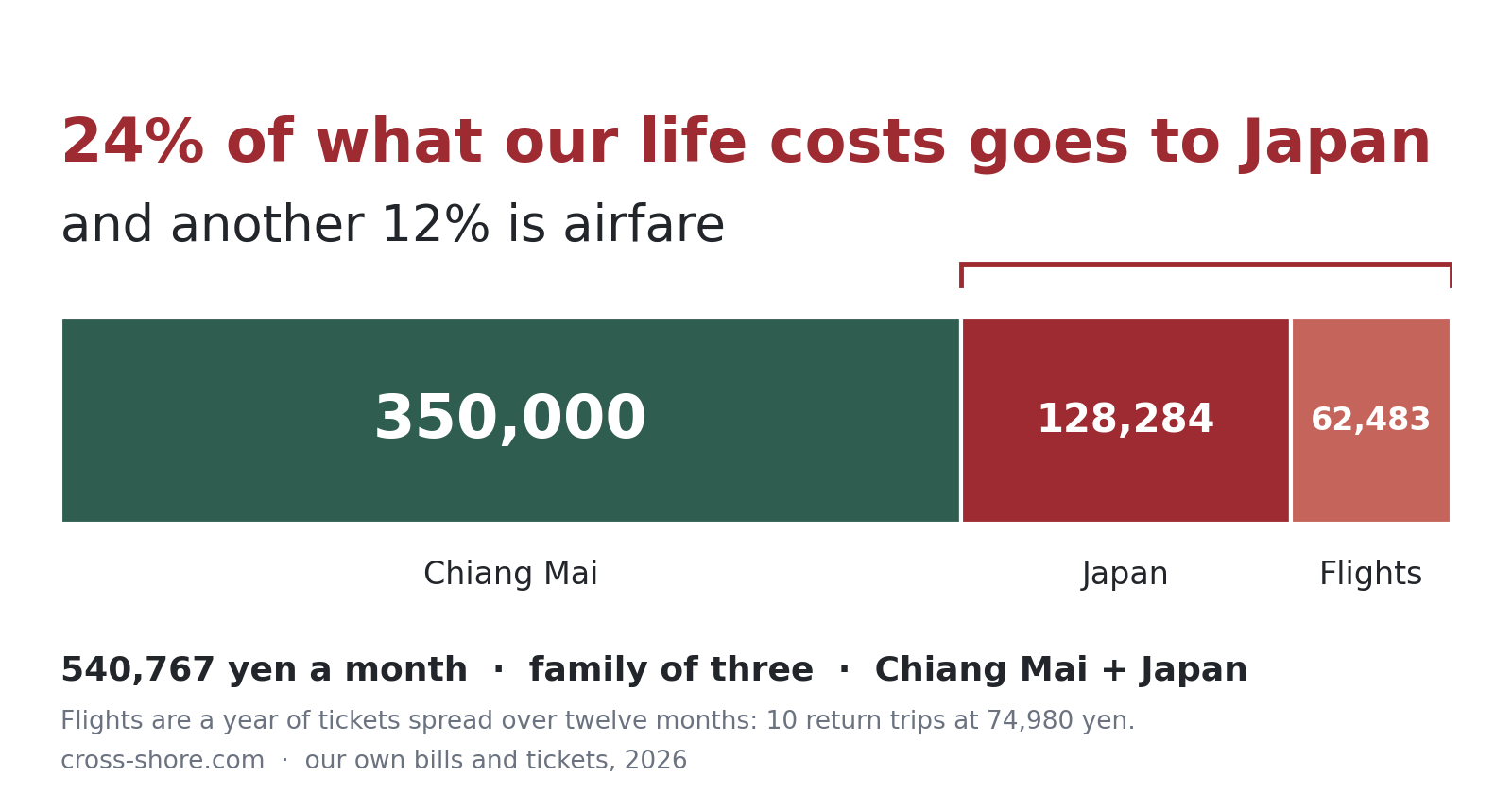
Put those together — 330,000–350,000 to live here, plus 128,284 owed in Japan, plus 62,483 in airfare — and our real two-base cost is roughly 521,000–541,000 yen a month.
Just over a third of what our life costs is spent outside Chiang Mai. To be exact about what that share is: about 24 per cent goes to Japan as pension, residence tax and health insurance, and about 12 per cent is airfare, which is not spent in either country so much as between them. The Chiang Mai number is real, and it is also only part of the picture. A cost-of-living figure that leaves out what you still owe at home, and what it costs to get back there, is describing a shorter stay than the one you are planning.
Paying for all of this
Almost everything we buy is paid for in baht, which raises the obvious question: how do you actually get money into Thailand?
Not through a Thai bank account, in my case. My visa does not allow me to open one — the DTV is treated as a tourist visa, and every bank I approached in Chiang Mai declined on that basis. My wife, on an education visa with a named guardian, opened one without difficulty. So our household runs on a mix: cash changed at a good local exchange office, and a multi-currency account for everything else.
The fees matter more than people expect, because you pay them every month for years. Here is what mine actually cost:
| Step | Fee |
|---|---|
| Japanese bank → Wise (in yen) | Free |
| Converting 100,000 yen to baht | 931 yen (about 0.9%) |
| Sending on to a Thai account | 61.44 THB on 120,000 — about 0.05% |
I also use the Wise debit card for day-to-day spending, which is what makes it work without a local account — an 83 THB Grab ride goes through the same way a 2,807 THB hardware-store run does.
That matters more here than it would elsewhere, because Thailand runs on QR payment and QR payment is closed to us. Market stalls, taxis and small shops generally take QR payment or cash, and QR needs a Thai bank account. Without one, that half of the choice disappears and you are down to cash. So our system has two halves: the Wise card wherever cards are accepted, and physical baht for everything else.
For the cash half, I do not use ATMs at all. I carry yen and change it at an exchange office in town, where the rate is better than any card withdrawal I have been quoted. It is an unglamorous answer, but it is the one we actually use.
- My 100,000-yen transfer cost 931 yen to convert — about 0.9% — and my Japanese bank charged nothing to send the yen across.
- The Wise debit card works without a Thai bank account, which is the only reason our household functions: my visa will not let me open one.
- I verified my identity before leaving Japan, while I still had a registered address and my documents in one place. Requirements vary by country, but doing it early cost me nothing.
→ Related: why the DTV visa stops you opening a Thai bank account, and what long-stay health insurance actually costs here.
What I would tell someone building a budget
The first thing worth settling is whether you are budgeting for one person or for a household. The solo budgets you see quoted here — usually 25,000–40,000 THB a month — are not figures I can vouch for, because I have never lived that way in Chiang Mai. What I can tell you is that our school fee alone is roughly 15,500 THB of that range before anyone eats.
Price the school first, not last. Rent is our largest single line, but you can move house. The school fee is the one you cannot negotiate, cannot reduce, and will still be paying in ten years — so it decides whether the rest of the budget is a rounding error or the main event.
Budget for the hot-season electricity bill and treat the rainy season as a rebate. Ours moved between 677 and 2,374 THB in consecutive months. Plan on the higher number and a good month becomes a saving instead of a shortfall.
Separate needs from wants honestly. Food is a quarter of what we paid in Japan; local transport and veterinary care are cheaper again. Rent is about the same. Petrol, alcohol, children’s lessons and imported goods are more expensive than people expect. Your own ratio depends entirely on which of those you actually buy.
Do not let a second property sit idle. It is the difference between two-base living costing double and costing roughly the same.
Budget for the country you left, not just the one you moved to. Japanese pension, residence tax and health insurance come to 128,284 yen a month, and flights to 62,483. That is 190,767 yen a month, just over a third of our total — roughly 24 per cent owed in Japan and 12 per cent in airfare. I have not seen either line in the cost-of-living guides I have read. Work out what you will still owe at home before you decide whether the move is affordable.
FAQ
How much does it cost to live in Chiang Mai per month?
Our family of three plus a dog spends 330,000–350,000 yen a month — around $2,050–2,170 — with rent at 122,360 and school fees at 75,000. I have never lived here alone, so I have no single-person figure of my own and I am not going to repeat one I cannot source.
What does the cost of living in Chiang Mai include?
Our figure covers rent, utilities, school, food, the car and everything we buy locally. It excludes the house we still own in Japan, Japanese pension, residence tax and health insurance totalling 128,284 yen a month, and flights of 62,483 a month. Including those, our real two-base total is 521,000–541,000 yen a month.
How much is rent in Chiang Mai for a family?
We pay 25,000 THB a month for a three-bedroom house with a garden in the suburbs, found through an introduction. Moving in cost 125,000 THB up front — a 50,000 THB deposit plus three months’ rent.
Is Chiang Mai cheaper than Japan?
For food it is roughly a quarter of the price, and local transport and veterinary care are cheaper again. Rent is about the same as our Japanese mortgage. Petrol, alcohol, children’s activities and imported goods are more expensive.
What do utilities cost in Chiang Mai?
Our electricity ranged from 677 to 2,374 THB depending on air conditioning use and season. Water was 180–295 THB, home internet 552 THB. We have no gas contract.
How much is school in Chiang Mai for a foreign child?
Our daughter attends a bilingual school — roughly 70% English, 30% Thai — at about 900,000 yen a year including meals, and the current fee schedule stays broadly the same from primary through high school. That is not a full international school. I have not priced the international schools here, so I can only vouch for the figure we pay.
Can you live in Chiang Mai on $1,000 a month?
I cannot answer that from experience — I have never lived here alone, and I say so in the article. What I can tell you is the family side: the school alone is around $470 a month before anything else, so for us it was never in range.
What is the cheapest way to send money to Thailand?
Converting yen to baht through a multi-currency account cost me 931 yen on 100,000 — about 0.9% — with the transfer from my Japanese bank free. For physical cash I carry yen and use a city exchange office rather than an ATM.
Can you use QR payment in Thailand without a Thai bank account?
No. Thai QR payment is tied to a local bank account, and my visa does not allow me to open one. We use a multi-currency card for anything that takes cards and cash for the rest.
Do you need a car in Chiang Mai?
Not if you stay central — songthaews are 20–30 THB and Grab is cheap. We bought a used car because of the school run, and petrol became a real monthly cost.

I split the year between Kamakura, Japan and Chiang Mai, Thailand, and write these guides from our own records, our own experience, and named sources. More about me.
Last updated: August 2026. Prices change — these are the amounts we actually paid in mid-2026, at roughly 4.89 yen to the baht.
→ More on this: all our money guides — what we pay, how we move it, and what our insurance covered.