
CHIANG MAI · CRAFTS
Chiang Mai has its own celadon — the pale green-blue glazed stoneware the north was already firing in the fourteenth century, in the days of the Lanna kingdom. I visited two celadon shops on 1 November 2026, read up on one of them at home, and returned to it on 3 November to see the workshop behind it.
If you are planning the whole move rather than a day out, start with my first-hand guide to moving to Chiang Mai.
What Chiang Mai celadon is
Celadon is stoneware covered in a glassy green-blue glaze. Look closely and the surface is covered in a fine web of cracks. That is crackle: as the piece cools after firing, the glaze and the clay shrink by different amounts, and the glaze alone cracks. For me, that colour and that pattern are what the word celadon means.
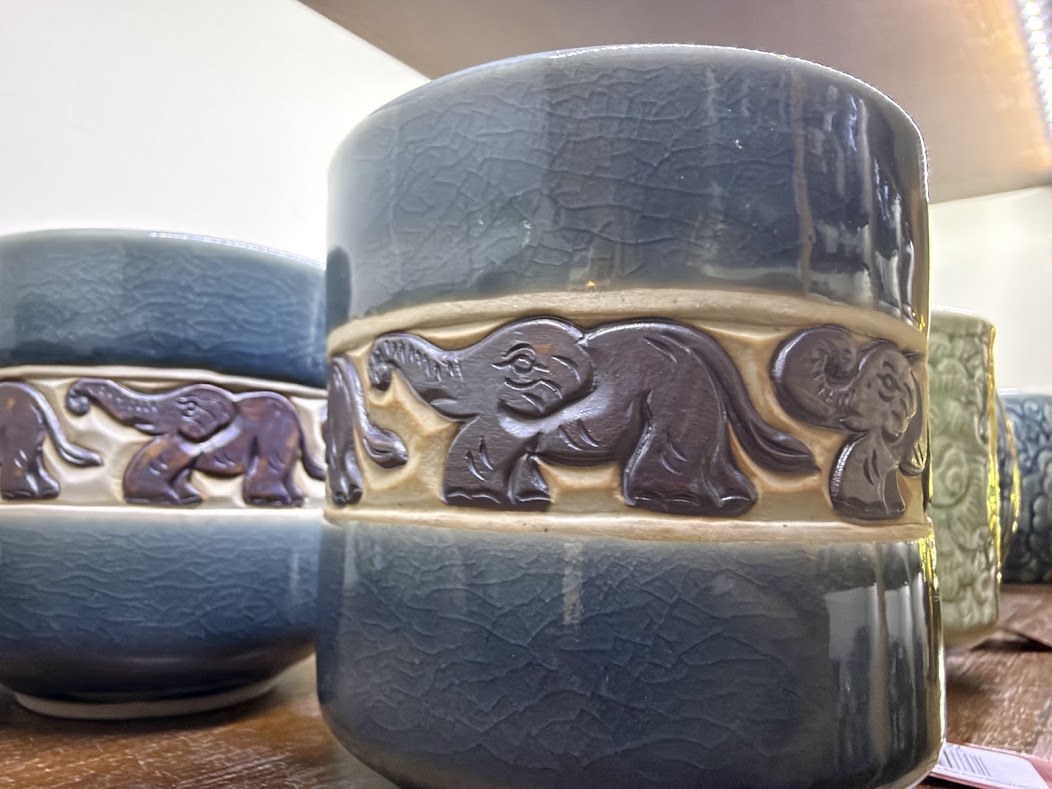
Besides the pale jade green, there is also a blue glaze. Patterns may be carved into the clay or painted by hand. Elephants, flowers and traditional Lanna motifs are the usual subjects.
It is older than I expected. The Smithsonian’s National Museum of Asian Art holds celadon-glazed stoneware from the kilns at San Kamphaeng, east of Chiang Mai, and dates it to the fourteenth to mid-sixteenth century, when this was the kingdom of Lanna.
The modern standing is easier to pin down. Thailand’s Department of Intellectual Property has registered Chiang Mai celadon as a geographical indication (GI). In October 2017 Chiang Mai was named a UNESCO Creative City of Crafts and Folk Art, with ceramics such as celadon among the crafts it put forward, and the World Crafts Council has since named it a World Craft City, again with celadon as one of the local ceramics it cites.
A Thai feature on Baan Celadon puts the local tradition at nearly 600 years. Baan Celadon itself was founded in 1989, and I could not establish whether the craft continued without interruption from the medieval kilns to the workshops operating today.
Two shops in one day
On the first weekend of November, friends came over from Japan. They wanted to visit celadon shops and had already looked some up, so my family and I tagged along. We went to two that day.
Mengrai Kilns, in the Old City
The first was Mengrai Kilns, inside the Old City; its website gives the address as Soi Samlan 6, off Arak Road. The tableware there is simple in shape. What caught my eye was a turquoise-like blue — a clear, strong blue, quite unlike the pale green of classic celadon, and striking when a whole shelf of it is lined up.
We came home with a pink plate and a small elephant. My daughter chose the plate: the rim keeps the colour of the clay, and the inside shifts from pink to pale violet. At home we put sesame balls on it. We had looked at the same shelf, and she and I had stopped at completely different things. The elephant is pale celadon green, small enough to sit in your palm, with a hole in its back — for a single flower or a pen, I suppose. I did not ask.
Baan Celadon, out of town to the east
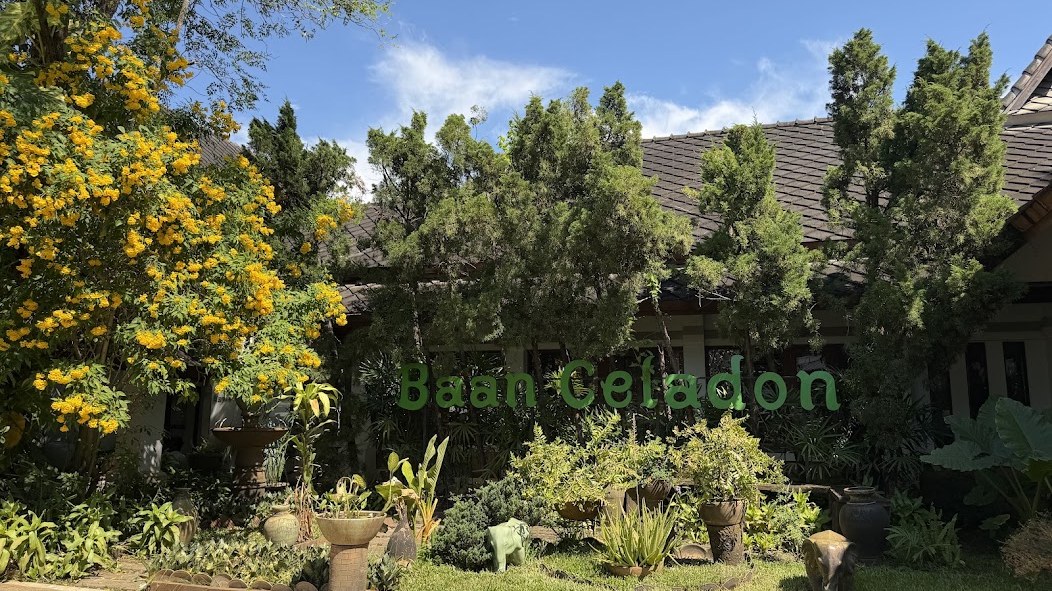
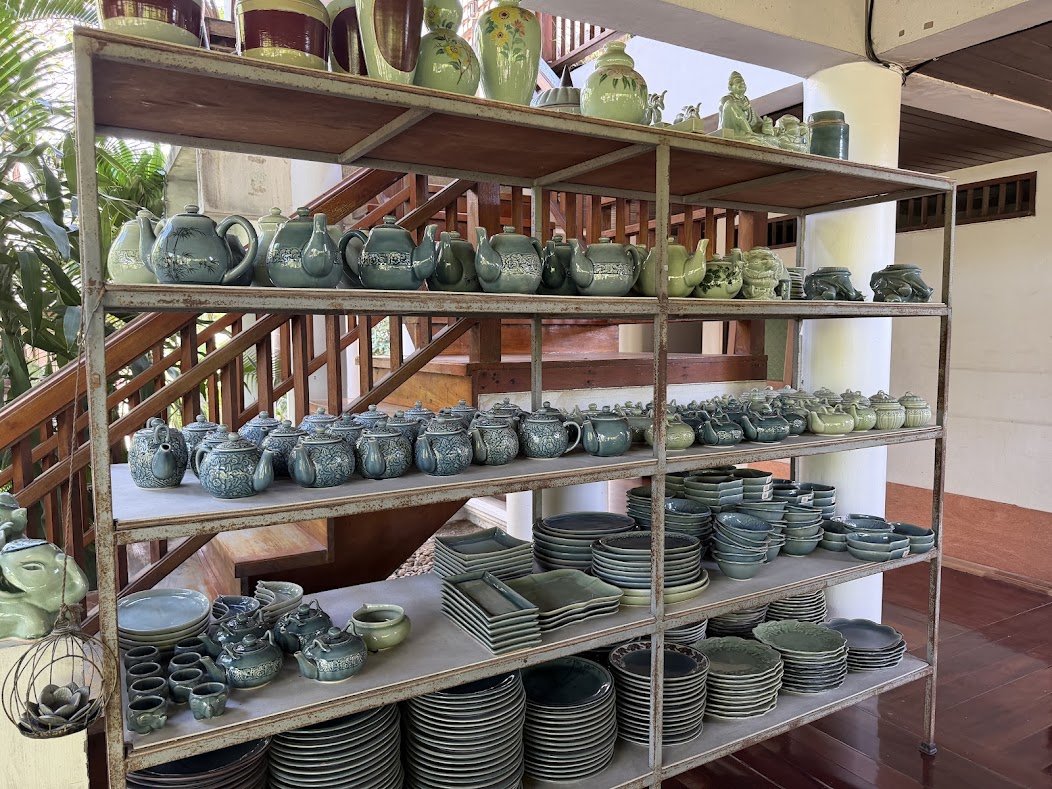
The second was Baan Celadon, in a town east of the city, in San Kamphaeng district. Here the designs were more elaborate. Jade-green plates were stacked on the shelves next to blue mugs with a band of elephants in relief, and there were plates boxed as gifts. My family only looked that day, while our friends bought something.
What I read when I got home
At home I looked Baan Celadon up. According to the shop’s own website, it was founded in 1989 and makes and sells handmade celadon, aiming to keep the Lanna celadon tradition while making things people buy today. The site sets out how a piece is made:
- The clay is prepared, then shaped on a wheel or with moulds and a jigger, a machine for shaping clay.
- The piece rests for a few days before any pattern is carved by hand.
- It air-dries for anything from a few days to a few weeks. The site is clear that this cannot be hurried.
- It is bisque-fired at 800–900°C — a first, lower firing before any glaze goes on.
- It is dipped in a jade-green or a blue glaze.
- It is fired again at 1,260–1,280°C for more than twelve hours in a reduction firing, with little oxygen in the kiln. The site says the crackle comes from this firing and is a feature of their work.
The jade glaze uses ash from local materials. The shop also has an underglaze painting room, and the site names its painting techniques: a shaded style it calls Stone Pattern, highlights in engobe (a coloured liquid-clay coating), and the brown rims you see on some plates. It sells three lines — figurines, vases and tableware — and says the traditional methods limit how much it can make.
I also found a feature on the shop in The Cloud, a Thai online magazine, published on 6 October 2026. It describes the business as starting out small and family-run, describes the glaze as rice-paddy clay mixed with the ash of two local woods, and gives slightly different kiln figures from the website: 800°C for the bisque and 1,260°C for fourteen hours. According to the feature, the business passed to a younger generation around 2022. The glaze materials used to go in untested and the colour varied, so now every batch of glaze is tested. The feature says customers expect crackle and are less likely to choose pieces without it. Many of the craftsmen are close to retirement, and the shop is looking for young people.
The more I read, the more I wanted to see it being made. Our first visit had been on 1 November. On 3 November — my idea this time — I went back.
The workshop behind the shop
The workshop is behind the shop. I asked, and they showed me round.
A potter sat at a wheel, and while I watched, a lump of clay became a bowl. The Cloud’s feature explains that cups and vases are thrown on the wheel, plates and bowls are shaped on the jigger, and small figures are slip-cast by pouring liquid clay into a mould. Everything is finished by hand.
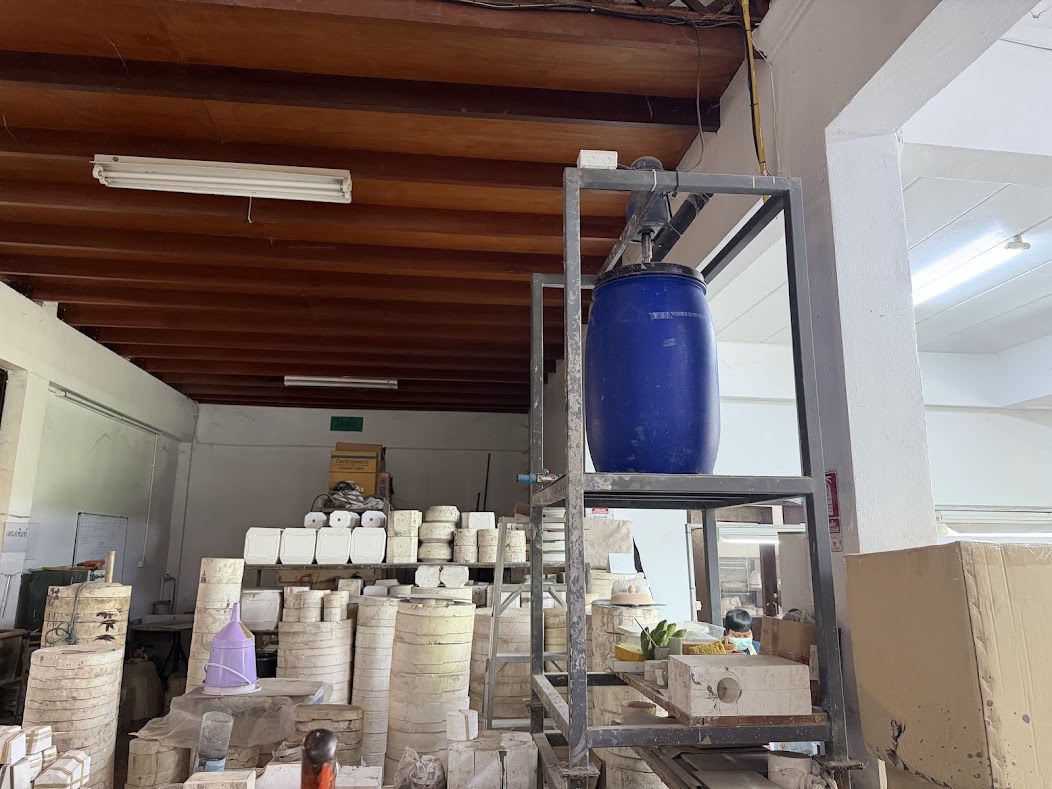
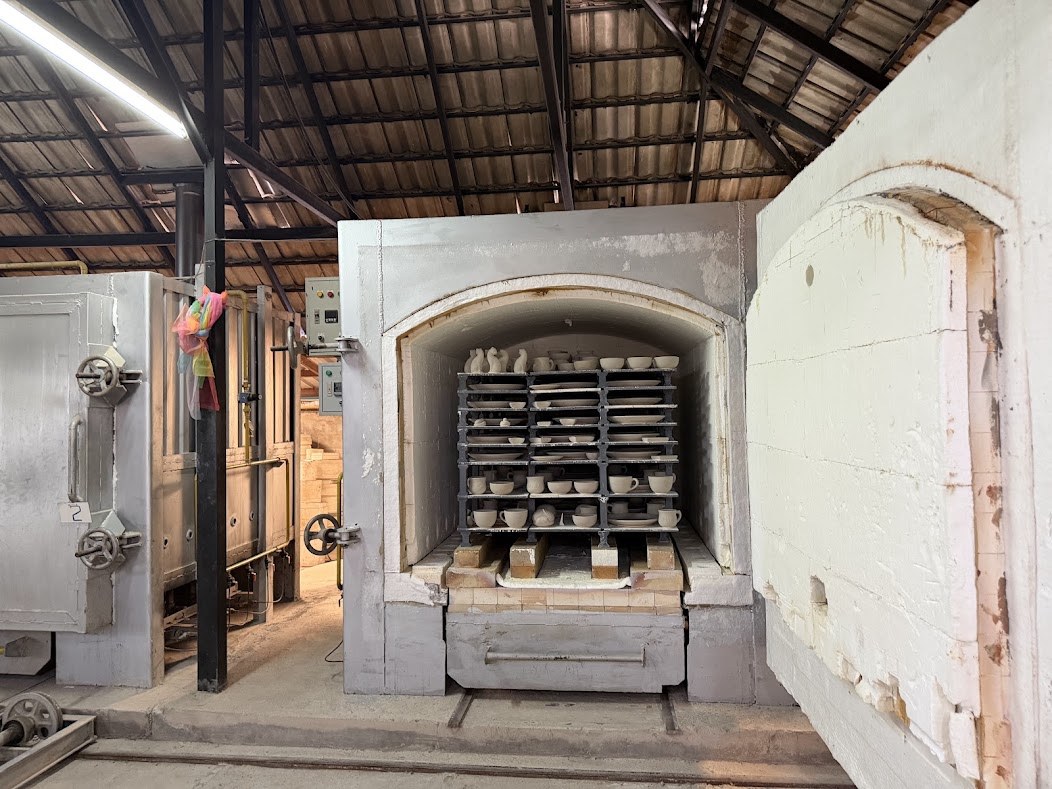
In the next room, plaster moulds were stacked like a wall, and dozens of black round plates lay on a table. There were shelves of jars and bowls waiting for their bisque firing, and beyond them the kiln. Its door was open, with bisque-fired tableware inside, shelf by shelf. A sign on it read “Family Kiln”.
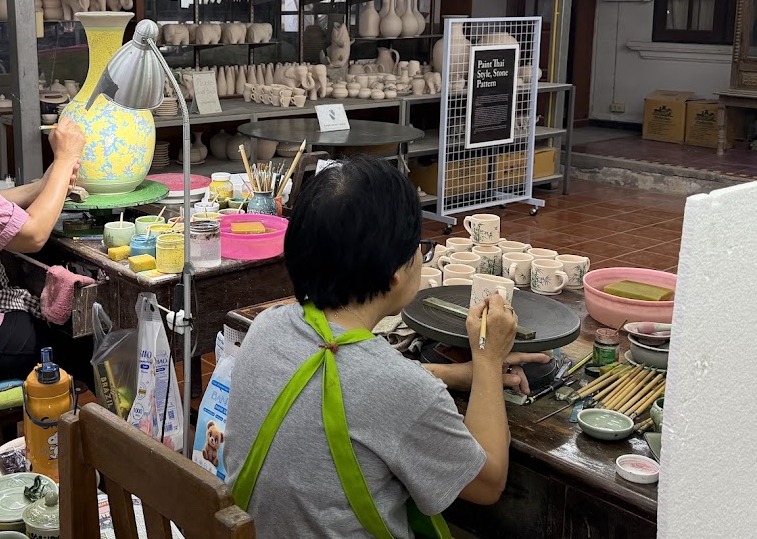
In another room, women sat at tables painting patterns onto large yellow jars by hand. At the next table someone was holding a black clay elephant and finishing it — a slip-cast elephant, worked over one at a time. Elephants seem to be the shop’s signature: they turn up as figures and in the bands on the mugs.
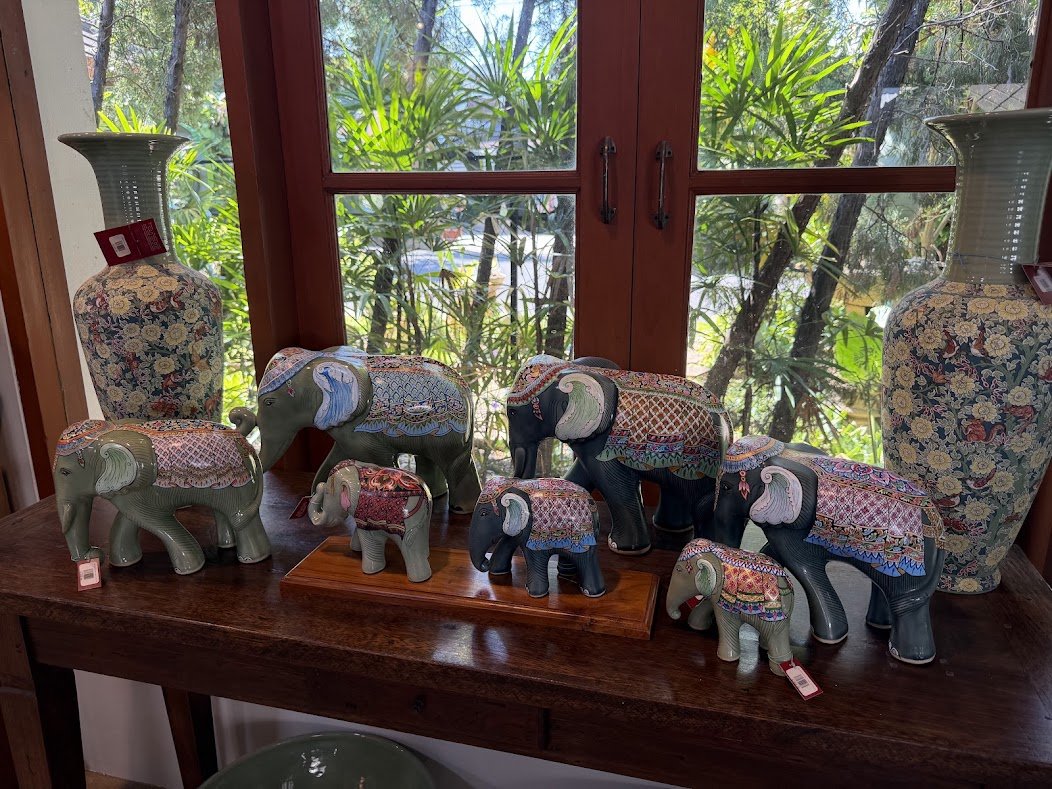
Back in the shop, the piece I could not stop looking at was a painted elephant, covered in fine patterns from its back to its feet. Having just watched the painters at work, I looked at it differently.
I did not ask the staff about the crackle; that explanation comes from the published sources linked above.
What we brought home
Two blue plates, 150 baht each: one with a band of elephants in relief around the rim, one with a brown rim. Set next to the pink plate from our first visit, the difference in colour is much clearer than it was on the shop shelves.
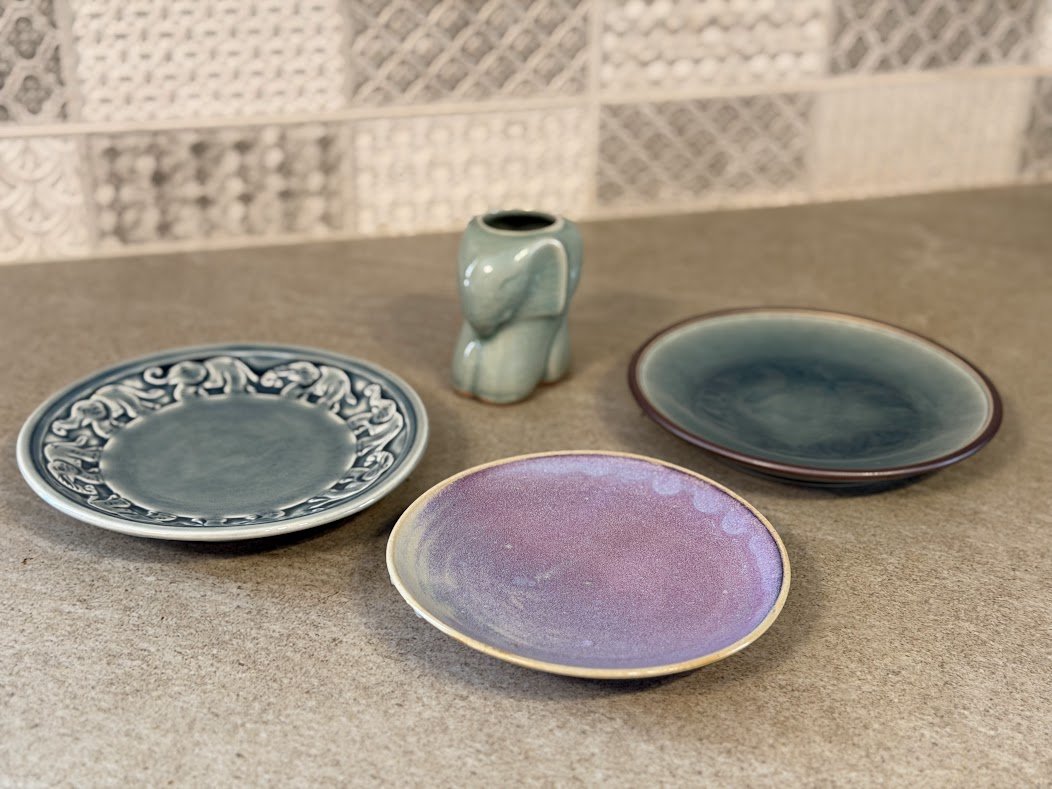
In the workshop I had seen the wheel, the moulds, the kiln and the brushes. Having seen them, I use these plates a little differently.
If you go
| Mengrai Kilns | Baan Celadon | |
|---|---|---|
| Where | Old City, Soi Samlan 6 off Arak Road | San Kamphaeng district, east of the city |
| Style | Simple shapes; strong turquoise-like blues | More elaborate designs; jade green and blue, carved elephants, hand-painted pieces |
| Workshop | I did not see one | Behind the shop; I was shown round when I asked |
| What we bought | A pink plate and a small elephant | Two blue plates, 150 baht each |
- For simple shapes and strong blues, Mengrai Kilns is inside the Old City and easy to fit into a walk.
- For elaborate designs, go to Baan Celadon. I was shown the workshop when I asked. If a workshop visit matters to you, check with the shop before you go.
- Look for the crackle. At Baan Celadon it is part of what they make, not a flaw.
- Opening hours and prices change. Check each shop’s website before you go.
If you are interested in northern Thai crafts, I have also written about making Karen hill tribe silver in a village in Lamphun and about visiting Ban Nam Bo Noi, a Karen village.
A Japanese version of this piece first appeared in WIRESIDE, a web magazine I write for. Last updated: November 2026.

I split the year between Kamakura, Japan and Chiang Mai, Thailand, and write these guides from our own records, our own experience, and named sources. More about me.