Lamphun · Ways of living
There are no affiliate links in this article. I paid for the trip myself. The guide and the silversmith appear here under changed names, as they do in my article on Karen silver. The village is named, because the village names itself on a sign at its own entrance. Everything I describe seeing, I saw on 1 August 2026.
I have written that a family of three lives in Chiang Mai for about 330,000 to 350,000 yen a month. Two and a half hours south, in neighbouring Lamphun province, there is a village where that number does not mean anything. Not because the people there cannot reach it. Because they were offered a power line and a water main, and said no. This is what I saw, what the record says, and what I had been assuming without noticing.
The number I had been writing
I keep a household budget in public. A family of three in Chiang Mai, around 330,000 to 350,000 yen a month, of which a bilingual school is 900,000 yen a year and the single largest line. That figure is the honest version of “Chiang Mai is cheap,” and it is the one I stand behind.
I did not go looking for a corrective to it. I went to a Karen village in Lamphun because I had booked a day of silver making, and this village was on the same road.
Across the road from the power line
The village is not cut off from the road or the power line. It is two and a half hours from Chiang Mai, so it is not close to a city — but distance from a city is different from isolation, which is what people tend to assume.
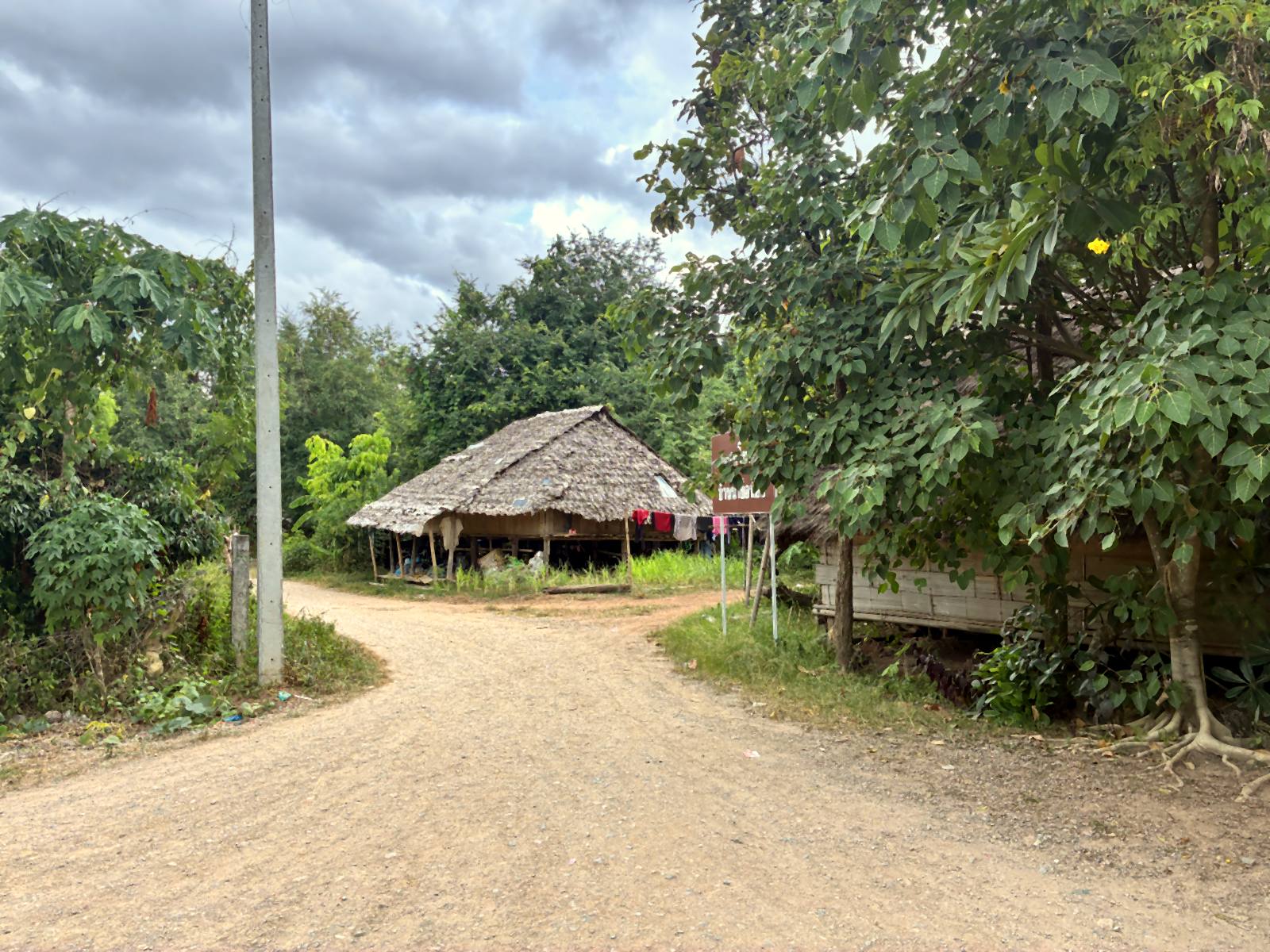
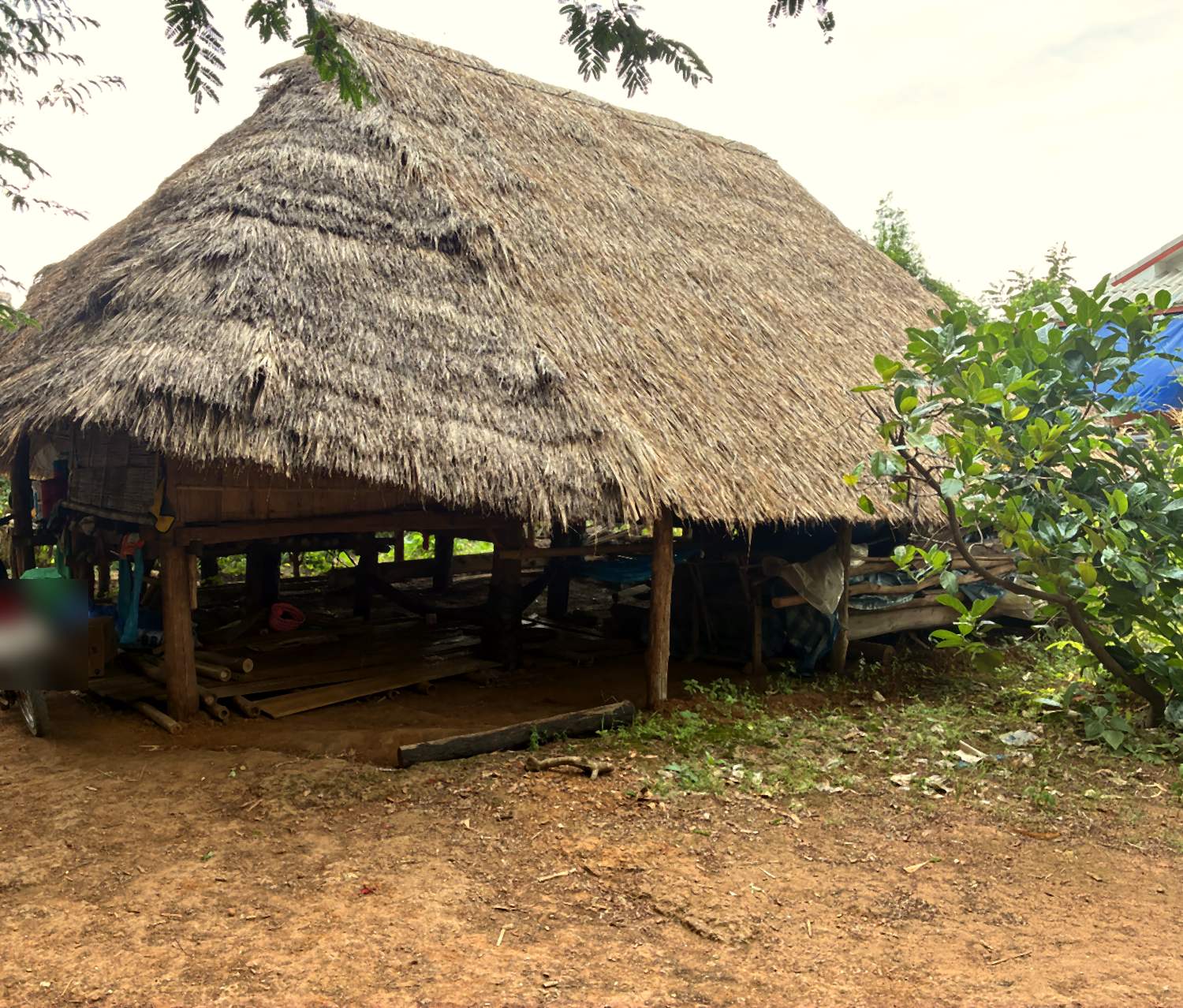
There is a concrete utility pole standing at the roadside. Beyond it, across a dirt track, are the thatched roofs. Thai reporting describes the community as sitting no more than fifty metres from the power poles and the main road. From where I was standing it looked closer than that. The road is right there.
And there is no electricity and no running water.
Not because the grid has not arrived. It has arrived. It is across the road. According to that same reporting, government agencies approached the village offering to install both, and the villagers turned them down and asked to look after themselves.
A villager, quoted in a Thai national daily in 2015, put it in five words:
“It is not that we do not have it. We do not take it.”
That report is from October 2015. I am quoting it because I could not have learned any of this from one afternoon of walking around, and because it is on the public record in Thai and simply does not exist in English. What I can tell you first-hand is what the place looked like on 1 August 2026.
Where this is
Moo 21, Na Sai subdistrict, Li district, Lamphun province. Roughly two and a half hours south of Chiang Mai by car.
That is the same district as Huai Tom, the community I wrote about in my article on Karen hill tribe silver. These two places are twenty minutes apart and belong to the same story, which I did not realise until afterwards.
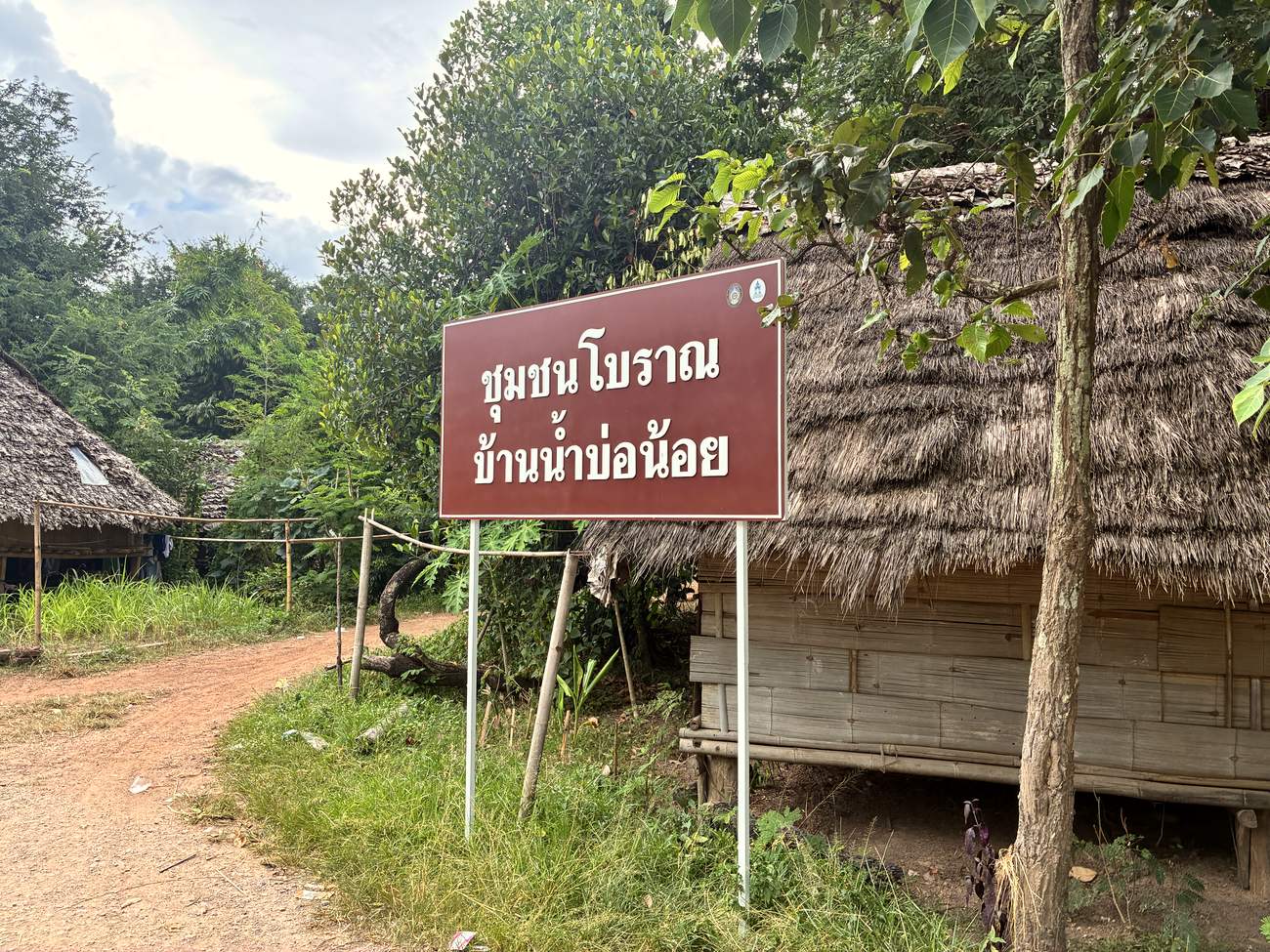
There is a sign at the entrance. It reads, in Thai, “ancient community, Ban Nam Bo Noi.” The village names itself.
The well the village is named after
I had this wrong in my own notes, so I will correct it in public.
I had written down that this was “the village where the well water is scarce.” It is not. Nam Bo Noi means small well, and the well is the reason the village is there.
It is a hole in laterite bedrock. No more than six inches across and about half a metre deep in the Krungthep Turakij account; the government tourism listing gives about five inches and 30 centimetres, so treat the figures as approximate. Water comes up through it all year and does not run dry, which on that kind of rock is unusual enough that the villagers treat it as sacred. It has a structure built over it to protect it.
The belief attached to it is that people who could not be cured at a hospital came, prayed, drank from it and recovered. Word travelled as far as Lampang, Phrae and Chiang Mai, and people came to take the water away.
The villager quoted in that 2015 report says the honest thing about it himself:
“It cannot be proved. It is a belief.”
And this is where the village comes from. Around 1998, people hired by a businessman in Bangkok began drilling out the laterite around the well and taking it away to sell. Families from Huai Tom and the villages nearby moved onto the site to protect it, on an agreement among themselves that they would look after the place and keep the precepts.
So the village was not founded by people who ran out of options. It was founded by people who moved towards something.
I saw the well. I did not photograph it, which I regret, so you will have to take the description.
A community founded in 1998
The sign says ancient community. The settlement is not ancient.
It began around 1998 to 1999 with roughly ten households. By the time of that 2015 report it was fifty-four. I do not have a current figure.
I want to be careful here, because I have written a whole article about a claim of ancientness that does not hold up. This is not that. The sign says “ancient community”, and the 2015 reporting dates the settlement itself to 1998–99. Read together, the likeliest meaning is that what is old here is the practice, not the village. That is my reading of a sign, not something anyone in the village said to me.
The houses are bamboo. No nails; the frames are tied with split bamboo. The roofs are thatch. The stated reason for bamboo is not poverty and not aesthetics: hardwood takes decades to replace and bamboo takes two or three years, so bamboo is what does not cost the forest.
Pga K’nyau is the name the people here use for themselves. The community-tourism chair quoted in the 2015 report glossed it as “simple people” — that is his gloss, not a linguistic authority’s.
The rules
The community is Buddhist, and follows Khruba Chaiyawongsa Phatthana, usually called Khruba Wong — the same monk who founded the villages around Huai Tom. The connection between this place and the silver village is not geographic coincidence. It is the same lineage.
They keep the five precepts, and they add one: no meat. Locally the place is known as the vegetarian village.
The rules of the community, which follow those of the settlements around Wat Phra Phutthabat Huai Tom, are set out in that 2015 report:
- No keeping, killing, or distributing animals in the village, the temple or anywhere else
- No selling alcohol
- No serving alcohol, including at festivals
- Keep the peace and do not disturb your neighbours
- Be loving and faithful to your family
- Go to the temple, keep the precepts, meditate, do public service regularly, and do not act against the teaching
Break them and the village head warns you three times. After that you are asked to leave.
There is no rule against leaving. Anyone who wants to go and live outside can. As of that report, nobody had, and the village had grown fivefold.
What I actually saw
All of the following is 1 August 2026, one afternoon, on foot.
Bamboo walls and thatched roofs, some of the houses up on stilts with the space underneath used for storage and for parking a motorbike. Some households have a motorbike; not all do.
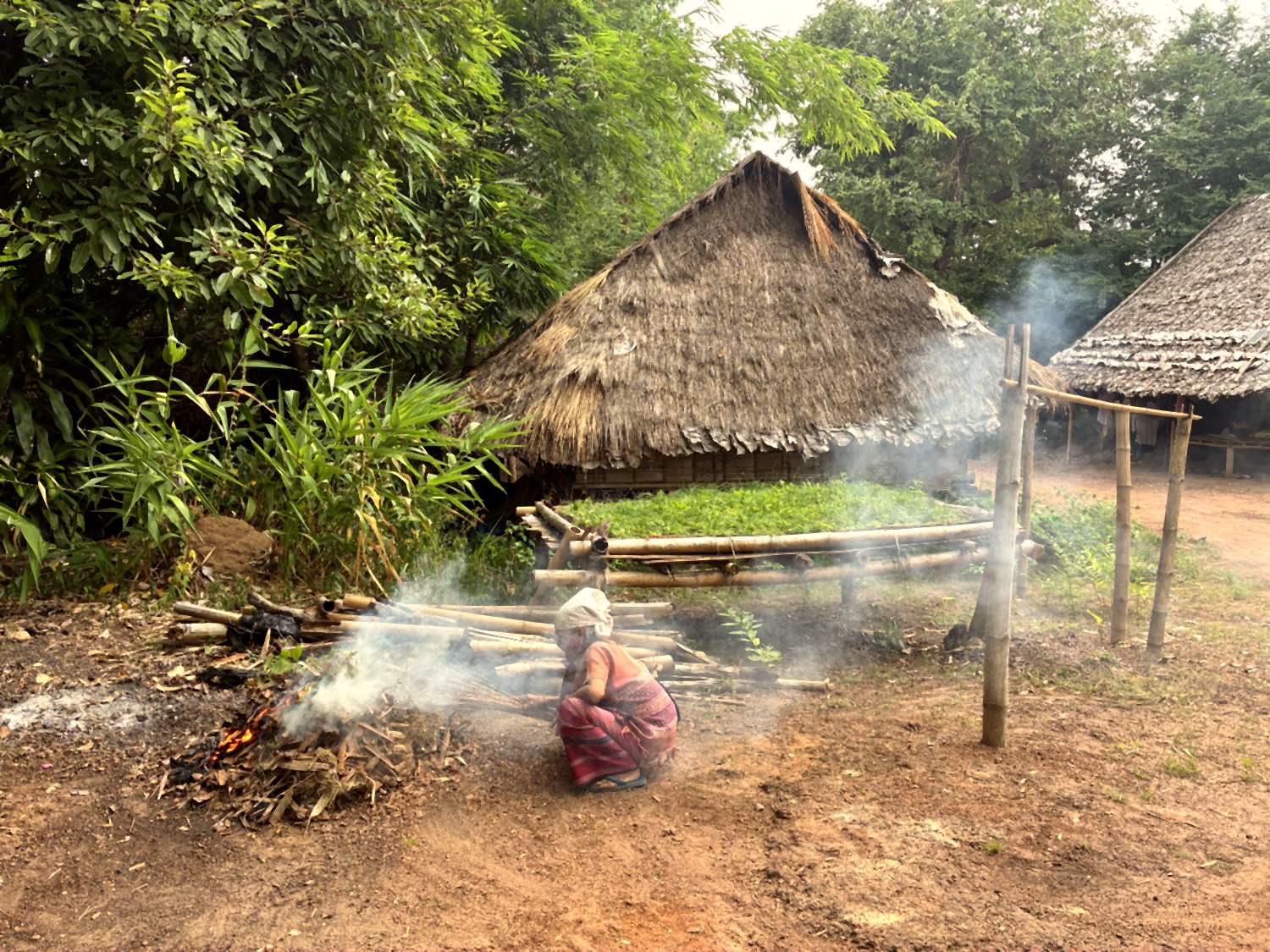
A woman lighting a cooking fire outside her house.
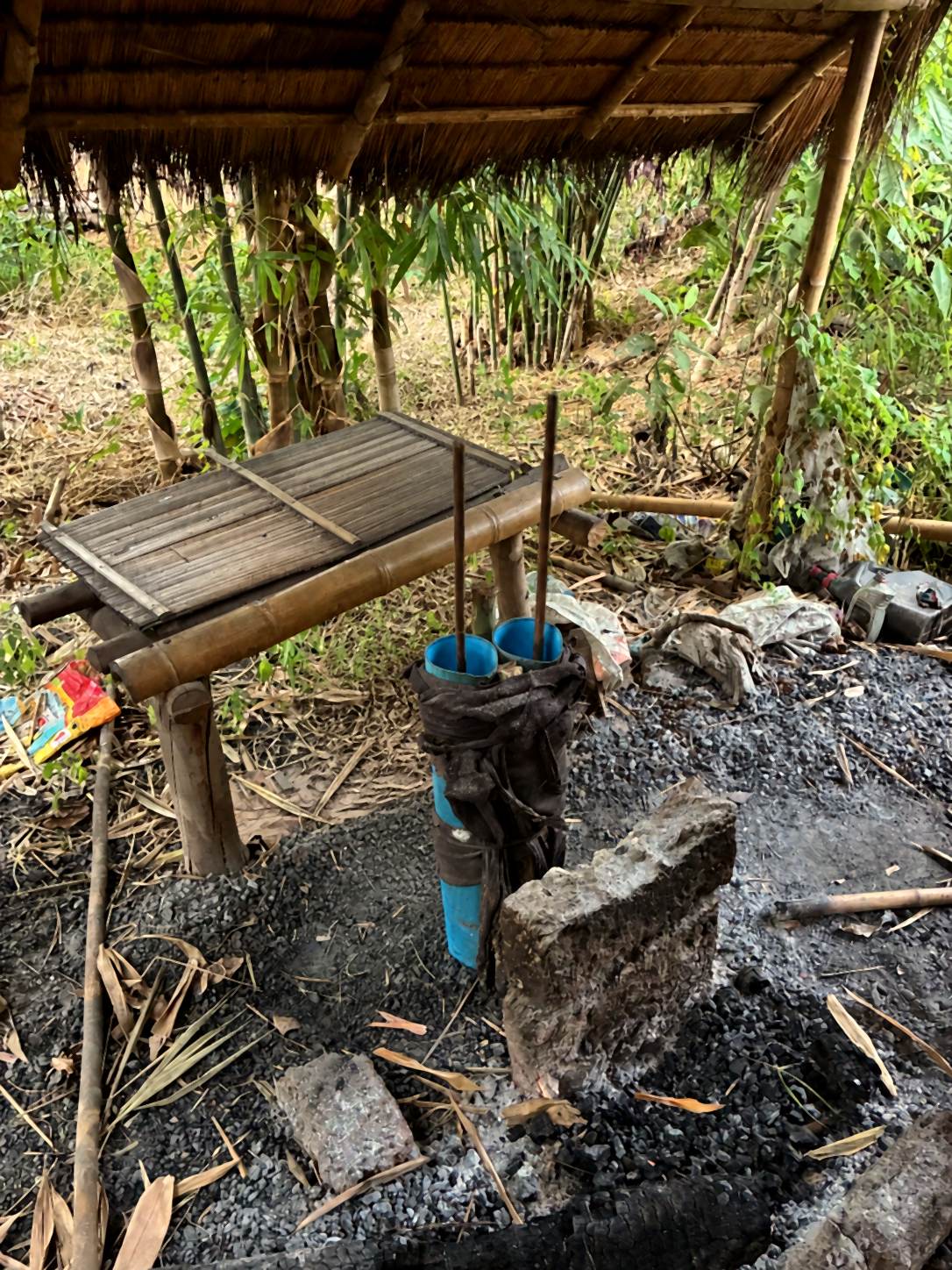
A forge. Charcoal bed, a bamboo bench, and a hand bellows made from blue PVC pipe with leather lashed round it. Bamboo, thatch, and plastic plumbing pipe, all in the same square metre.
The toilet is shared. A concrete block building, I think, though I would not swear to it.
I saw household rubbish being burned. This is not the regional burning season that Chiang Mai argues about every March. I did not check whether the village has a collection service — and the 2015 report says the Na Sai sub-district administration does come in to look after waste, water and sanitation here.
This next one is not something I saw — it is what Arthit told me, and I am keeping it in his words rather than mine. There is no hospital here, so a birth means leaving the village for a hospital outside it.
The children go to school. I did not ask where, and I did not see a school in the village, so I am not going to tell you where it is.
And there is a small shop. There is also a house selling bamboo baskets. So the village is not outside the cash economy. What it turned down was a power line and a water main.
The ten children
About ten children gathered when we arrived and followed us the whole way round. Nothing was asked for. Not money, not sweets, not anything. As far as I could tell it was straightforward curiosity about a foreigner.
I had been braced for something. I did not decide to be; I noticed it afterwards, which is worse.
That told me more about what I had turned up expecting than about the village.
My own daughter was with us. She had picked out a bright yellow party dress and white trainers that morning in Chiang Mai, which is not what you would choose for this, and at the forge she ended up with the bellows in both hands, working air into the charcoal.
It is the part of the day I keep going back to. There was a live fire, the tools were out, and nobody moved her away from it.
Separately, and about the village’s own children rather than mine: the 2015 report has a father here describing the pressure from outside — his children go out, they see water and electricity and now the internet, and they want them — and saying that he explains to them why the family lives as it does, and that they accept it. That is his account of his own children. I am not in a position to check it and I am not going to pretend otherwise.
Who showed me around
Two people walked me through this village.
Mr Shimizu, who has thirty years in northern Thailand behind him and drove us, and Arthit — the Karen silversmith from the village in the next valley, the one whose workshop I spent the morning in.
Arthit explained things the whole way round, patiently, in a village of his own people.
And I have almost none of it. I was there as somebody on a nice day out, not as somebody working, and by the time I understood what I was standing in it was two days later and I was reading Thai newspaper archives.
What I do have is one sentence. Arthit told me there is no hospital here, so a birth means leaving the village. He said it the way you say something you have known your whole life. That is his account, not something I saw.
It is the only line in this article that comes from a Karen man who lives twenty minutes away and knows the place. In my article on the silver I wrote that I had not asked the makers, and that this was a hole in that article. This is one sentence towards filling it. I am not going to pretend it is more than that, and I am not going to reconstruct the rest from memory and present it as his testimony.
What I do not know
Whether any of this is a good life is not a question I am in a position to answer after one afternoon.
I am not in a position to explain why people here choose this life.
If you want to go
Start with the village’s own terms, which are better than anything I would come up with.
The community takes visitors as part of the community-based tourism programme run out of Ban Huai Tom. The person who runs that programme described the arrangement to that 2015 reporter like this: when visitors come, everyone carries on living normally. It is not a zoo staged for people to come and look at. The villagers do not adjust, and the tourism side does not interfere.
That is the standard to hold yourself to if you go.
Practically: it is about two and a half hours from Chiang Mai and you need a vehicle. The village sits just off the road, so getting to it is not the hard part; finding it is. DASTA’s current listing gives visiting hours of 08:00 to 16:00, no admission charge, and asks that you contact the Ban Huai Tom community committee before each visit rather than turning up. (Checked 6 August 2026.)
Ask before photographing people. The village being open does not make somebody’s home or somebody’s face open.
I am not offering to arrange visits in either article. This is where people live — fifty-four households as of the 2015 report, and I do not have a current figure. It does receive visitors: the community is listed by DASTA as part of the community-based tourism programme run from Ban Huai Tom. So the right way in is that programme, not a stranger with a website.
Questions people ask
Where is Ban Nam Bo Noi? Moo 21, Na Sai subdistrict, Li district, Lamphun province, northern Thailand. About two and a half hours south of Chiang Mai by car, in the same district as the Huai Tom temple community.
Why does the village have no electricity? Because it declined it. Thai reporting describes government agencies offering to install electricity and water, and the villagers refusing and asking to look after themselves. Their stated reasoning is that once the utilities arrive, the appliances and the bills follow, and that the way of life they moved there to keep would not survive it.
Is this the same as the Karen silver village? No, but they are related. The silver workshop I wrote about is in Huai Tom, in the same district, about twenty minutes away. Both communities follow the same monk, Khruba Wong, and both are vegetarian. The people of Ban Nam Bo Noi moved there from Huai Tom and the villages around it.
Can you visit? Yes. It is part of the community-based tourism programme run from Ban Huai Tom. Go through that rather than turning up expecting a tour.
Do the villagers use money? Yes. There is a shop in the village and at least one household selling bamboo baskets, and the community sells woven cloth. Declining a power line is not the same as declining an economy.
What should I not do when visiting? Photograph people without asking, and bring meat. The community does not eat it — that is one of the rules of the settlements around Huai Tom, not a preference — so do not carry any in with you.
Where the non-first-hand parts come from
Everything I describe seeing — the houses, the forge, the fire, the shop, the children, the shared toilet — is what I saw on 1 August 2026. Everything about how and why the village came to be there, I have taken from the following.
- Krungthep Turakij (Bangkok Business News), “Nam Bo Noi: the hidden place of Li”, 23 October 2015 — the fifty metres, the refusal of electricity and water, the “we do not take it” quotation, the founding around 1998–99, ten households growing to fifty-four, the dimensions and the story of the well, the community rules and the three warnings, the reason for building in bamboo, the “not a zoo” description of the tourism arrangement, and the father’s account of his children. Link (Thai)
- DASTA (Designated Areas for Sustainable Tourism Administration) — the community’s listing as a visitable community. Link (Thai)
- Chulalongkorn University, Faculty of Arts, Linguistics — the village’s location and Pga K’nyau language material. Link (Thai)
What I have not sourced, and am not presenting as established: the number of households in 2026; where the children go to school; whether the concrete building is in fact the shared toilet; and anything Arthit told me during the walk, because I did not write it down and will not reconstruct it.
On the names. Mr Shimizu and Arthit are not their real names, for the reasons given in my article on Karen silver. The village itself is named because it names itself, on a sign at its own entrance, and because it is already documented in Thai.
→ Related: what Karen hill tribe silver actually is, from the village twenty minutes away, and what a family of three actually spends in Chiang Mai. If you are working out how to get to places like this yourself, the practical side is in my first-hand Chiang Mai relocation guide.