Chiang Mai · Crafts
There are no affiliate links in this article. I paid for the trip myself, and prices and payments are stated in full below. The guide and the silversmith appear here under changed names. They are private people who did not set out to be written about in English, and parts of this article touch on their community’s history and their livelihoods. Everything else — the dates, the figures, the process, the sources — is exactly as it happened.
Karen hill tribe silver is sold as an ancient tribal tradition. I went to one of the villages it comes from, on 1 August 2026, and made a piece myself. What I found is that the origin story is not settled: a Thai government record puts a royal visit there in 1978 and dates the Royal Project village to it, the guide who took me says the silver trade began through it, and a Thai government page says the designs are the community’s own. Here is what I saw, what the record actually supports, and where the accounts disagree.
The story you are told when you buy it
Search for Karen hill tribe silver and you will read some version of the same paragraph. A semi-nomadic people from southern China. Generations of silversmiths. Jewellery as a marker of status and affluence, made by the tribe for the tribe, now finally available to you at ninety-nine per cent purity.
Nearly every page I found saying this had something to sell. They are commercial sources rather than independent histories, and I read them that way.
I am not going to pretend I arrived sceptical. I booked a silver-making day in a Karen village because my daughter would enjoy it and because I wanted to see a craft up close. The scepticism arrived in the car, two hours into the drive, from the man driving it.
Mr Shimizu has been coming to Chiang Mai for thirty years and living here for twenty. He guides in Japanese, he is married to a Hmong woman, and he has been buying textiles from one particular Karen family since the mother of that household did the weaving. Somewhere past Lamphun he said, more or less in passing:
“Karen silver is not something the Karen make for themselves. They do not really wear silver. It is a job.”
That sentence turned a pleasant day out into this article. It also turned out to need immediate qualification. Later that day, the man who taught us in the workshop — Arthit, the silversmith, and the only maker I met all day — was wearing three silver bracelets on his own wrist. I took his point to be historical rather than literal: that silver was not part of traditional Karen dress the way it is for some of their neighbours. That reading holds up, and I will come to the evidence for it. The flat version of the sentence does not.
The village I visited
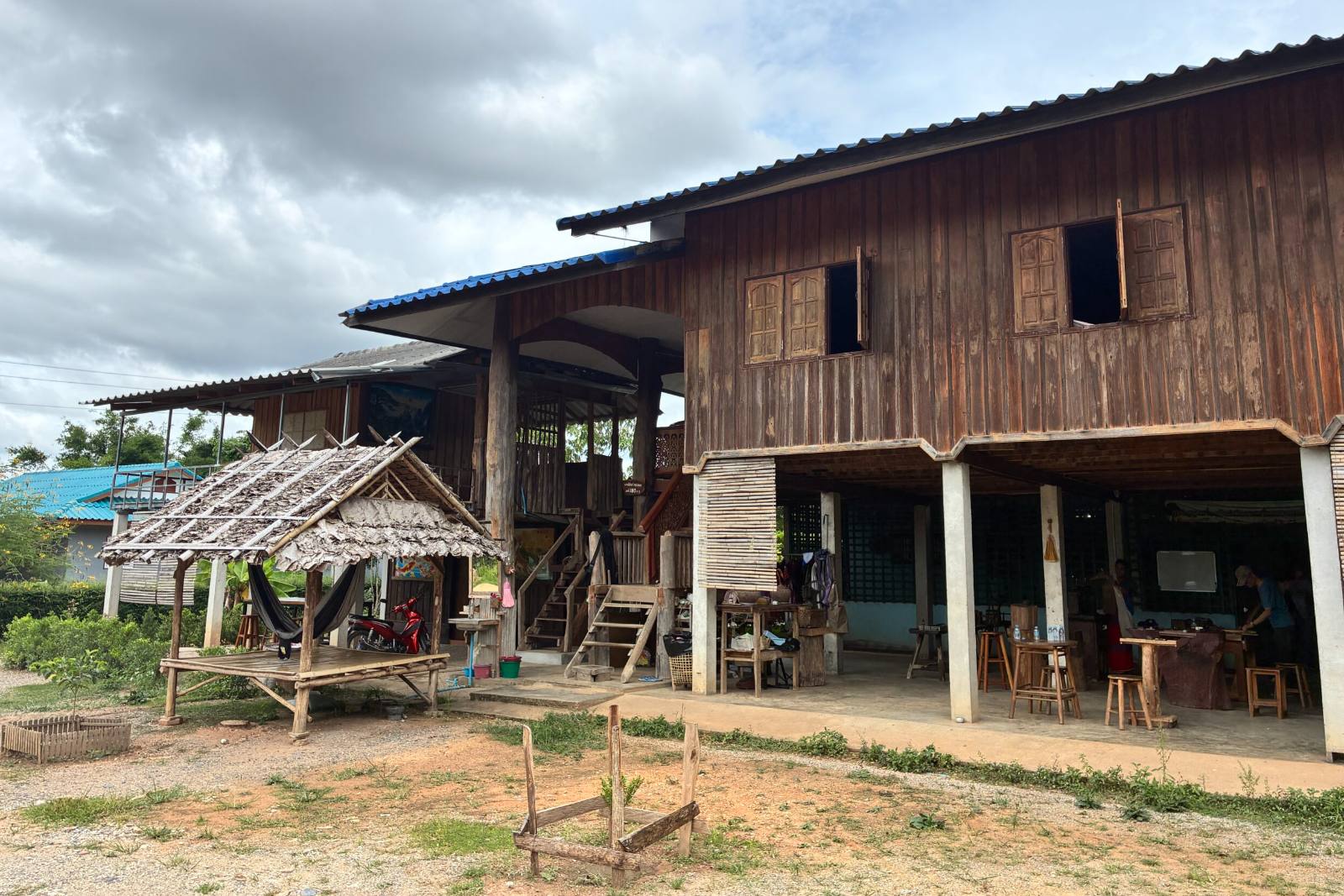
Karen silver comes from a number of communities in the north. This is one of them, and it is the one I can tell you about first-hand. The place is in Na Sai, a subdistrict of Li in Lamphun province, one of ten villages that sit around the temple of Wat Phra Phutthabat Huai Tom, all of them founded by the same monk. It is roughly two and a half hours south of Chiang Mai, the last stretch on hill roads with no shops and no toilets. You need a car. There is no bus that will get you there and back in a day.
These are Karen villages, but not ones that grew where they stand. Karen families have been relocating here from other northern provinces since 1946, following a monk named Khruba Chaiyawongsa Phatthana, usually called Khruba Wong. DASTA dates the building of the temple here to 1971–1975, when Pga K’nyau families came to work on it and the community was formally established. That is the wave Mr Shimizu says the family I visited traces itself to — the last part is his account, not the record.
What he gave them, as Mr Shimizu tells it, was land first and then a school and a clinic — before which, going to a hospital meant walking two or three hours down a mountain. He also pushed for the children to be schooled on the same terms as Thai children. I have not found that part in the public record, and I pass it on as his account rather than as history.
Wat Phra Phutthabat Huai Tom is a substantial temple, and he is generally counted among the three most significant khruba of Lan Na. He died on 17 May 2000 and was not cremated. His body is on display in a glass case, gilded, and every year on 17 May the village holds a robe-changing ceremony for him. Published research recorded more than ten thousand people attending in 2015 and 2016; I do not have a figure for this year.
Walk through it now and you hear hammering. Not from every house, though, and that turns out to be the story.
What happened in 1978
Here is the part that is on the public record, and that the product pages I read did not mention.
The Royal Project began in 1969, after King Bhumibol learned that villagers at Doi Pui, near the palace outside Chiang Mai, were earning about as much from local peaches as from opium. He granted 200,000 baht for a trial orchard and set up a highland programme with four stated goals, one of them eliminating opium cultivation. Most of the work was agricultural: coffee, fruit, cut flowers, rotational crops.
At Huai Tom, the intervention took a different form. What the government record actually gives me is a visit. DASTA, the Thai state agency for designated tourism areas, records that King Rama IX came to Phrabat Huai Tom in 1978; the regional tourism authority listing dates the Royal Project village here to that visit. Handicraft is what it became known for. The Thai government’s own tourism page says the products are usually displayed for sale at the Ban Huai Tom Center of Handicraft Research, and that some makers work to order for individuals.
Here is where I have to be careful, because it is the hinge of this whole article. That the 1978 visit happened, and that the Royal Project village here is dated to it, is documented. That the village’s silver trade began there, and began then, is Mr Shimizu’s account. I have not found a public record that dates the start of silversmithing at Huai Tom, and I would like one. What I can say is that nobody I have found dates it earlier.
If his account is right, the trade is forty-eight years old — which is a long time, and not what “ancient” is doing on a product page.
His version, built on decades in the north, adds something no official source I found says:
They were handed a full set of silversmithing tools, free, and told to start. But these were not silversmithing families. Nobody knew what to make.
If a household is given tools and asked to start, where do the first designs come from?
Where do Karen hill tribe silver designs come from?
There are two answers on the record, and they do not agree.
The first is Mr Shimizu’s. His account is that two other highland peoples in northern Thailand — the Mien (Yao) and the Akha — are the ones associated with silver here. I have not read a survey of hill tribe silverwork that I can cite to you, so treat this paragraph as one experienced resident’s account and not as the literature.
The Karen are not on that list. To be exact about what I did here: I read general surveys of hill tribe dress and material culture, and Karen entries lead with weaving and backstrap-loom textiles, not with silver as dress. That is not the same as proving no Karen community ever used silver ornament, and I want to be clear I have not proved that. It is the narrow sense in which his line about not wearing silver holds up — and the three bracelets on Arthit’s own wrist are the reason the literal version does not. He goes further:
The designs are really Yao. Yao silver is a different level, much finer line work. Karen silver is Karen because Karen people make it. It is not a Karen design.
The second answer is the Thai government’s, and it points the other way. A page published by the Public Relations Department describes the silverware of this exact community — Phra Bat Huai Tom, Na Sai, Li district — as carrying local patterns tied to Pga K’nyau Karen belief, and names them:
- grains of sand, for the unity of the villagers
- grains of rice, for respect towards what gives life
- the weaving pattern, for keeping your word
- pod duang, the old Thai coin and the best known of them, for wealth and a settled life
It also names smoking the metal as a technique particular to the community.
So which is it? I do not know, and I am not going to pretend the question is closed by one guide or one government page.
What I can lay out is who is saying what, and what each of them has at stake. Including me.
Mr Shimizu has thirty years in Chiang Mai and twenty living there, and a long association with Karen households across that time. He does not sell silver. How long he has been coming to this particular village is something I did not ask, and it is shorter than the thirty years he has been going to the weaving family. He does, however, have an interest in the day itself: I paid him 3,500 baht to drive and interpret, he stands to receive enquiries through this article, and I have said plainly further down that I want to repay his kindness to my family. I am telling you this because you should know it before you weigh what he told me, not because I think it makes him wrong.
The government page is published by the Public Relations Department to promote craft tourism in Lamphun, which is a reason to read it carefully rather than discard it. It is also narrower than it first appears: it describes what the patterns mean to the community now. That is not the same as establishing where they came from.
And I did not ask the makers. Neither Arthit nor the handicraft centre gave me their account of the 1978 question or the designs. That is a hole in this article and I am not going to paper over it. Two accounts are not all the accounts there are.
The origin remains unresolved. If you know of research on this, I would like to see it and I will correct this article.
He says the raw metal has changed too. Originally the villages melted down silver coins left behind by missionaries and Chinese traders. Today, he says, the bar silver is mostly imported from Korea. I did not see supplier records and could not check it.
What I actually made, and what it cost
The workshop is one household. Everything happens there: the furnace, the anvils, the tools, lunch, and at the end a small shop.
We arrived at 10:15 and left around four. Roughly how it went:
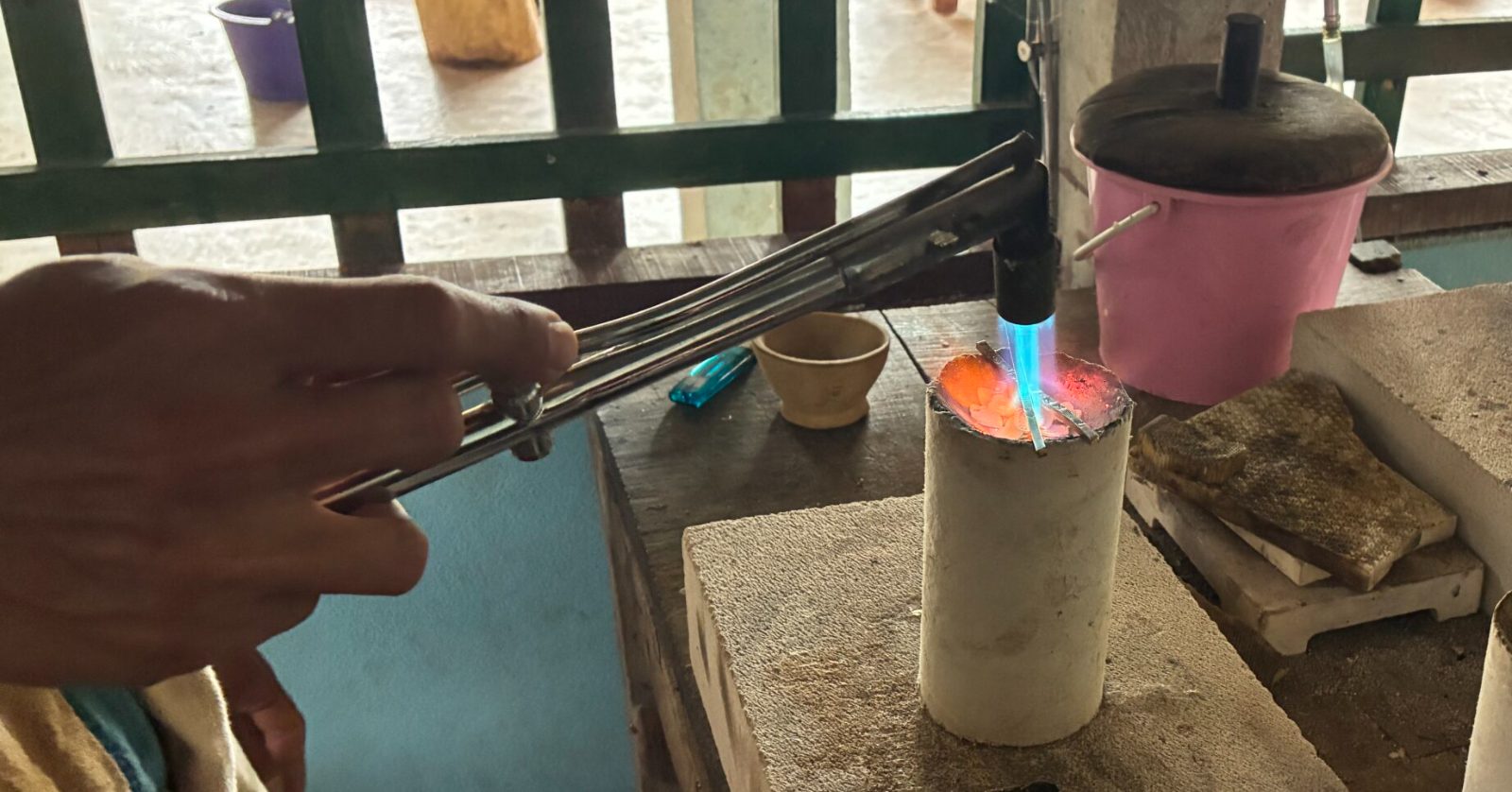
10:15 to 12:30. The forming. Granulated silver goes into the crucible and melts. The melt is poured into a rod mould and cools into a bar. Then you hammer, and keep hammering, until that bar is a long rectangle with four flat faces. Several times during this the piece goes back into the fire and then straight into water, which softens the metal so it will keep moving under the hammer.
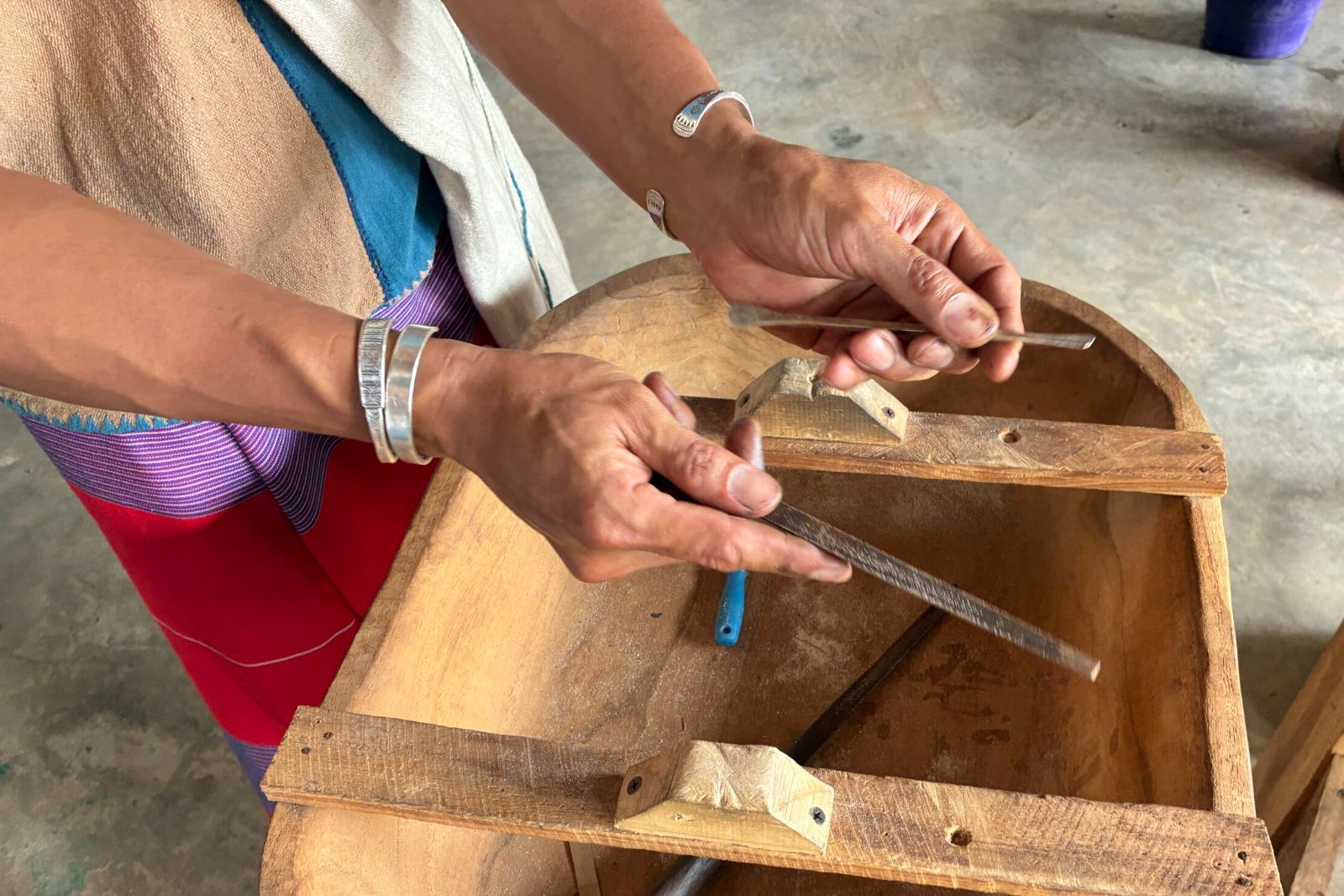
Then the pattern, and this is worth being exact about, because “hand-hammered” can be read to mean more than it does. It is not freehand engraving. The workshop has a set of design punches. You set one down on the face of the metal, strike it, move along, and strike again, until the pattern runs the length of the piece. What you are doing is placing and striking, not drawing. There are no letters or numbers in the set, so you cannot put a name or a date on it.
Then you bend the strip round into a bracelet.
12:30 to 13:30. Lunch, which has its own section below. There is a longan tree in the yard, and we were told to help ourselves.
13:30 to 14:30. The finishing. The piece is whitened and dried, then bleached and dried again. Only after that is the struck pattern blacked in with charcoal, so the lines stand out dark against the metal. Then polishing, then the final shaping.
14:30 to 16:00. A walk through the village, and the temple.
You can make a bracelet or a ring. They warned us the ring was harder instead of steering us towards it, and we made bracelets.
Flattening the bar, anyone can do. Placing the punches evenly is where it falls apart. Mr Shimizu told me about a previous guest who could not get the pattern to sit straight, gave up on it, and instead went over the whole surface with the round face of the hammer until it had a dimpled, beaten texture. It came out looking deliberate and rather good. He tells the story as a compliment.
| Silver used | 19 g; the workshop stated 99.25 per cent, and I did not have it assayed |
| Price per person | 3,100 THB, silver, instruction and lunch included |
| Our party | 4 people, so 12,400 THB, paid in cash directly to the family |
| Our child | Free |
| Guide, driver, translation, fuel | 3,500 THB, paid to Mr Shimizu |
| Group size | About six people a day is the practical limit |
| Lunch | Pad thai, cooked there |
Those are what we paid on 1 August 2026, not a quotation. Silver is a traded commodity and the workshop price moves with it — and on Mr Shimizu’s account, that same movement is what emptied the village of silversmiths. So it would be dishonest of me to present a figure like 3,100 baht as fixed.
The split is the part worth looking at. The 12,400 baht went into the hands of the family who did the work, in cash, from me, on the day. The 3,500 baht went to the man who drove us. I watched both payments happen. That is the whole arrangement, and I will come back later to why the way it was quoted is what made me choose it.
The workshop ends beside a small shop with pieces the family have made. Nobody walked us over to it, nobody stood beside us while we looked, and nobody mentioned it again. We bought three things, rings and bracelets, for 1,750 baht, because we wanted them. No tip was asked for at any point, by anyone. If you would rather make your piece and go home, that is a complete visit.
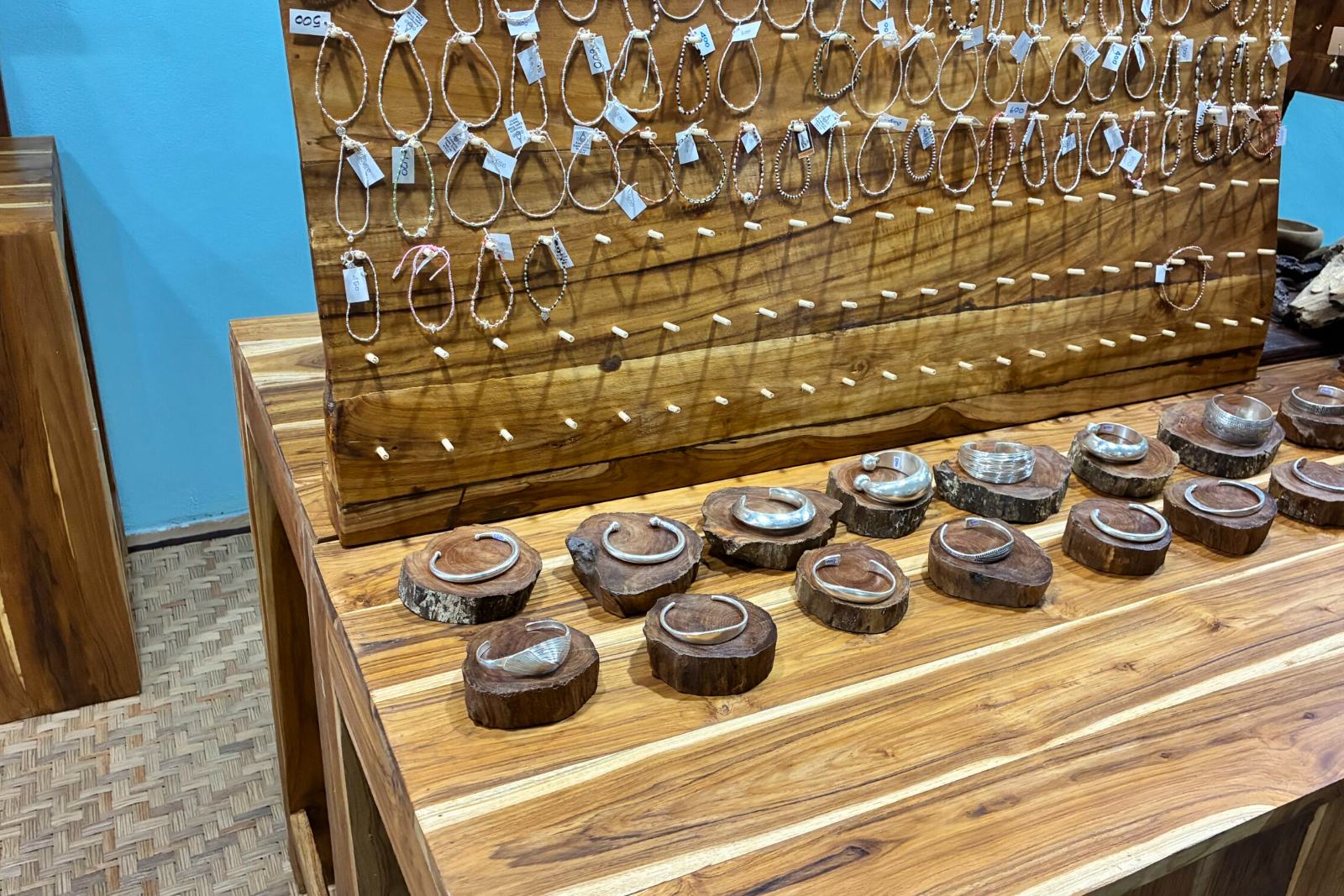
Everything is settled at the end, after the work is done rather than before it starts. Bring cash as the default. Thai QR payment worked on the day we went, but that is one payment on one visit rather than a facility I can promise you. I did not test cards, and I would not turn up assuming they work.
What else began in the 1970s
Lunch was pad thai, a soup, and fried mushrooms. There was no meat in any of it. I did not notice at the time.
I looked into it afterwards, because I did not want to turn one meat-free lunch into a claim about a thousand households.
This is not a preference. Khruba Wong set the terms of the community he founded: keep the five precepts, keep no livestock, eat no meat of any kind inside the community, no alcohol, no drugs, vegetables only in the monks’ alms bowls, Karen dress when you come to the temple. His reasoning is recorded: if we hurt animals, the animals will hurt us, and illness follows; if we eat vegetarian food, we hurt nobody.
Published academic research on Huai Tom, based on fieldwork in the mid-2010s, describes these as regulations that villagers are required to observe strictly, and states that those who do not are expelled from the community. A 2015 report in a Thai national daily, covering a neighbouring settlement whose rules follow those of the communities around Wat Phra Phutthabat Huai Tom, sets out the same terms and the same consequence: three warnings from the village head, then being asked to leave. Two sources, arrived at independently, saying the same thing. I am quoting them, not auditing a thousand kitchens, and I cannot tell you from one visit how any of it is applied in 2026.
But I am not going to soften it into a quaint local custom either. What I can say is what was on the table: three dishes, no meat in any of them, in a village founded on a promise to stop eating it. Holding to something like that has a cost I did not pay and could not see from a single day.
So I ate inside that promise without knowing it, and spent the meal thinking about my forearm.
1946 onwards. Karen families begin relocating here. 1971 brings a large group.
1978. King Rama IX visits Phrabat Huai Tom; the Royal Project village here is dated to that visit. On Mr Shimizu’s account, this is where the silver starts.
2000. Khruba Wong dies. The rules continue.
The village is explicitly Buddhist, founded by a Buddhist monk, which sets it apart from many northern Karen communities where Christianity, Buddhism and older animist practice sit alongside each other.
None of this was on the product pages I read.
The Karen craft with a clearer documented history
If you want the Karen craft whose origins I have not found anyone arguing about, you have to drive somewhere else entirely. It is the cloth.
Karen weaving is done on a backstrap loom, the tension held against the weaver’s own body. At the household Mr Shimizu takes people to, the dyeing is done with plants. I have not researched Karen weaving deeply enough to use it as proof about the silver, and “I have not come across an argument about it” is not the same as “there is none”. What I can tell you is what I watched being done in that household.
Mr Shimizu has been going to a Karen weaving and natural-dyeing household for thirty years, which is longer than he has been visiting the silversmiths. It is a different village, a two-hour drive out of Chiang Mai in a different direction. The mother of that family is now well enough known that she has taught at Chiang Mai University, and there is a banner with her photograph on it. He noticed she had become a legend somewhat later than everyone else did.
So the two crafts are not in the same place. The craft that got exported and branded is the one whose origin I could not pin down. The weaving, which I have not seen marketed to me as ancient, is a separate day out in a different direction — and I have not researched its history to the same depth, so I am not offering it as a contrast that proves anything.
Why the village went quiet
For a stretch, silver worked. This part is Mr Shimizu’s account of the years before I arrived, and I have not tested it against anything. Every Monday, makers came down from the hills to Chiang Mai and sold to the shops. Shops took orders from tourists and exporters and sent the numbers back up: ten of these, two hundred of those. Money came in. What I can see for myself is the residue: some houses in the village are still called silver mansions.
Then the orders stopped. Mr Shimizu puts that down to the silver price rising and continuing to rise. I have not tested that against price data or order books; it is his reading of what happened to the households he buys from.
It has become very quiet. It used to be almost the whole village doing it. Now, not at all.
That is Mr Shimizu on the present state of the place. On my visit I heard work in some houses and none in others, which is as far as one day lets me go.
He says many households went back to farming when the regular orders stopped. I did not speak to any of them, so I am not going to characterise why one house kept going and another did not.
Arthit is in his late thirties and his family were silversmiths a generation back. He has been doing this work for about eighteen years, since he finished school at twenty, which means he started well after the good years and has spent most of his working life in the quiet ones. His answer was not to chase new wholesale buyers, which is the thing that stopped working, but to sell the making of it. Bring people to the village, put a hammer in their hands, charge for the day, and let the workshop be the product rather than the bracelet. He wants it to grow into something larger than a household sideline. When he started taking visitors is not something I know.
Mr Shimizu has thirty years in the north behind him, and as far as he knows this is the only place where you can actually do it. Not the only village that makes Karen silver, but the only one he knows of that will let you make it. That is one well-placed person’s knowledge, not a survey.
How to buy it with your eyes open
I am not telling you to avoid Karen silver. I bought some. Here is what I would want to know first.
What I can say. The workshop stated that our silver was 99.25 per cent; I did not have it assayed. High-purity silver is soft, marks easily, and goes that particular warm grey rather than staying bright, and that is what ours has done. It is worked by hand and it does not come off a machine. The workshop I visited is in Lamphun province; where any particular piece was made is a question for whoever is selling it.
What “hand-hammered” actually covers. The metal is melted, poured, and beaten into shape by hand, which is real work and takes hours. The pattern, though, is struck with punches from a set the workshop already owns, one strike at a time. That is why you see the same motifs recurring across different sellers. It is hand-made and repeatable at once, and neither of those words is a criticism. It is simply what the process is.
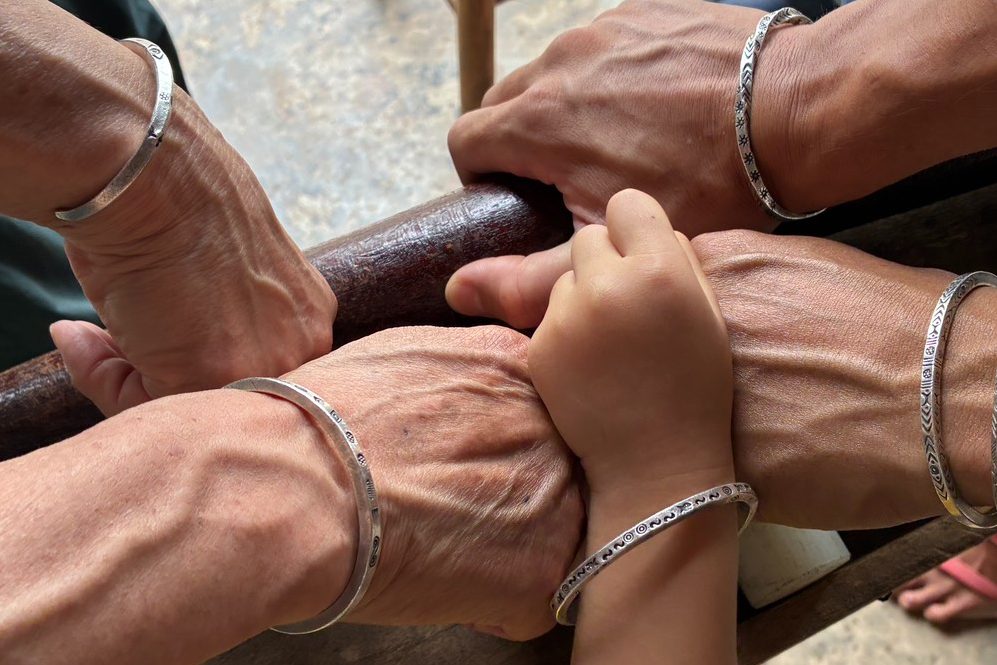
What is marketing. “Ancient tribal tradition.” “Passed down through generations.” “Worn by the Karen for centuries.” Treat these as sales copy unless the seller can tell you something specific about where the piece came from.
Questions worth asking a seller. Which district is it from. Who made it, or at least which village. The detail in the answer will vary, and a vague answer is not proof of anything — long supply chains lose that information honestly. But it is worth asking, the same way you would ask a fishmonger where the fish came from.
Purity is worth one note. The workshop described our silver as 99.25 per cent; I did not have it assayed. That is above sterling silver, which is 92.5 per cent. I did not survey what other sellers quote. The point is only that “hill tribe silver” is not a graded standard with anyone auditing it. It is a description.
Visiting, and the money question
Mr Shimizu told me it was open when we visited, that no permit was required and that no general camera ban applied; I did not verify drop-in access with the community committee. I asked him before we went, because a lot of writing about hill tribe villages implies otherwise. The government tourism listing for the neighbouring Nam Bo Noi community asks visitors to go through the Phrabat Huai Tom community committee, so ask locally rather than taking my day as the rule. That is not the same as permission to photograph people or the inside of somebody’s house. For that you ask, as you would anywhere. The obstacle beyond that is logistical: it is far, the road is not obvious, and as far as I could find there is no bus that gets you there and back in a day, so you need a vehicle.
The reason I chose this particular arrangement was the way it was quoted to me.
Before we went, I was given two numbers rather than one. 3,100 baht per person for the workshop, which I would hand to the household myself, in cash, on the day. 3,500 baht for the car, the driving and the translation, which went to Mr Shimizu. Nobody asked me to transfer a bundled total in advance.
This is a preference, not a verdict. I am describing one day I booked, and I have no view on anyone else’s arrangement because I have not seen inside one. A bundled price can be perfectly legitimate, and a good operator has costs that a two-line quote does not show. What I liked about mine is narrower than that: an itemised price is a price I can check, and I happen to want to see the split.
Here is that split, then, with nothing added to it: on the day we went, 12,400 baht went into the hands of the family that did the work, and 3,500 baht went to the man who drove us there. I watched both payments happen. Whether that matters to you is yours to decide.
If it does, the question to ask about any day out like this is simply how the price breaks down and when the maker is paid. Plenty of operators will have a good answer. It is worth asking anyway.
If you want to go
I am not arranging visits, and there is no link or form here. My day was booked through Mr Shimizu, who guides in Japanese and has known this family for years. That is how I got there, and it is the only route I can describe first-hand. It is not a route that is open to you unless you read Japanese.
If you want to go and do not read Japanese, these are the two enquiries I would make. Neither goes through me.
- Ask a Chiang Mai operator directly whether they go to Huai Tom. I have not booked one, and I cannot name a route that reaches this particular workshop, so treat this as a question to ask rather than a recommendation. The thing worth asking any operator is how the price breaks down and when the maker is paid.
- The Huai Tom community runs its own community-based tourism programme, and the neighbouring settlement is listed through it. DASTA, the Thai state agency for designated tourism areas, lists Phrabat Huai Tom with silverware making among the community activities.
Why I am not offering to introduce anyone. The workshop is a house in a village, and about six people a day is what one household can take. Passing enquiries through myself would put a stranger with a website between a reader and a family, in a language neither of them shares. I receive nothing either way, and I would rather send you to people who do this properly.
Three practical notes, whichever route you take. Prices move with the silver market, so treat the figures above as what we actually paid in August 2026 rather than a quote. The robe-changing ceremony falls on 17 May and the village is taken up with it around that date; roads in the rainy season are their own conversation. And the village was founded on a commitment not to eat meat — published research describes it as a rule the community is expected to observe strictly, and there was none on the table when I ate there. Do not bring any with you.
Questions people ask
Is Karen hill tribe silver real silver?
It is silver. The workshop I visited stated 99.25 per cent for the metal I worked with; I did not have it assayed. Sterling silver is 92.5 per cent. I did not survey what other sellers quote, and there is no graded standard behind the phrase “hill tribe silver”. That softness is real enough in the hand: it dents and scratches more easily than sterling.
How can I tell whether Karen hill tribe silver is real?
Separate two questions, because sellers often blur them. Purity is about the metal, and you cannot judge it by eye — you would need an assay, and what you normally get is the seller’s figure. Provenance is about who made it and where, and appearance will not tell you that either: the same struck motifs recur across many sellers because the punch sets are similar. Neither can be established from looking at the piece. Ask which district and which village, and treat a confident answer to the cultural-origin question with more caution than a confident answer about the metal.
Is Karen hill tribe silver a traditional Karen craft?
That is genuinely contested, and this article lays out both accounts. A Thai government record puts a royal visit at Phrabat Huai Tom in 1978, and the Royal Project village there is dated to it, and the guide I travelled with says the village’s silver trade began there. A Thai government tourism page describes the motifs as local patterns tied to Pga K’nyau Karen belief. I have not found independent research settling it either way. What is not in dispute is that the objects themselves are made by hand by Karen households in Lamphun.
Where do Karen hill tribe silver designs come from?
Two answers are on the record and they disagree. Mr Shimizu, who has thirty years in northern Thailand and a long association with Karen households, sees Mien and Akha influence. Thailand’s Public Relations Department describes the patterns as local and Karen, naming grains of sand, grains of rice, the weaving pattern and pod duang. Ask the seller which account they are repeating and why.
How much does Karen hill tribe silver cost?
Two different prices are worth separating. The making day we did cost 3,100 baht per person in August 2026, including the silver and lunch. Finished pieces in the workshop’s own shop ran from a few hundred baht upwards; we spent 1,750 baht on three. Both move with the silver market.
Can visitors make Karen hill tribe silver near Chiang Mai?
Yes, and as far as my guide knows this is the only place that offers it, which is one well-placed person’s knowledge rather than a survey. It is about two and a half hours from Chiang Mai by car and needs to be arranged in advance, because it happens in someone’s house. About six people a day is the practical limit.
How do I look after high-purity silver?
Assume it is softer than sterling. It bends out of round if you sit on it, it picks up scratches from ordinary wear, and it darkens gradually rather than staying bright. Most of that is reversible with a polishing cloth. The darkening in the struck pattern is deliberate and you do not want to polish it out.
Can I see the weaving on the same trip?
No. The weaving and natural-dyeing households Mr Shimizu works with are in a different village, a two-hour drive from Chiang Mai in a different direction. They are two separate days out.
Are the Kayan and the Karen the same people?
Related, not the same. The women who wear brass neck coils are Kayan, called Padaung in Burmese, usually described as a subgroup within the wider Karen family and most associated with Mae Hong Son and the Myanmar side. That description comes from general reference works rather than primary ethnography, and how these groups relate to one another is itself disputed; I have not found specialist sources that settle it. The village in this article does not practise it.
Where the non-first-hand parts come from
Everything about the workshop day — the process, the times, the prices, the payments, the shop, the bracelets on people’s wrists — is what I saw on 1 August 2026. For the history I have relied on the following, and where I could not source something I have said so in the text.
- Pisith Nasee, “Constructing the Charisma of Khruba (Venerable Monks) in Contemporary Thai Society”, Southeast Asian Studies Vol.7 No.2, Kyoto University, 2018 (fieldwork mid-2010s) — the ten villages, relocation from 1946, Khruba Wong’s standing and death, the community regulations and expulsion, the 17 May ceremony, the 2015–2016 attendance figure. Link
- Public Relations Department, Royal Thai Government, “Creative Tourism: Making Silverware in Lamphun Province”, 17 May 2023 — the four named motifs and their stated meanings, the smoking technique, and the Ban Huai Tom handicraft research centre. Link
- Krungthep Turakij (Bangkok Business News), “Nam Bo Noi: the hidden place of Li”, 23 October 2015 — the community regulations and the three-warnings-then-leave rule, at a neighbouring settlement founded by followers of the same monk. Link (Thai)
- Lamphun Provincial Public Relations Office — Khruba Wong’s date of death and the annual robe-changing ceremony. Link (Thai)
- DASTA (Designated Areas for Sustainable Tourism Administration), Thai government, community listing for Phrabat Huai Tom, checked 6 August 2026 — the temple built 1971–1975, the community formally established, the 1978 visit by King Rama IX, the ten villages today, and silverware among the community activities. Link
- Tourism Lampang & Lamphun, Phrabat Huai Tom Royal Project Development Centre, checked 6 August 2026 — the Royal Project village dated to the 1978 royal visit, and silversmithing among the crafts demonstrated. Link
- Royal Project Foundation — the 1969 origin of the Royal Project. Link
What I have not sourced, and am not presenting as established: that silversmithing at Huai Tom began in 1978 or through the centre; that tools were supplied free; that the motifs derive from Mien or Akha work; that the bar silver now comes from Korea; the origin of the Kayan/Karen distinction beyond general reference works; and any claim about what share of the world’s “Karen silver” comes from this district. The surveys of hill tribe dress I read are general reference works rather than primary ethnography, and I have treated them as such.
Claims attributed to Mr Shimizu are his testimony and are marked as such in the text. If you can point me to research on the origin of these motifs, I would like to see it.
On the names. Mr Shimizu and Arthit are not their real names. I have changed them because this article sets one man’s account against a government publication, and because the second is a private craftsman whose livelihood is not served by having his household indexed in English. Nothing else about them is altered: the years, the trade, the family history and the quotations are as given to me. If a researcher needs to verify a claim with the people concerned, write to me.
→ More on this: all our guides on daily life in Chiang Mai.