THAILAND · PAPERWORK
The part I cannot settle is whether I needed to be there at all.
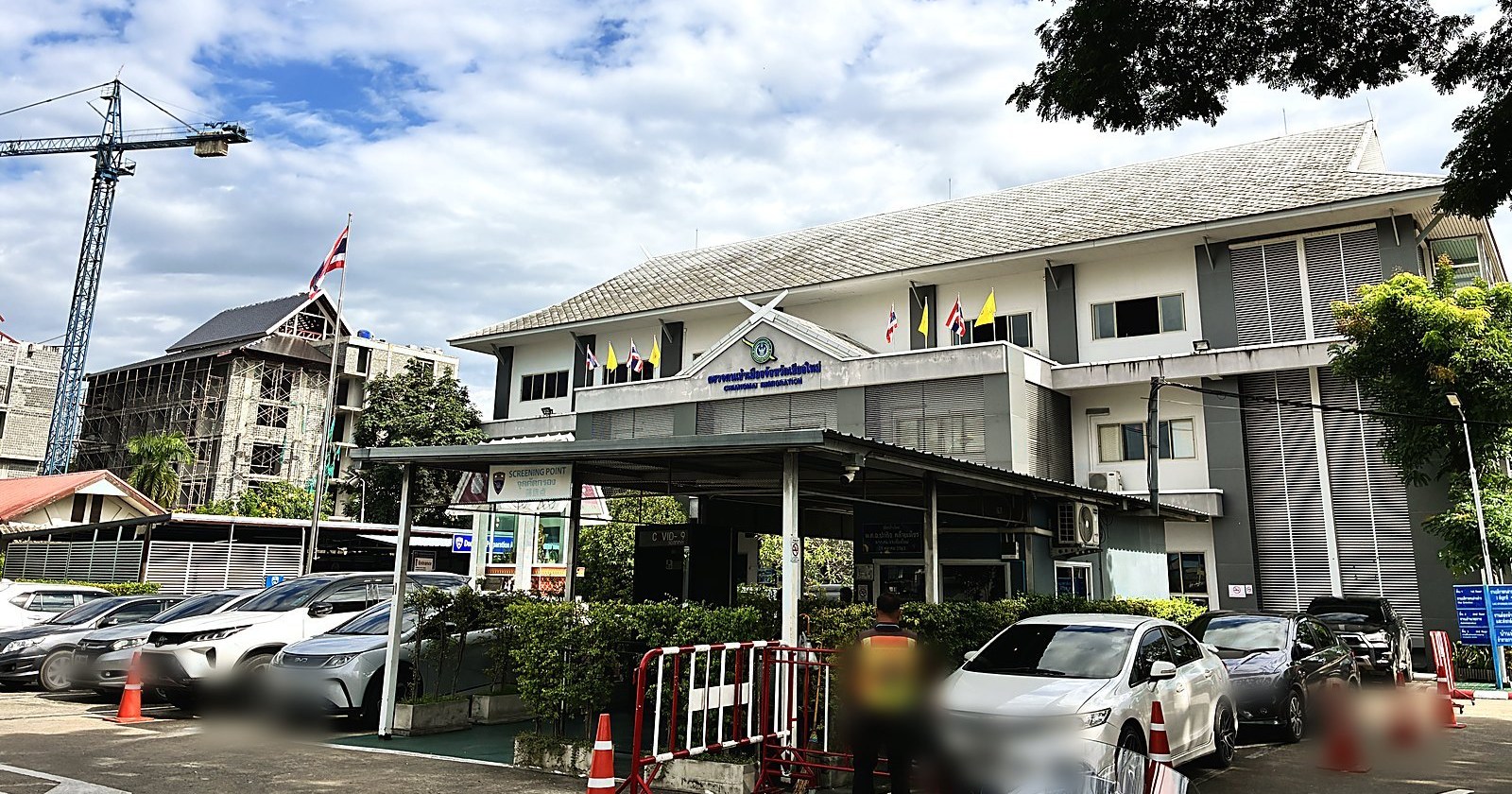
I walked into Chiang Mai Immigration at about half past three on a Monday and walked out with a receipt timed 15:50. No queue number. No conversation. Nothing to pay. What I still cannot tell you is whether the law required any of it — because the regulation and the immigration service’s own 2025 material give different answers, and I have found nothing that reconciles them.
If you are planning the whole move rather than one form, start with my first-hand guide to moving to Chiang Mai.
What a TM30 is, and who the law names
TM30 is a notification of where a foreign national is staying, made under Section 38 of the Immigration Act B.E. 2522.
The section names four kinds of person: the house master, the owner or the possessor of the residence, and the hotel manager. It is worth reading that list slowly, because “possessor” is not obviously limited to the person who owns the building. I am not going to tell you which of those four you are. I can tell you that in our house, the first notification was made by our landlord.
The deadline is twenty-four hours from the time the foreigner takes up residence — not from the time the aircraft lands. The immigration bureau’s own public handbook puts it as “within twenty-four hours from the time the alien has taken residence”, and the TM.30 form repeats it: “within 24 hours from the time of arriving at the residence”.
Section 77 sets the penalty at up to 2,000 baht for anyone made responsible by Section 38 — house master, owner or possessor — and at 2,000 to 10,000 baht where the responsible party is a hotel manager. Immigration’s 2025 material describes the 2,000 baht fine as falling on the residence’s owner. I have not been fined and cannot describe how that process runs.
The 2020 regulation allows four routes: in person, through someone you authorise, by registered post, or through the immigration bureau’s electronic system. A landlord who has registered the property can file without leaving the house.
I hold a DTV, and I re-enter often, which is why this comes up in our house as regularly as it does.
Two official answers, and they do not agree
If you leave Thailand and come back to the same house, does it have to be filed again?
The 2020 regulation says no, subject to conditions. The rule made under Section 38 and published in the Royal Gazette on 16 June 2020 provides that once the notification has been made, and the foreigner afterwards stays elsewhere from time to time and returns to the same place, within a period of accommodation that has not yet ended, another notification is not required. The same clause states that this includes foreigners holding a visa valid for multiple entries who leave the Kingdom and return within the visa’s validity, and foreigners returning on a re-entry permit. It took effect on 30 June 2020 and replaced the 1979 rule.
Both conditions matter, and I can only verify one of them. The same place is clear enough. The period of accommodation is not: I have not established whether it means the term of the lease, the period written on the original notification, or something else, and the regulation does not define it. That phrase is what decides how far the exemption reaches, so I would not read the exemption as broader than the condition I cannot pin down.
A 2025 immigration document gives the opposite instruction. Material prepared by Immigration Division 1 lists the cases in which the notification must be resubmitted as a change of residence and “re-entry into the kingdom and stay at the previously reported residence”.
I cannot reconcile those two, and I am not going to pretend the gap is smaller than it is. The regulation is the instrument made under the Act. The 2025 document was prepared by Immigration Division 1 and is published on the Board of Investment’s site. Both are official.
What I do is a habit, not a legal position. I file every time I come back. My daughter’s school told us to, when we were enrolling her. Not immigration, not my landlord, not an agent. I have never tested not filing, and I have never asked an officer which document they work from, so I cannot tell you what happens to someone who relies on the 2020 regulation if immigration applies the 2025 position instead.
Who files it in our house, and why it is me
Our landlord made the first notification when we moved in, and he is registered on the immigration system, which is how we came away with the paperwork we still use.
I have filed every subsequent notification myself.
It is not a matter of principle. Asking him each time is more effort than going. I leave the country often. Each exit would mean a message, a wait, a follow-up if nothing happened, and no way to see whether it had been done. Going in person takes an afternoon and ends with a piece of paper in my hand.
If your landlord is willing and registered, that is the better arrangement, and mine is both. I am the one who stopped asking.
What it does require is documents — and if you are still choosing a place, what we went through to rent this house covers the contract and the landlord paperwork you will want copies of.
What the handbook asks for, and what I take
The immigration bureau publishes the national requirement, and it is short. The public handbook lists the TM.30 form itself, plus three photocopies from the passport, each one certified by the foreigner:
- the bio data page
- the latest arrival stamp
- the visa page
It also lists the fee as N/A and the total processing time as ten minutes.
What I take to Chiang Mai Immigration is longer than that, and I am describing my own folder rather than a national rule. In addition to the form and the passport itself, I bring the notification paperwork our landlord received when he filed the first time, the lease, a copy of the landlord’s ID, and the house registration document. Nobody has asked me for his signature or for a letter authorising me to file on his behalf.
I would not reuse an old set of copies. The handbook asks for the latest arrival stamp, and a set of copies made before your last flight no longer contains it.
Because I file after every trip, I need repeat copies of the landlord’s documents. I am not going back to him for a fresh set each time. Ask for several at the start, or agree that you can keep and copy them. There is a photocopy shop outside the immigration gate. I would rather have my own copier.
What happened on 17 August
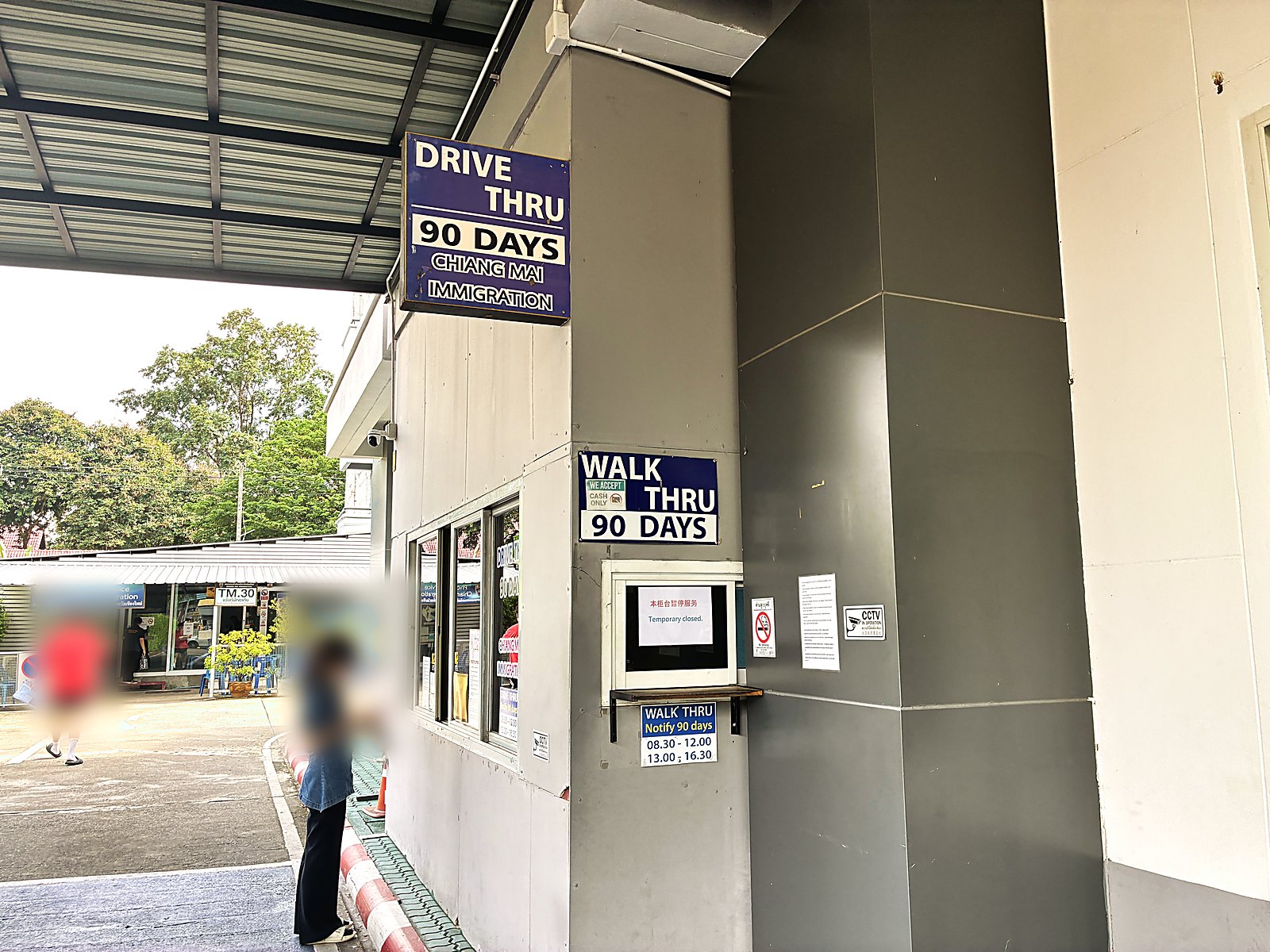
The trip was Chiang Mai–Shanghai–Qingdao and back. I landed late on Saturday 15 August and filed on Monday 17 August.
That is beyond twenty-four hours, and I was not fined. One office, one visit, one officer. I am reporting it because it happened, not as something to plan around.
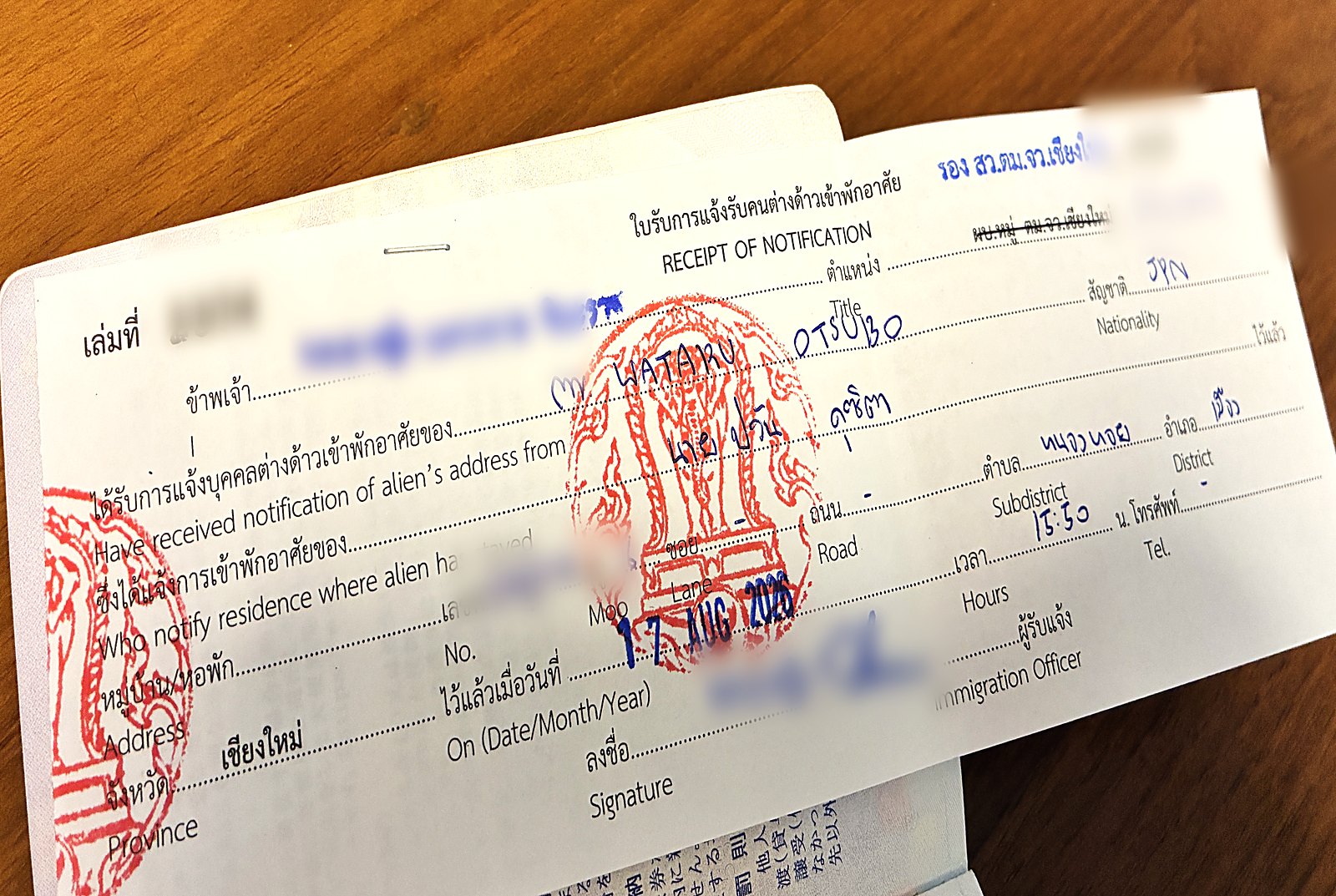
I arrived at about 15:30 or 15:40. The receipt is timed 15:50. About twenty minutes from walking in to walking out, on that visit.
I did not need a queue number. The last time, someone told me to take one: I had walked in during the morning rush without realising the numbers were handed out near the entrance, and there were twenty people ahead of me. This time there was nobody to queue behind, and I was called about five minutes after sitting down.
There was no conversation. I handed over the folder, the officer worked through it, and the receipt came back. Nobody told me what to do next time.
It cost nothing, which matches the published fee.
On every previous visit, the office kept the photocopies. This time the officer handed them back. I do not know whether that is a change of procedure or one officer’s habit, and either way it is a reason to carry spares.
TM30 is not the 90-day report
These two get mixed up constantly. They are different obligations under different sections.
| TM30 | 90-day report | |
|---|---|---|
| Section | 38 | 37(5) |
| Who files | House master, owner, possessor, hotel manager | The foreign national |
| Form | TM30 | TM47 |
| Triggered by | Taking up residence | Staying more than 90 consecutive days |
In our house the two have landed on different people, and the reason is how often each of us leaves.
| Visa | Travel | 90-day report | TM30 | |
|---|---|---|---|---|
| Me | DTV | Out of the country often | Never filed one | Filed after every re-entry |
| My wife and daughter | An education visa for my daughter, and a guardian visa for my wife tied to it | Stay put | Handled at the appointment where the visas were extended. I did not go with them and have not seen the forms | The landlord’s first notification only |
My daughter’s education visa gave ninety days on first entry, and my wife’s guardian visa is tied to it. They applied for the one-year extensions at immigration, and the 90-day reporting was handled at that same appointment rather than as a separate trip. I did not go with them, so I am passing that on rather than describing it. If you are going to be at the counter anyway, it is worth asking whether both can be done in one visit.
I have never filed a 90-day report, and TM30 is not the reason. Thai government guidance sourced to Immigration Division 1 says that if a foreigner leaves the Kingdom and re-enters, the day count starts at zero in every case. I leave and come back before ninety consecutive days are up. The obligation has never come due for me. My wife stays, so hers does.
The school’s reason for filing every time was that the TM30 record and the 90-day report have to line up. That is what we were told at enrolment. I have not found an immigration document that states it, and I have not been through a 90-day report myself, so I am passing it on as advice we acted on rather than as a rule I can show you.
The receipt I have never used
The paper I come home with is a Receipt of Notification, torn from the bottom of the TM30 form. The 2020 regulation requires the receiving officer to issue it. No expiry date is printed on it.
I have never been asked to show an earlier receipt at a later filing, or anywhere else. Not once.
That is not an argument for skipping it, and it is not a claim about what the receipt is for. I have not applied for an extension or a re-entry permit, so I cannot tell you what either of those asks for. The absence of an expiry date only means that no expiry date is printed on the receipt.
What I would do
- When you sign a lease, ask whether the landlord is registered to file TM30 online. That is a better question than whether they will file it, because it tells you whether they can do it without leaving home.
- Copy the bio data page, the visa page and the latest arrival stamp, and certify them. Redo the arrival-stamp copy after every entry.
- Get several copies of the landlord’s documents at the start, or agree that you can keep and copy them.
- I will try the late afternoon again. I have been in the morning rush and I have been at half past three. That is two visits, and I cannot say the same would be true on another day or in another month.
- Ask your local immigration office whether you need to refile after a trip. The 2020 regulation and the 2025 immigration document do not say the same thing, and I have not asked an officer which one applies at my counter. I file every time. That is what I do, not what I have established.
→ If it is the visa you are working out rather than the form, the DTV, first-hand is the longer piece.
FAQ
Who does Section 38 name as responsible for filing a TM30?
The house master, the owner or possessor of the residence, and the hotel manager. The section does not say which of those categories a tenant falls into, and I am not going to decide that for you. Immigration’s 2025 briefing describes the 2,000 baht fine as falling on the residence’s owner.
Do I need a new TM30 every time I re-enter Thailand?
Two official documents disagree. The 2020 regulation exempts a return to the same place, within a period of accommodation that has not ended, and says that includes multiple-entry visa holders returning within the visa’s validity. I have not established what that period of accommodation means, and the regulation does not define it. A 2025 Immigration Division 1 document lists re-entry to a previously reported residence as a case requiring resubmission. I file every time and have never tested not filing.
What documents does immigration ask for?
The published national requirement is the TM.30 form and three certified photocopies from the passport: the bio data page, the latest arrival stamp and the visa page. What I take to Chiang Mai Immigration also includes the lease, a copy of the landlord’s ID and the house registration document — that is my folder, not the published list.
How much does it cost?
The published fee is N/A, and I have never paid anything.
How long does it take?
The handbook gives ten minutes of processing. I arrived at about 15:30 and my receipt is timed 15:50. That was a quiet afternoon with no queue.
What happens if it is filed late?
Section 77 provides a fine of up to 2,000 baht for anyone Section 38 makes responsible — house master, owner or possessor — and 2,000 to 10,000 baht for a hotel manager. I filed about two days after arriving and was not fined — one visit, one office, and not something I would treat as a rule.
Is TM30 the same as the 90-day report?
No. TM30 sits under Section 38, which names the house master, the owner or possessor of the residence, and the hotel manager; the 90-day report sits under Section 37(5), is filed by you on form TM47, and is triggered by staying more than ninety consecutive days. If you leave Thailand and re-enter, the day count starts at zero again.
Can it be filed online?
Yes. The 2020 regulation lists the immigration bureau’s electronic system alongside filing in person, through someone you authorise, and by registered post. I have only ever filed in person and cannot describe the online route.

I split the year between Kamakura, Japan and Chiang Mai, Thailand, and write these guides from our own records, our own experience, and named sources. More about me.
Last updated: September 2026. This is one household’s experience at one immigration office. Rules and local practice change — check with the office that covers your address.
→ More on this: all our guides on daily life in Chiang Mai.