THAILAND · TRAVEL INSURANCE
This guide contains affiliate links. If you buy through them I may earn a commission at no additional cost to you, and I only recommend things I have used myself.
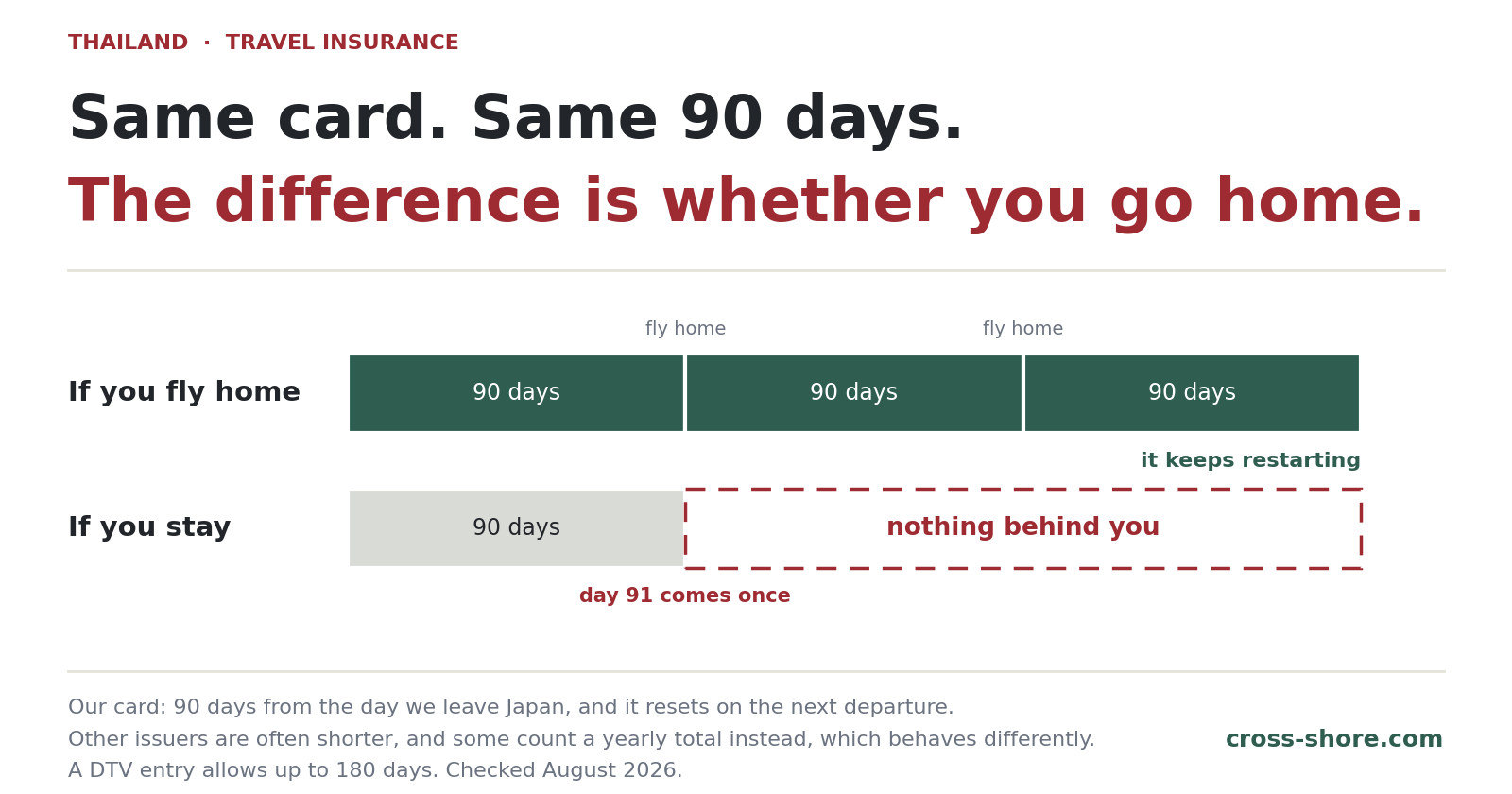
I do not buy a separate travel-insurance policy for Thailand; I rely on the cover attached to a Japanese credit card. It runs for 90 days from the day I leave Japan and starts again after I return to Japan and depart again. Because I go back and forth between Kamakura and Chiang Mai several times a year, each of my stays has so far ended before the card’s 90-day limit.
My wife and daughter need more than that. They stay longer. Our cover is SafetyWing. The policy is in my wife’s name, our daughter is on it, and I am not. See what we pay and the limits. If you are planning the whole move rather than a trip, start with my first-hand guide to moving to Chiang Mai.
Currency: amounts are given in the currency they were quoted in. Conversions use the Bank of Japan’s official rate for August 2026 — ¥161 to US$1 and 100 THB to US$3.04 — and are there for scale only.
What a trip policy is actually for
A travel policy is built around a trip: a start date, an end date, and the things that go wrong between them. Injury, sudden illness, theft, and travel disruption — delays, missed connections and cancellations. It is designed for a period you can name in advance.
Flight disruption matters in Chiang Mai during Yi Peng. The airport reported 170 cancellations or schedule changes in 2024 and announced 161 for 2025 as of 31 October, because the sky above the airport fills with paper lanterns and they come down again. For 2025, the airport announced that airlines had scheduled all festival-night flights to finish before 7pm. I have written that up separately, with the numbers and the districts where lanterns are banned.
Some policies cover delay expenses, but the terms and exclusions vary. If your worry is a delay, a stolen bag or a broken ankle during a two-week trip, check the policy’s start date, delay benefit and exclusions before departure.
I am not going to list products or rank them, because I have not bought one for this country. I can show where short-trip cover stopped being enough for my family.
The 90 days belong to the trip, not to you
On my card, the 90 days are counted from departure from Japan, not from each entry into Thailand.
Under my card’s terms, a new covered trip begins when I return to Japan and depart again. That is why I have not needed anything else so far.
A DTV entry allows a stay of up to 180 days, and the holder may apply once for an extension of up to a further 180 days; approval is at the discretion of the immigration office. Confirm the current fee and documents with Immigration. A DTV stay can therefore run well past the 90-day limit on my card.
If the stay continues past the policy limit, the card cover ends.
90 is my number, on a Japanese card. Other cards use different limits and different reset rules, and some carry no travel cover at all. Check whether your own card resets after each trip or uses a yearly limit. I found this distinction in the policy wording rather than on the headline page.
The dividing line is whether your stay outlasts the policy, and whether returning home resets it
For a two-week holiday, compare ordinary short-trip policies. The plan my wife uses renews every 28 days and was chosen for a longer stay.
You go back and forth, like I do. Check whether your card’s cover resets on each departure or runs as a yearly total. If it resets, and each stay sits inside the limit, you may already have what you need — which is what I concluded. Read the exclusions rather than the headline, especially around motorbikes.
You stay, or somebody in your household stays. In our case, the person who needed longer cover was not the one flying home. A stay does not reset anything. Day 91 comes once.
You do not know yet. Compare the policy limit with the longest stay you may realistically make.
What we actually pay for, and who it is for
Our cover is SafetyWing. The policy is in my wife’s name, our daughter is on it, and I am not on it.
That distinction matters because my card restarts when I return to Japan; my wife and daughter stay longer.
On Essential, SafetyWing publishes that “one child (older than 14 days but younger than 10 years old) per adult, or 2 children per group/family can be included in the insurance without added cost”, and that “a group member can be added to the plan only at a purchase point”. Our daughter is included under my wife’s policy. SafetyWing does not say what alternative is available if you need to add a child later, so ask before you buy. (Checked 11 August 2026.)
We chose it for three other reasons.
Our quote was US$102.76 per 28 days. The 364-day option was equivalent to US$92.48 per 28 days and was paid in one instalment — the published 10 per cent discount for paying in full. We took the 28-day cycle, because a 12-month commitment did not fit our schedule.
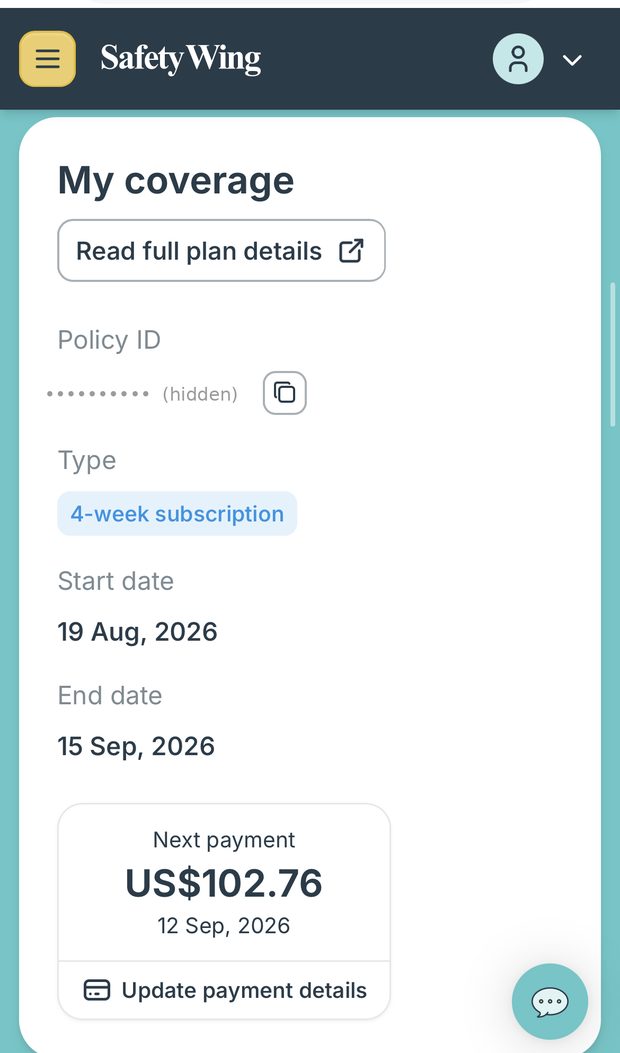
They are the same Essential plan, but the payment option changes the home-country allowance. SafetyWing publishes both: on a single 364-day payment it is up to 90 days per visit and 179 days in total per 364 days; on any other payment mode it is 30 days per visit within a rolling 90-day period. The plan also has to have been active for at least 90 days before home-country cover can be used at all. That matters in a two-base life. Check the version attached to your own quote.
It can be bought after you have already left. You do not have to decide before you fly, or predict in March what your October looks like. SafetyWing’s policy page says that for a claim relating to treatment, an incident or symptoms within the first 72 hours of purchase, it may ask for documents confirming when they began. If you buy after departure, keep documents showing when the incident or symptoms began.
It is designed mainly for emergencies outside the insured person’s home country, and visits home have their own separate limits. We are between Kamakura and Chiang Mai, so a Thailand-only policy would need separate overseas cover.
Essential does not cover pre-existing conditions or trip cancellation; I explain those limits below. What I am not going to do is tell you it is the cheapest. For someone living permanently in Thailand and treated entirely inside Thailand, a local Thai policy is a serious option and may well be better. In July 2026 Allianz Ayudhya quoted 98,154 THB (~US$2,984) a year for my wife and daughter, and that policy carries a 30% co-payment for insured members under 11. The full breakdown of the four options we looked at, and what each one quoted, is in a separate piece written for people who have already decided to move here.
Reader offer: new SafetyWing members can get 8 weeks of electronics-theft cover free with the code CROSSSHORECHIANGMAI. Click the pink camera icon on the Nomad Insurance page and apply the code before you create your account. It works on 28-day or annual Nomad Essential subscriptions, for new members only. Worth knowing: after the eight weeks, the add-on renews as a paid extra unless you cancel it. I confirmed the code on my ambassador dashboard on 10 August 2026; SafetyWing can change the offer or code validity.
What I cannot tell you about hospital costs
We have never paid an uninsured hospital-admission bill in Thailand, and I could not verify a figure, so I will not quote one.
We use private hospitals in Chiang Mai, but I have not compared the whole market. Low everyday prices in Thailand do not tell you what a hospital admission will cost.
The things a policy will not fix
Cancelled flights. I said earlier that the airport reported 170 cancellations or schedule changes in 2024 and announced 161 for 2025 as of 31 October. On Essential, SafetyWing’s published material states that the ticket is not reimbursed and that trip cancellation is not covered. There is a limited benefit for expenses such as meals and accommodation during a qualifying transportation delay, which is a different thing from getting the ticket back. Complete has a US$300 trip-cancellation benefit for specified reasons; it should not be read as cover for an airline cancelling a festival flight.
Pre-existing conditions. We have not made a claim, and nobody in our household has tested this. I can point you to the published exclusions, but I cannot predict how a claim would be decided. Ask the insurer directly and get the answer in writing.
The visa. Insurance does not fix your right to be here. The DTV does not carry a published insurance requirement — I was not asked for proof in Tokyo, and I could not find a published rule imposing one.
What I would do
- Find your own number, and the reset condition. Open your card’s policy wording and look for two things: how many days it runs, and whether that allowance starts again each time you leave home or is counted as a yearly total. For repeated long stays, check the reset condition as well as the day limit.
- Compare the policy limit with the longest stay you are realistically planning, not the one you have booked.
- If your planned stay is longer than the policy limit, work out how you will cover the gap before the card cover ends. Buying after departure is possible on this plan. Anything that was already there may fall under the pre-existing-condition rules, and SafetyWing may ask for documents about anything arising in the first 72 hours. Put a date in your calendar well before your card cover ends, not on the last day.
- If you are a family, sort the child out at the point of purchase. On this plan the free child slot exists only at sign-up. What alternative is available if you need to add a child later is not published, so ask before you buy.
FAQ
Does travel insurance cover you in Thailand?
It depends on the destination, the trip length, the exclusions and the policy terms. The number to check first is how many days it runs for.
How long does credit card travel insurance last?
My two Japanese cards run for 90 days from departure, and start again after I return to Japan and depart again. That reset is the part people miss. Check your own card’s limit and its reset rule.
Do you need insurance for a DTV?
The published rules do not require it, and I was not asked for proof in Tokyo.
What happens if you get sick without insurance in Thailand?
I do not have a verified figure, so I am not going to estimate. We have not been treated here without cover.
Can you buy travel insurance after you have already left home?
The Essential plan my wife uses can be bought after departure and renews every 28 days. Not every product allows this. SafetyWing may ask for documents about a claim arising within 72 hours of purchase.
Is Thai local insurance cheaper?
In July 2026 Allianz Ayudhya quoted 98,154 THB (~US$2,984) a year for my wife and daughter, on a plan that carries a 30% co-payment for insured members under 11. Whether it is cheaper depends on age, benefits, exclusions, deductibles or co-payments, and how much of the year you spend in Thailand.
Does travel insurance cover flight cancellation during the lantern festival?
Three different things get mixed up here. If an airline cancels a festival flight, check the ticket terms and the policy’s delay benefit. Essential does not provide general trip-cancellation cover, and it does not reimburse the ticket for a flight you missed. There is a limited benefit for expenses during a qualifying delay, which is not the same as getting the fare back.
Which one do you use?
I use the travel cover attached to my Japanese card. My wife and daughter use SafetyWing Essential — they are the ones who stay.

I split the year between Kamakura, Japan and Chiang Mai, Thailand, and write these guides from our own records, our own experience, and named sources. More about me.
Last updated: August 2026. Insurance terms and prices change — confirm current details on your own policy wording and your own quote before you buy.
→ More on this: all our money guides — what we pay, how we move it, and what our insurance covered.