Yi Peng and Loy Krathong in Chiang Mai: the dates, the no-fly zones, and the flights that do not take off


THAILAND · YI PENG

This guide contains affiliate links. If you buy through them I may earn a commission at no additional cost to you, and I only recommend things I have used myself.

Currency: amounts are given in the currency they were quoted in. Conversions use the Bank of Japan’s official rate for August 2026 — ¥161 to US$1 and 100 THB to US$3.04 — and are there for scale only.

I have not seen this festival. We moved to Chiang Mai in 2026 and November has not come round yet. The dates, the rules and the 2024 and 2025 flight figures come from public announcements; the booking and connectivity examples are mine. This article covers the three things that are decided before you arrive: when it actually is, where you are allowed to release a lantern, and whether your flight will take off. In 2024, the festival affected 170 flights.

The 2026 dates are not confirmed yet

The date moves every year because it is set by the moon, not the calendar. Loy Krathong falls on the full moon of the twelfth month of the Thai lunar calendar, and Yi Peng — the northern, Lanna festival that runs alongside it — moves with it. In practice that puts it somewhere in November most years, but “somewhere in November” is a range of three or four weeks, and that is wide enough to ruin a booking.

As of 8 August 2026, the Tourism Authority of Thailand has not published the 2026 dates. I checked its newsroom and there is no 2026 Loy Krathong announcement there. TAT publishes a monthly events calendar in the month before — the August 2026 calendar was published in July 2026. I do not know when the 2026 announcement will appear.

The most recent official notice I found is Chiang Mai province’s own, which put the 2025 festival on 5 and 6 November, with the city’s events running 4 to 6 November.

It helps to know why the unofficial dates differ. The Thai lunar calendar does not line up with the solar year, and the gap is corrected by inserting an extra month in some years. That is why you cannot simply take last year’s date and subtract eleven days: in a year with the extra month the festival lands roughly a month later than that arithmetic suggests, and in a year without it, it does not. I am not going to work it out myself and present the answer as a fact. Because the unofficial 2026 dates conflict, I am waiting for an official announcement.

There is a second reason to wait. The dates of the festival and the dates of the official ticketed events are not always the same thing, and the venues outside the city publish their own schedule. If your trip is built around releasing a lantern rather than around being in Chiang Mai, it is the venue’s date you need, not the calendar’s.

You will find 2026 dates stated confidently in a lot of places. I could not find an official source for any of them, so I am not going to repeat a number here. What I would do is wait for the official announcement before booking anything that cannot be changed. If your dates are fixed by work or school holidays and you cannot wait, book something you can move.

Yi Peng and Loy Krathong are not the same thing

They happen at the same time and people use the names as though they were interchangeable, but they are two festivals sitting on top of each other.

Loy Krathong is national and it happens on water. A krathong is a small float. Mr Shimizu — that is not his real name; he asked me to keep it out — described how they are made here: the trunk of a banana plant, cut flat into a disc, then decorated. You set it on the river and let it go.

Yi Peng is northern and it happens in the air. This is the one people picture: paper lanterns with a fuel cell underneath, rising when the air inside heats up. The lantern itself is a khom loi. Chiang Mai was the capital of the former Lanna kingdom, which is why the two traditions run together here.

Krathongs are small, they are cheap, and they are commonly sold near the Ping River during the festival. The krathong Mr Shimizu described was made from banana plant material — banana trunk, banana leaf, flowers, a candle. Lanterns create a different problem, because they land away from the point where they were released.

In 2024, Loy Krathong activities were easier to find inside the city, but local restrictions and permitted locations still applied. Lanterns are the tightly controlled half. If you come expecting to release one wherever you happen to be standing, you have planned for the wrong festival.

Where you can actually release a lantern

Chiang Mai province sets out no-fly zones for lanterns each year, and the areas involved cover most of where a visitor is likely to be staying. The most recent announcement I have read is the one for 2025, issued by Chiang Mai provincial clerk Chainarong Nantasai, on 7 October 2025. It names the same six districts and 39 sub-districts as the 2024 announcement, and divides the no-release area into two official categories: an aviation safety zone (“Toffy Zone”) and a Level 1 special surveillance zone (“Red Zone”).

Districts of Chiang Mai where sky lanterns were banned under the province's 2024 and 2025 announcements: Muang Chiang Mai and Hang Dong entirely, with parts of Mae Rim, San Sai, San Patong and Saraphi
Where lanterns could not be released under Chiang Mai province’s announcements, which covered six districts and 39 sub-districts in both 2024 and 2025. The zones are re-issued each year and the 2026 list had not been published when this was written.

The districts named were:

  • Muang Chiang Mai — all sub-districts. This is the city itself, including the Old City and Nimman.
  • Hang Dong — all sub-districts.
  • Mae Rim — Donkaew, Muang Kaew, Rim Tai, Mae Sa and Rim Nue.
  • San Sai — Nong Harn.
  • San Patong — Tung Tom.
  • Saraphi — Khua Mung, Don Kaeo, San Sai, Tha Wang Tan and Nong Phueng.

Chiang Mai province’s own announcement sets this out as six districts and 39 sub-districts in total, and the list did not change between 2024 and 2025.

Outside those zones you still cannot simply light one. The application process changed. In 2024 the province required an application to the district chief at least 30 days in advance, and permitted 62,000 lanterns. For 2025 the province issued permits through a mobile app called Bampen, with login details available from the district office. The deadlines are the part to notice: in 2025 an application was due at least 14 days before release, or 30 days inside the airport flight path. Applying the week before was already too late.

One thing to be careful about: this is re-issued each year, and the 2026 announcement had not appeared when I wrote this. The zones held steady from 2024 to 2025, but the application route did not. Do not assume either carries over unchanged, and do not assume it will be looser.

The penalties are not small

Releasing a lantern in a restricted zone, or without the required approval, carries up to five years in prison, a fine of up to 200,000 THB (~US$6,080), or both, on conviction.

If a lantern causes a fire, the penalty is separate and heavier: up to seven years in prison and a fine of up to 140,000 THB (~US$4,256).

The same penalties appear in both the 2024 and the 2025 provincial announcements. Fire is written into the law as its own offence, with a longer maximum sentence than the release itself.

The flights that do not take off

Chiang Mai International Airport during the lantern festival: 170 flights cancelled or retimed in 2024 and 161 announced for 2025; the flights that moved in 2024 were the ones after 7pm, and for 2025 airlines scheduled festival-night flights to finish before 7pm
170 flights were cancelled or retimed in 2024, and 161 were announced for 2025 as of 31 October. In 2024 the affected flights were the ones scheduled after 7pm; for 2025 the airport announced that airlines had scheduled all festival-night flights to finish before 7pm. Figures for 2026 were not available.

The airport reported 170 cancellations or schedule changes in 2024, and announced 161 for 2025 as of 31 October. For 2024 the airport’s director, Ronnakorn Chalermsanyakorn, gave the breakdown on 12 November: 74 cancelled and 96 retimed, with 16 extra services added. For 2025 his successor, Karan Thanakuljeerapat, announced 65 cancelled and 96 retimed as of 31 October, with 44 extra services added, and said airlines had scheduled all festival-night flights to finish before 7pm. The same 7pm line held in 2024: Thai PBS World reported that the flights affected were the ones initially scheduled to operate after 7pm on the Friday and the Saturday. Lanterns are an aircraft hazard and fall once the fuel burns out.

I live between Kamakura and Chiang Mai, and my most recent return ticket came to ¥74,980 (~US$466) — out on Thai VietJet’s overnight direct, back on Hong Kong Express via Hong Kong, where I slept in the airport. On the dates I checked, the cheaper options were late flights. If you sort by price and book the first result, you may choose the same late-evening window affected in 2024.

For my latest booking, the direct overnight option was the cheapest. It departs after 7 p.m. That is the period affected during the festival: after 7pm in 2024, and in 2025 airlines scheduled all festival-night flights to finish before it. When I have a fixed date I take the daytime routing through Hong Kong or Bangkok instead and accept the extra four or five hours. When we moved with our dog I paid about ¥74,000 (~US$460) one way on a full-service carrier rather than fly budget, for the cabin conditions rather than the schedule.

  1. Do not plan to fly after 7pm on the festival nights. That was the window that moved in 2024, and in 2025 airlines scheduled all festival-night flights to finish before it. Come in a day early and leave a day late if you can.
  2. If your flight changes, check the airline’s notice and your ticket terms as soon as you receive the notice.
  3. Check what your travel cover says about delays and cancellations. A change can create extra costs, but what is covered depends on the policy.

I have not seen figures for 2026. Expect substantial schedule changes even if neither previous count repeats.

One resident’s view

Mr Shimizu has lived in Chiang Mai for thirty years. He does not enjoy this festival, and he was clear about that when we talked. I am going to give you his reasons because he has watched it for three decades and I have not watched it once, but I want to be careful about the frame: this is one resident’s view, he is not speaking for the city, and I am not going to speak for anybody else who lives here.

His objection is mechanical before it is anything else. A khom loi rises only while the fuel cell underneath it is burning. When that burns out, the lantern comes down. It comes down somewhere, and nobody controls where.

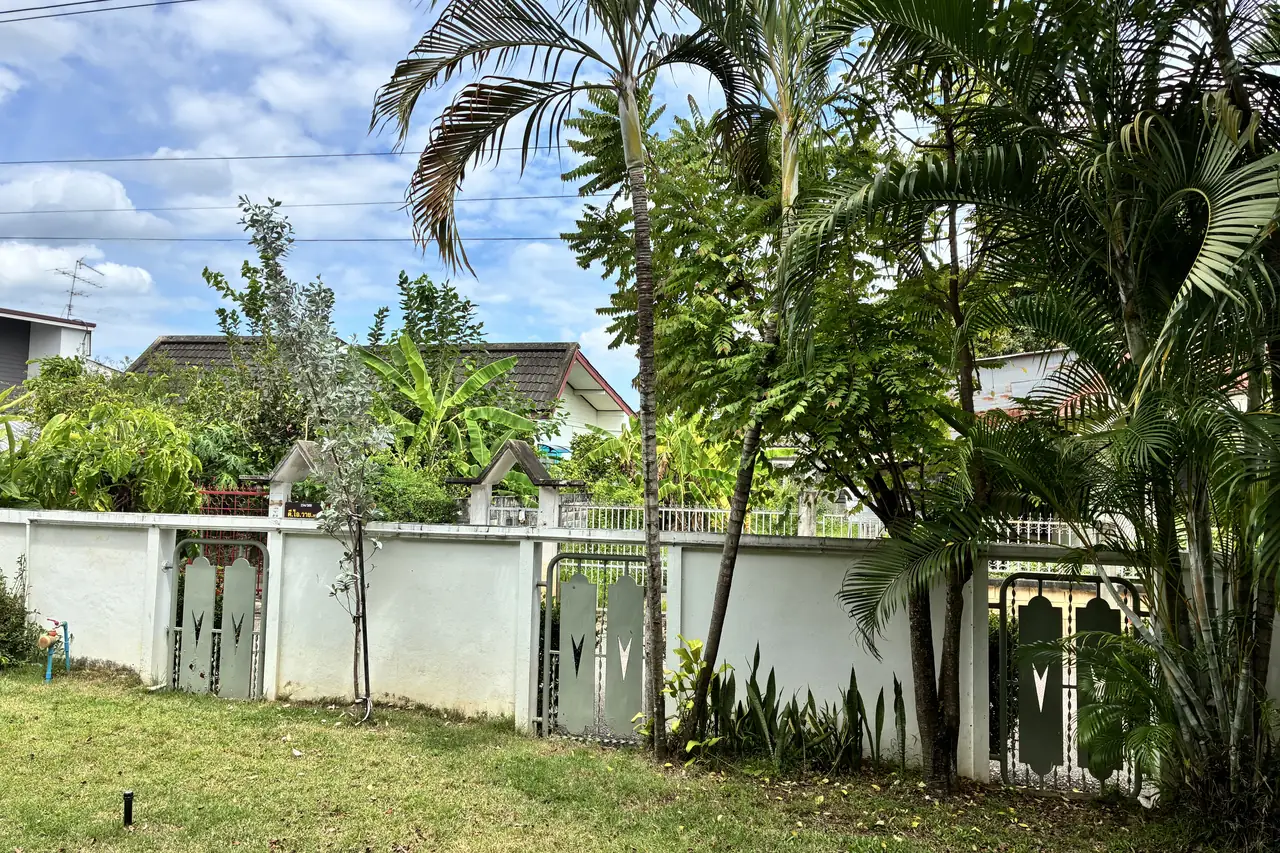
The lanterns he described contained wire. That is the part he keeps returning to. Wire lands on power lines, and when it does it shorts them. He says a power cut somewhere in the area is an annual event, and that fires happen too. He watched one come down on the lines behind the Night Bazaar and saw the sparks and the bang that followed. One has landed on his own roof. The photograph at the top of this piece is one of his — a spent lantern hanging in a tree above a house, in daylight, the way they are found rather than the way they are photographed.

The other half of it is what is left the next morning. Lanterns come down on the hills outside the city and stay there. He has been here long enough to have watched that accumulate.

He also pointed out something I had not thought about: Mr Shimizu said releases used to be free. He described the price at a ticketed venue as being in the thousands of baht. I have not verified whether every current permitted event is ticketed, and I have not seen an official 2026 price list, so I am not going to put a number on it here.

You can take his view or leave it. I found it useful because it is the only account I have from someone who has seen what is left afterwards.

The size of it

The Tourism Authority of Thailand’s Chiang Mai office gave two figures for the 2024 festival, through its director, Patsalin Sawettarat, on 15 November 2024. Hotel occupancy inside the city ran above 90 per cent, and the festival was forecast to generate over 1 billion baht (~US$30.4 million). Thai PBS World put the visitor forecast at more than 300,000 for the same festival.

Hotel occupancy inside the city exceeded 90 per cent in 2024, so rooms can fill early. What a normal month here costs, for comparison, is in our cost of living breakdown.

Where to stay, and the honest limit on what I can tell you

I have never booked a room here during the festival, so I have no festival prices to give you and I am not going to invent any. We live here. What I do have is the rest of the year.

My wife’s parents stayed at the Shangri-La Chiang Mai, booked through Trip.com, and my wife stayed there with them. It is a short walk from the Night Bazaar, and the old city is close enough to walk to; I have done that walk. I did not time it, so I am not giving you a number. The distance is the part that matters on festival nights, when the roads around Tha Phae and the river close or crawl. I have been inside it and inside several of the hotels around it. That is the extent of it: I can tell you what the area is like to be in, not what a room costs on 5 November.

The one thing I would actually insist on is the cancellation policy, not the hotel. The 2026 dates are not published yet. If you book a non-refundable rate now against a date somebody guessed on a blog, you are betting money on that guess. Book a rate you can move, and move it when the province announces.

There is no booking link in this section. We used Trip.com for that stay, but I do not have an affiliate arrangement with any accommodation service, so there is nothing here for me to earn from and nothing for you to click. If that changes, I will say so on this page.

If you are coming anyway

I am not telling anybody not to go. Here is what I would do.

Avoid evening flights on the festival nights. In 2024 the departures after 7pm were the ones that moved; in 2025, airlines scheduled all festival-night flights to finish before 7pm.

Assume you cannot release a lantern where you are staying. The city itself was inside the no-release area in both 2024 and 2025. If releasing one matters to you, that means a permitted venue, booked ahead — and check the current year’s rules rather than mine.

Sort out data before you land. For short trips, an eSIM is what I use. The travel eSIM I use is data-only, so it does not give me a Thai number. That matters when a local service needs to call you. I have written up what I actually pay, and the one that failed on me, in a separate piece.

Airalo
The travel eSIM I use to have data when I land — data-only, so no Thai number

Check what your insurance says about delays and cancellations, not just medical cover. To be straight about our own: my wife and daughter are covered by SafetyWing and I am not. That plan renews every 28 days and was chosen for a longer stay. For a short trip, compare ordinary trip policies as well as long-stay cover, and check what each one says about a delayed or cancelled flight.

If you are thinking about staying rather than visiting, the longer version of all of this is in our guide to moving to Chiang Mai.

FAQ

When is the Chiang Mai lantern festival in 2026?

The date follows the full moon of the twelfth Thai lunar month, so it moves each year. As of 8 August 2026 the Tourism Authority of Thailand had not published the 2026 dates. The province dated the 2025 festival to 5–6 November; Chiang Mai city’s own events ran from 4–6 November.

Can you release a lantern in Chiang Mai city?

Not in 2024 or 2025. Muang Chiang Mai district, which covers the city, was entirely inside the no-release area, as was Hang Dong. The zones are re-issued each year.

What happens if you release one anyway?

On conviction, up to five years’ imprisonment and a fine of up to 200,000 THB (~US$6,080). If it causes a fire, up to seven years and up to 140,000 THB (~US$4,256).

Are flights cancelled during the lantern festival?

Some are. The airport reported 170 cancellations or time changes for 2024, and announced 161 for 2025 as of 31 October. In 2024 the flights affected were the ones scheduled to operate after 7pm on the Friday and the Saturday; for 2025, airlines scheduled all festival-night flights to finish before 7pm.

Is Yi Peng the same as Loy Krathong?

No. They fall at the same time. Loy Krathong is national and goes on the water; Yi Peng is the northern festival and goes in the air. Chiang Mai has both.

Do you need a ticket?

For an organised lantern release, book a permitted venue in advance. I have not seen an official 2026 price list, so I am not quoting a figure, and I have not verified whether every venue charges spectators.

How busy does Chiang Mai get?

Hotel occupancy inside the city ran above 90 per cent in 2024. If you book before the official dates appear, choose a changeable rate.

Have you been?

No. I moved to Chiang Mai in 2026 and November has not come round yet. The festival claims are public records or the resident’s account; the booking and connectivity examples are mine.

Wataru Otsubo
Wataru Otsubo
Founder, Cross Shore

I split the year between Kamakura, Japan and Chiang Mai, Thailand, and write these guides from our own records, our own experience, and named sources. More about me.