THAILAND · CONNECTIVITY
This article contains one affiliate link, to Airalo, at the end. I bought every eSIM below myself, including both Airalo plans, before I had any commercial relationship with them. World eSIM appears here more often than Airalo does and pays me nothing. True is my own carrier and is not an advertiser here in any form. Every price is dated.
Currency: amounts I paid are given in the currency I paid them in. Conversions use the Bank of Japan’s official rate for August 2026 — ¥161 to US$1 and 100 THB to US$3.04, which puts 1 THB at about 4.89 yen — and are there for scale only. Ranges, quotes and future budgets are estimates, not payments.
My Japanese line has stayed at ¥290 (about US$1.80) and 1GB since the day I signed up.
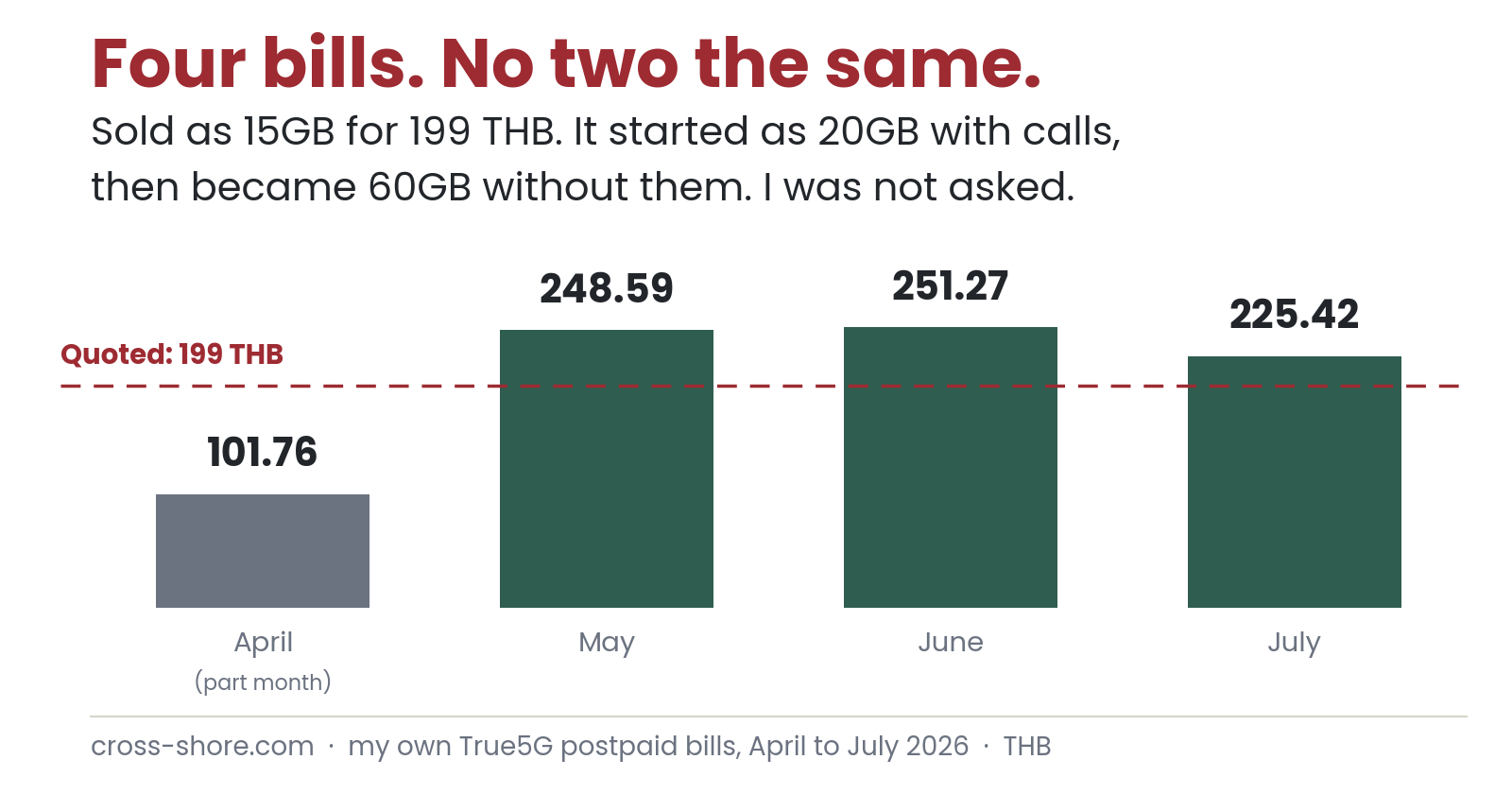
My Thai line was sold to me as 15GB for 199 THB. It began as 20GB with 70 minutes of calls. Three months later, without my asking, it became 60GB with no calls at all. I have four bills from it and no two are the same amount.
The difference was not simply price. It was whether the terms stayed still.
For a two-week trip, compare prices. If you are moving somewhere, price is only one part of the decision.
The plan I was sold, and the plan I have
I signed a True5G postpaid contract in Chiang Mai on 22 April 2026, in the second shop I walked into.
In the first shop, the cheapest option available to me was 50GB for 399 THB a month. In the second, same carrier, same week: 15GB for 199 THB.
The offers available to me differed between the two branches. I do not know why. What I do know is that I would not have found the second price if I had stopped at the first counter. Walk into more than one shop.
Then comes the part I could not have planned for. What I was told is not what started. What started was 20GB with 70 minutes of calls.
At the three-month mark the promotion cycled. I now have 60GB and no call allowance. I did not ask for it and I was not consulted. I found out by looking. The price barely moved.
Here are the actual bills.
| Billing month | Charged |
|---|---|
| April 2026 | 101.76 THB — contract started on the 22nd |
| May 2026 | 248.59 THB |
| June 2026 | 251.27 THB |
| July 2026 | 225.42 THB |
Full months: 225.42 to 251.27 THB. The first was a part month. The three full months average 241.76 THB (about US$7.35).
I could not have told you that from memory. Asked before I opened the app, I would have said “about 220 a month,” and I would have been wrong in all three.
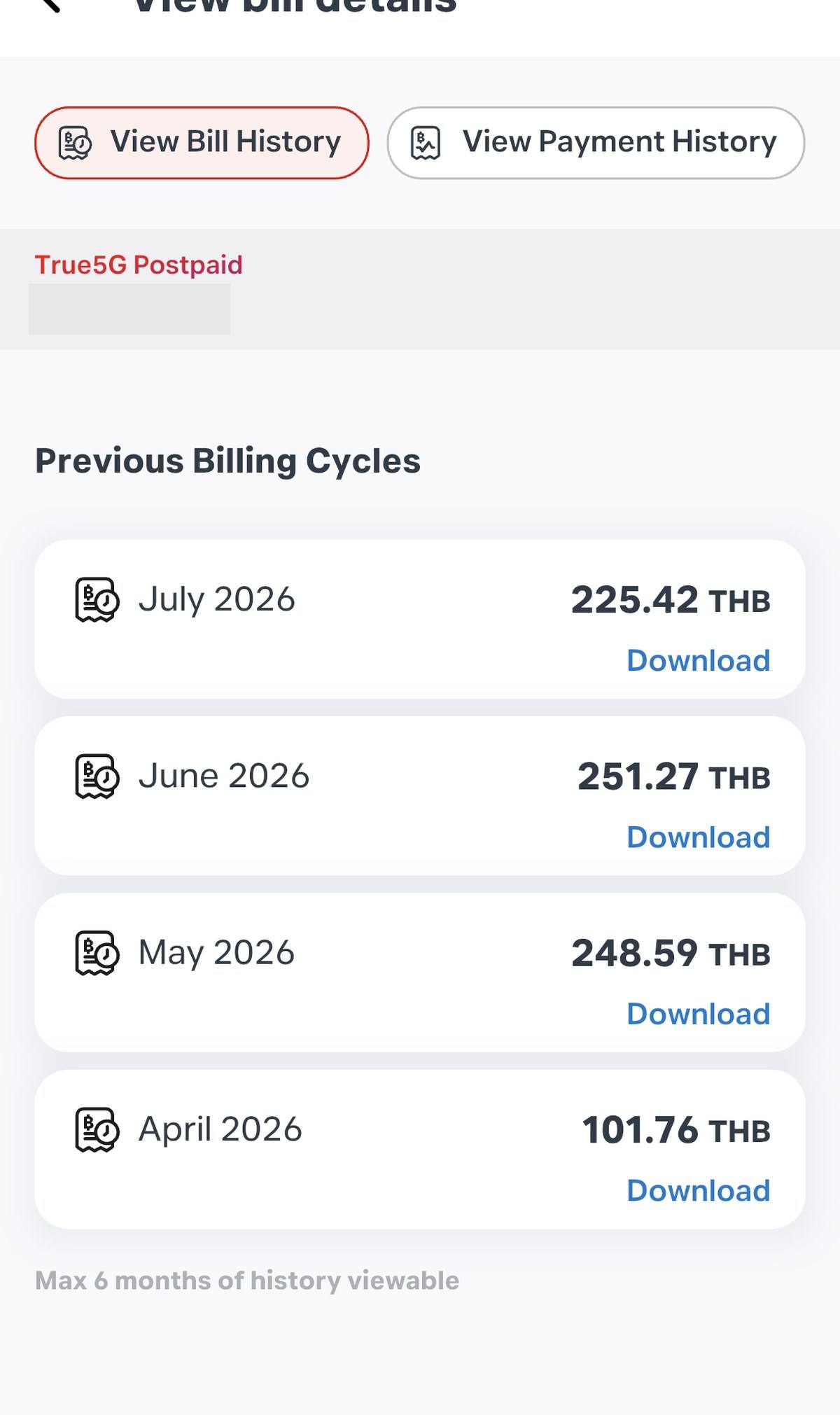
The line has worked every day since April. Its price and data allowance have matched the bills I received. The thing worth noticing is narrower, and it is about me: I had been carrying a number in my head that was not in any of my bills.
Why 20GB was not enough
I work remotely, often away from the house. The laptop I work on runs a virtual desktop, and it is configured not to join public Wi-Fi.
I set that up myself. I run the company, so there is nobody else to blame for it. Café Wi-Fi, airport Wi-Fi, hotel Wi-Fi: all of it is off the table, by my own decision.
For someone in that position, mobile data is not entertainment. It is the desk.
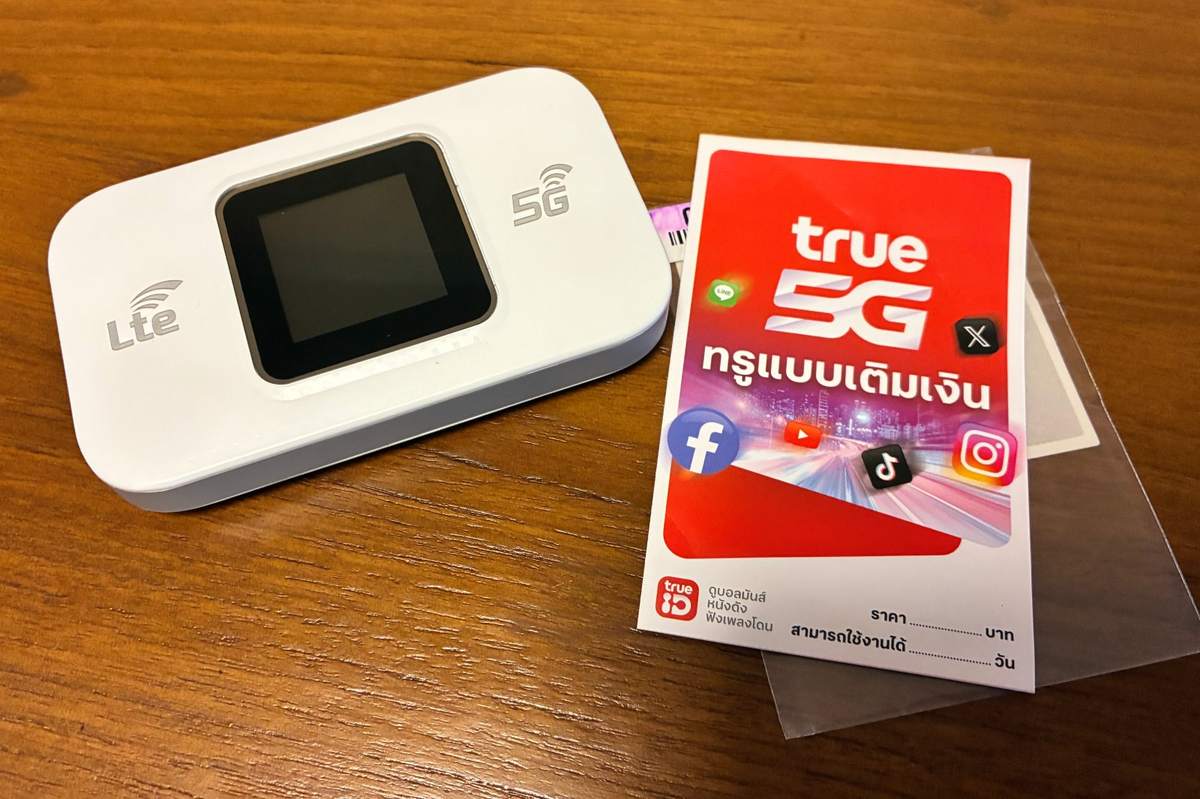
So I bought a pocket Wi-Fi from Lazada and put an annual SIM in it.
| Listed | Paid | |
|---|---|---|
| Pocket Wi-Fi router (4G/5G) | 770 THB + 38 THB shipping | 367.50 THB |
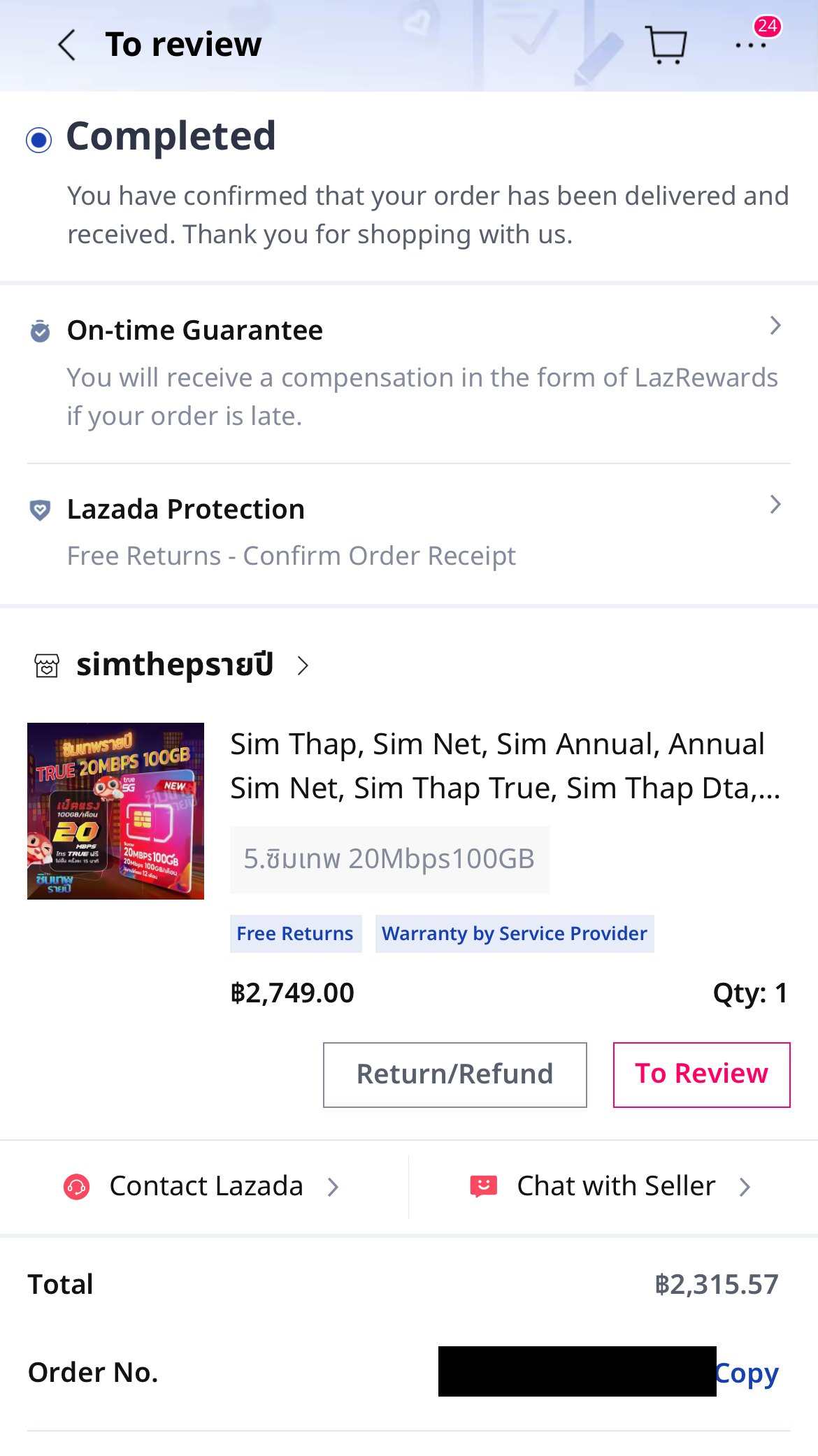
| Annual SIM — 100GB a month, capped at 20Mbps, 12 months | 2,749 THB | 2,315.57 THB |
On this order, three vouchers stacked and cut the listed router price by more than half.
The annual SIM works out at 192.96 THB a month. Add the router across the first year and the whole rig is 223.59 THB a month for 100GB.
The carrier line averages 241.76 THB for 60GB.
So in the first year the pocket setup costs 18.17 THB a month less and includes 40GB more data. But it is capped at 20Mbps, and it has no phone number. The two are not equivalents, and I am not declaring a winner between them. I am pointing at the fact that the thing I bought because the first one was not enough turned out to be the cheaper of the two.
What I hold now, in two countries
| Thailand — where I live | Japan — where I go back to | |
|---|---|---|
| The number | True5G postpaid. Full months 225.42–251.27 THB. Now 60GB, no call allowance | Nihon Tsushin “Gouriteki Simple 290”. ¥290 a month, 1GB, calls billed by the minute |
| Working data | Pocket Wi-Fi with an annual SIM. 192.96 THB a month, 100GB, capped at 20Mbps. Router was 367.50 THB once | Airalo eSIM. US$17.00 for five days, unlimited |
| At home | True fixed line, 552 THB a month | — |
The Japanese line is the one that has not moved. ¥290, 1GB, every month, no promotions cycling through it. When I am in Japan I switch the Thai line off — I have never checked what roaming on it would cost, so I am not going to put a number on it.
That ¥290 line is mainly a phone number. It is a number, and almost nothing else. 1GB will not run a working day. The data comes from a five-day eSIM I buy each time I fly. Stable and cheap, but only because I am not asking it to do very much.
What a number is for
If data is all you need, a number is dead weight. The trouble is that you do not find out which one you needed until you need it.
Here is the one case where a Thai number was clearly the thing that mattered. My wife applied for a Thai bank account, and among the documents requested was a letter from a mobile operator, in English, confirming the line was hers. The bank accepted the letter from our carrier. I did not test whether a prepaid provider could issue an equivalent.
Separately — and this is about connectivity rather than about which number you hold — everyone we have had to deal with here uses LINE, not WhatsApp. Our landlord, our daughter’s school, the shop that sold me my motorbike. I cannot tell you that holds for the whole country; it has held for every arrangement we have made.
On 4 August my motorbike would not start. Key left in the ignition overnight, battery flat, eight in the morning. I messaged the second-hand shop I bought it from on LINE at 8:30. The reply was two words: send location. He arrived at about ten, changed the battery in ten minutes, and charged 400 THB including the call-out. We do not share a language; it was broken English on both sides.
That is a good morning rather than a bad one. But the whole thing ran on a messaging app and a working data connection. It shows that losing connectivity here can make practical problems harder to solve. The bank application is my clearest case of a local number being useful; it does not prove that every bank requires one.
What I have actually paid for eSIMs
Six receipts, four countries, two providers, four months. All of them are mine.
| Date | Provider | Country | Plan | Paid | Per day |
|---|---|---|---|---|---|
| 16 Apr 2026 | World eSIM | Thailand | Unlimited, 5 days | ¥1,240 | ¥248 |
| 16 Apr 2026 | World eSIM | China | Unlimited, 2 days | ¥770 | ¥385 |
| 16 Apr 2026 | World eSIM | China | Unlimited, 1 day | ¥379 | ¥379 |
| 28 May 2026 | World eSIM | South Korea | Unlimited, 1 day | ¥891 | ¥891 |
| 28 Jun 2026 | Airalo | Japan | Unlimited, 5 days | US$17.00 | US$3.40 |
| 5 Aug 2026 | Airalo | China | Unlimited, 5 days | US$19.00 | US$3.80 |
This is not a price comparison and I want to be blunt about that. Different countries, different durations, different currencies, different dates. I have never bought the same country and duration from both providers, so these receipts cannot rank them.
The closest two lines I have: the same provider charged ¥379 for one unlimited day in one country and ¥891 for one unlimited day in another. More than double. The prices differed by destination in these receipts, but the dates and plan details also differed. Six receipts do not isolate the reason.
And notice what this table does that my carrier bill does not. In all six of my purchases, the price was agreed before I paid and did not move afterwards.
The one that stopped working
Both providers work the same way. You buy before you fly, and the QR code arrives as soon as the payment clears.
In April, flying to Thailand, I installed the eSIM while I was still in Japan. I landed, and it did not connect. It started working about a day later. I never established the cause.
I did not contact support — I have never contacted support at either company, which is also why I cannot tell you anything about how good it is.
Since then I install after I land, on the airport Wi-Fi. That is what I do. It is one dated failure with no diagnosis, not evidence that installing early is generally unsafe.
What I would actually check, having read the terms properly afterwards: installing an eSIM and starting its validity period are not the same event. Airalo’s own documentation says that for most plans the validity period begins when the eSIM connects to a supported network, but that some plans start as soon as it is installed — and that the policy is shown in the package details before you buy. (Checked 6 August 2026.)
So the useful instruction is not “install late.” It is: read the plan’s validity policy before you pay, and install it somewhere with a stable connection.
What an eSIM does not get you
One thing an eSIM will not solve, anywhere.
Japanese video services — NHK Plus and TVer — state that viewing is limited to Japan. A travel eSIM does not guarantee access to services restricted to Japan, and that is as true in Thailand as anywhere else. (Checked 6 August 2026.)
If it matters to you, solve it separately and do not expect a data plan to do it.
The invoice format matters
If you are running a company, the piece of paper matters as much as the price.
The World eSIM invoices I hold are issued by a Japanese company, Vision Inc., addressed to my company, and carry a Japanese qualified-invoice registration number.
The Airalo receipt I received was addressed to me personally and did not show a Japanese qualified-invoice registration number. It is a perfectly real receipt. It is not the same document.
To be precise about what that does and does not mean: claiming something as a business expense and holding a qualified invoice for consumption-tax purposes are two different questions, and a company registered outside Japan can be a registered qualified-invoice issuer. If you need a Japanese consumption-tax input credit, ask whether the provider issues a qualified invoice. Expense treatment is a separate question. Check the format before you buy, not after.
What I would do
A few days somewhere. An eSIM. Unless something you are doing needs SMS verification or a local contact number, data is enough, and the price is agreed before you buy.
A few weeks to a few months. An eSIM, and a local number only if something you are doing requires one — a bank, a lease, a delivery that has to reach you.
Moving there. If an institution asks for proof of a local number, check what type of line it accepts before you sign. Ask in more than one shop before you sign — the first shop I tried started at 399 THB, the second at 199, same carrier, same week. And do not build your data plan around the allowance you are quoted at the counter. Mine was described as 15GB, started as 20GB, and is now 60GB, inside four months. Buy for what you need this month and expect to revisit it.
If you cannot use public Wi-Fi, price a second connection from day one. That constraint changed my whole setup and it is invisible from the outside.
Expensing it. Check the invoice format first.
Buying an Airalo eSIM. Read the validity policy in the package details before you pay — whether the clock starts on installation or on first connection is stated there, and it decides where you should install it.
This is an affiliate link. I bought both Airalo plans in this article before I had any relationship with them.
Questions people ask
How much does a Thai SIM cost per month? I have a carrier contract and I still cannot give you one number. My full months have run 225.42 to 251.27 THB; the first was a part month at 101.76. The plan itself changed from 20GB with calls to 60GB without, at the three-month mark, without my asking. If you see a single monthly figure quoted anywhere, ask how many bills it is based on.
Do I need a local phone number, or just data? Data, unless something specific requires a number. The clearest case I have is my wife’s Thai bank application, which asked for an English letter from a mobile operator. The bank accepted the letter from our carrier; I did not test whether a prepaid provider could issue an equivalent.
Should I install my eSIM before I fly? Read the plan’s validity policy first. Airalo’s own documentation says most plans start counting when the eSIM connects to a supported network, but some start on installation, and the package details say which. (Checked 6 August 2026.) I installed one early in April 2026 and it did not work when I landed; it recovered a day later and I never established why. That is one undiagnosed failure, not a rule.
How much does an eSIM actually cost? Mine, over four months: ¥379 to ¥891 for a single day, ¥1,240 for five days in Thailand, US$17.00 for five days in Japan, US$19.00 for five days in China. The receipts differ in country, duration, provider or date, and no pair across the two providers matches on all four. The closest comparison I have is the same provider charging ¥379 for one unlimited day in one country and ¥891 in another.
Which is cheaper, Airalo or World eSIM? I cannot answer that from my own receipts and I am not going to pretend otherwise. I have never bought the same country and duration from both. What I can say is that four months in, I still buy from both.
Will an eSIM let me watch Japanese TV services abroad? Not reliably. NHK Plus and TVer state that viewing is limited to Japan, and a travel eSIM does not guarantee access to services restricted to Japan. That is true everywhere, not just in one country. (Checked 6 August 2026.)
Does the provider issue a Japanese qualified invoice? That is the question to ask, and it is not the same as asking whether you can expense it. The World eSIM invoices I hold carry a Japanese qualified-invoice registration number. The Airalo receipt I received did not. A company registered outside Japan can be a registered issuer, so check the actual document rather than the company’s country.
What is first-hand here, and what is not
First-hand, with documents I hold: the four True5G bills (April–July 2026), the pocket Wi-Fi and annual SIM purchases, the eSIM receipts in the table, the failed connection after arrival in April 2026, my wife’s bank document, the motorbike battery on 4 August 2026, the invoice formats.
First-hand but not documented: the two shop quotes in April 2026 — 50GB for 399 THB at the first counter, 15GB for 199 at the second. Those are my account of two conversations and I hold no paperwork for either. What I do hold is the contract that followed and four bills.
Checked on 6 August 2026: Nihon Tsushin’s “Gouriteki Simple 290” terms on the operator’s own site. Airalo’s help documentation on when a package’s validity period begins. TVer’s and NHK Plus’s own pages stating that viewing is limited to Japan. Japan’s National Tax Agency pages on qualified-invoice registration for non-resident businesses, and on input tax credit.
Not verified and not claimed: roaming charges on my Thai line; whether a prepaid data SIM would satisfy a Thai bank; the quality of either eSIM provider’s support, which I have never contacted; why the offers differed between the two shops.
→ Related: what we actually pay to live in Chiang Mai, including the ¥128,284 a month we still owe in Japan, and what it costs to move money into Thailand.

I split the year between Kamakura, Japan and Chiang Mai, Thailand, and write these guides from our own records, our own experience, and named sources. More about me.
→ More on this: all our guides on daily life in Chiang Mai.