THAILAND · MONEY
This guide contains affiliate links. If you buy through them I may earn a commission at no additional cost to you, and I only recommend things I have used myself.
Thailand runs on QR payments. At a market stall, in a taxi, at the shop on the corner, you scan a code and the money leaves your account instantly. It is faster and cleaner than anything I used in Japan — and I cannot use it. The visa I came here on did not get me a Thai bank account at any branch I tried, and without one the ordinary QR rail is shut. Sending money to Thailand turned out to be possible anyway, without opening my own Thai account. Here is exactly how, what each step costs, and the one thing I would do differently.
The bank account problem, and where it actually bites
I have a DTV, a five-year visa aimed at remote workers. Every bank branch I approached in Chiang Mai declined to open an account on it. Krungsri’s foreign currency deposit page excludes Tourist VISA customers, but I do not have a verified rule covering every bank or account type. Take this as what happened at the counters I stood at.
This is not a rumour or a bad branch, but it is also not one rule applied everywhere. Below is what I could document, and where I am only reading a pattern I have said so.
There is a documented reason for this, and there is my own read of it, and they are not the same thing.
The documented one. What the Bank of Thailand has actually published is a crackdown on mule accounts. In its January 2025 press release it requires banks to expand “the suspension of outgoing transfers and the refusal of new account openings to include accounts with a high risk of being mule accounts, even if they have not yet been reported as causing damage,” and to share lists of individuals showing suspicious behaviour. Nothing in it mentions foreigners, tourists or any visa class. So take the next sentence as my experience rather than as the rules: the branches I dealt with asked for documents a DTV does not produce, they treated my DTV as tourist-class, and the DTV holders I have compared notes with got the same answer. I found no published policy from any bank that names the DTV.
My own read, from a household that happens to hold one of each visa, is narrower, and I offer it as a rule of thumb rather than a rule. The visas that get you an account tend to be the ones whose extension requires a Thai balance. The DTV asks you to prove 500,000 THB once, at application, and a foreign account satisfies that. The visa does not require you to hold the funds in a Thai account. My wife’s education visa is the opposite: when she extends, immigration wants to see a balance in a Thai account. The requirement creates the account.
That is not the whole story. But it predicted our two outcomes, and if having a Thai account matters to you, it belongs in your visa decision rather than your after-arrival to-do list.
→ If you are still choosing, this is covered in my first-hand DTV visa guide.
What my wife’s attempt actually looked like
She got the account. It took three visits.
She went to Siam Commercial Bank, Central Chiang Mai branch, with her passport, a letter from the school, her TM30 receipt and a copy of her e-visa. She took a numbered ticket, waited about an hour, and reached a counter where we had limited shared English.
The answer was not no. It was “come back in two weeks.” At the second visit came a request for the original passport and an English-language document from the SIM card provider, neither of which had come up the first time.
What settled it, on the third visit, was bringing our daughter. The visa exists because she is at school here, and the school letter is a piece of paper making a claim about a child. So we brought the child. I am not going to tell you that is a documented requirement, because it is not one. It is what worked at that counter on that day.
I want to be fair about what those three visits were. The document list changed between visits. I do not know whether the fraud measures caused it — the Bank of Thailand’s published measures are about mule accounts and say nothing about foreign customers at a counter. The bank did not refuse her at any point. It asked for more, and then it opened the account.
Because the document list changed between visits, we now keep a written record of every one. A single sheet listing what you handed over and what you were asked to bring next can save you from starting again with each new officer. We learned that the slow way.
What you actually lose without an account
One thing, and it is bigger than it sounds: PromptPay.
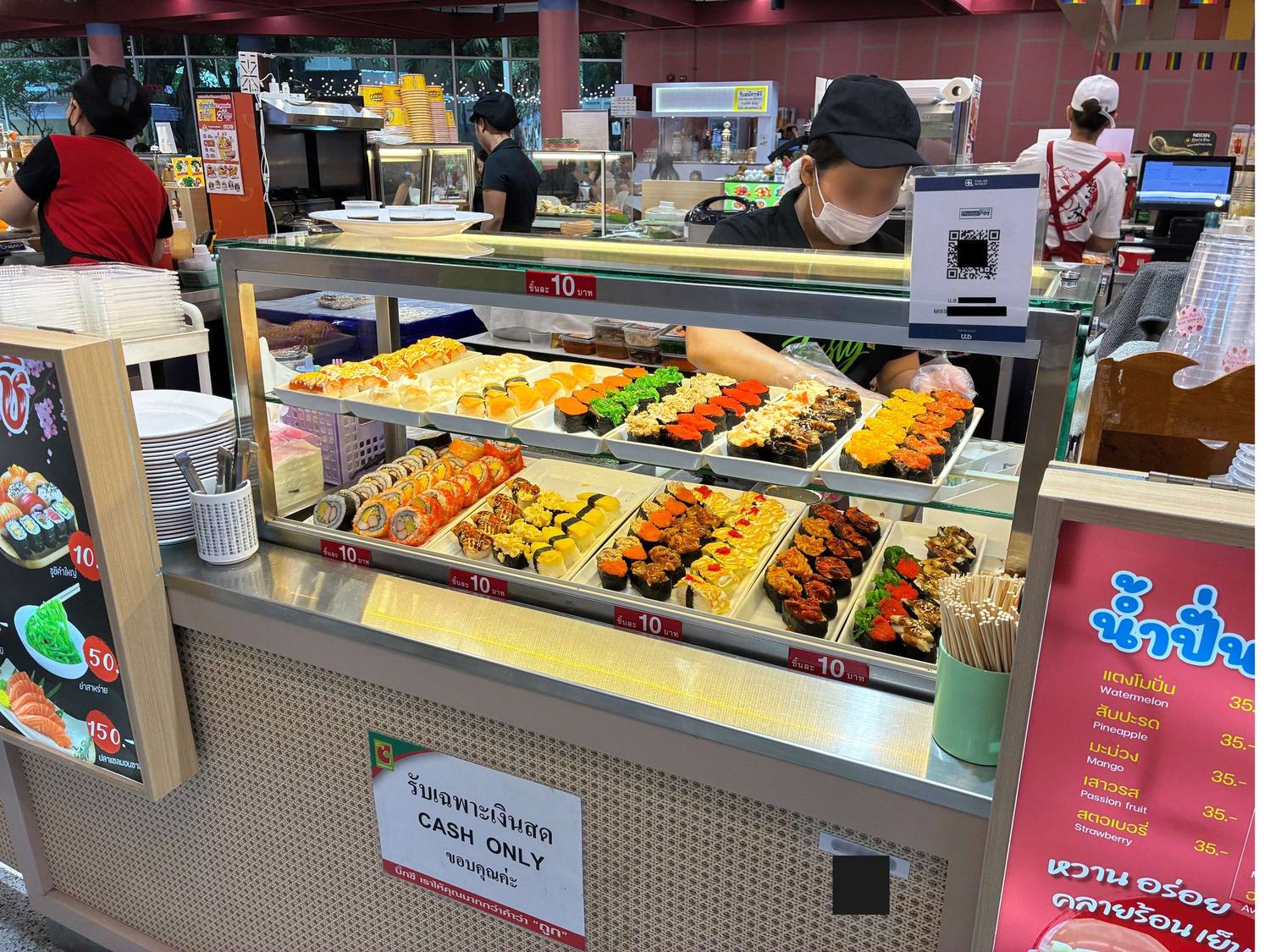
Thai QR payment is not a niche convenience. It is the default. Street food, songthaews, the hardware shop, small restaurants — you scan the vendor’s code and it debits your account. Think of it as the bank-account version of a tap-to-pay wallet, and assume it is everywhere.
I could not use ordinary PromptPay through my Japanese accounts, and it is worth being precise about why. Two different things get called PromptPay. One is registering to receive money — the Bank of Thailand describes that as linking an existing bank account to a citizen ID or a phone number. The other is paying a shop by scanning its QR code, which you do inside a Thai bank’s own app. It is the second one I cannot do, and the reason is simply that I have no Thai bank account and therefore no Thai banking app to scan with. (Bank of Thailand, checked 6 August 2026.)
There are routes in for visitors, and I went and read the terms rather than assuming. They are narrower than they look. Cross-border QR links work if you bank with a participating bank in one of several Asian countries. Visitor wallets exist, and the one most often pointed at people without a Thai account is Moreta — whose own help centre says Thailand QR has been paused for all users since 29 June, with an exception only for holders of a US or Canada passport, and even for them only for business QR codes. Personal PromptPay QR is not supported for anybody. Moreta says it is working to restore the service and has not published a date. The page was last updated 29 June 2026; I checked it on 10 August 2026.
That last point is the one that matters on the ground. The code taped to the counter at a market stall or handed to you by a songthaew driver is usually a personal one. And none of these routes does the job this article is about, which is putting money into a Thai person’s bank account.
For daily spending we are back to cards and cash, in a country that is steadily moving away from both.
Sending money to Thailand without a Thai bank account
Here is what I did not understand before we moved.
Not having a Thai bank account does not stop you sending money to one. It stops you holding baht in Thailand and it stops you using QR. But when a Thai person or business gives you their account details, you can transfer straight into it from a multi-currency account abroad.
That is how we have made almost every large payment so far.
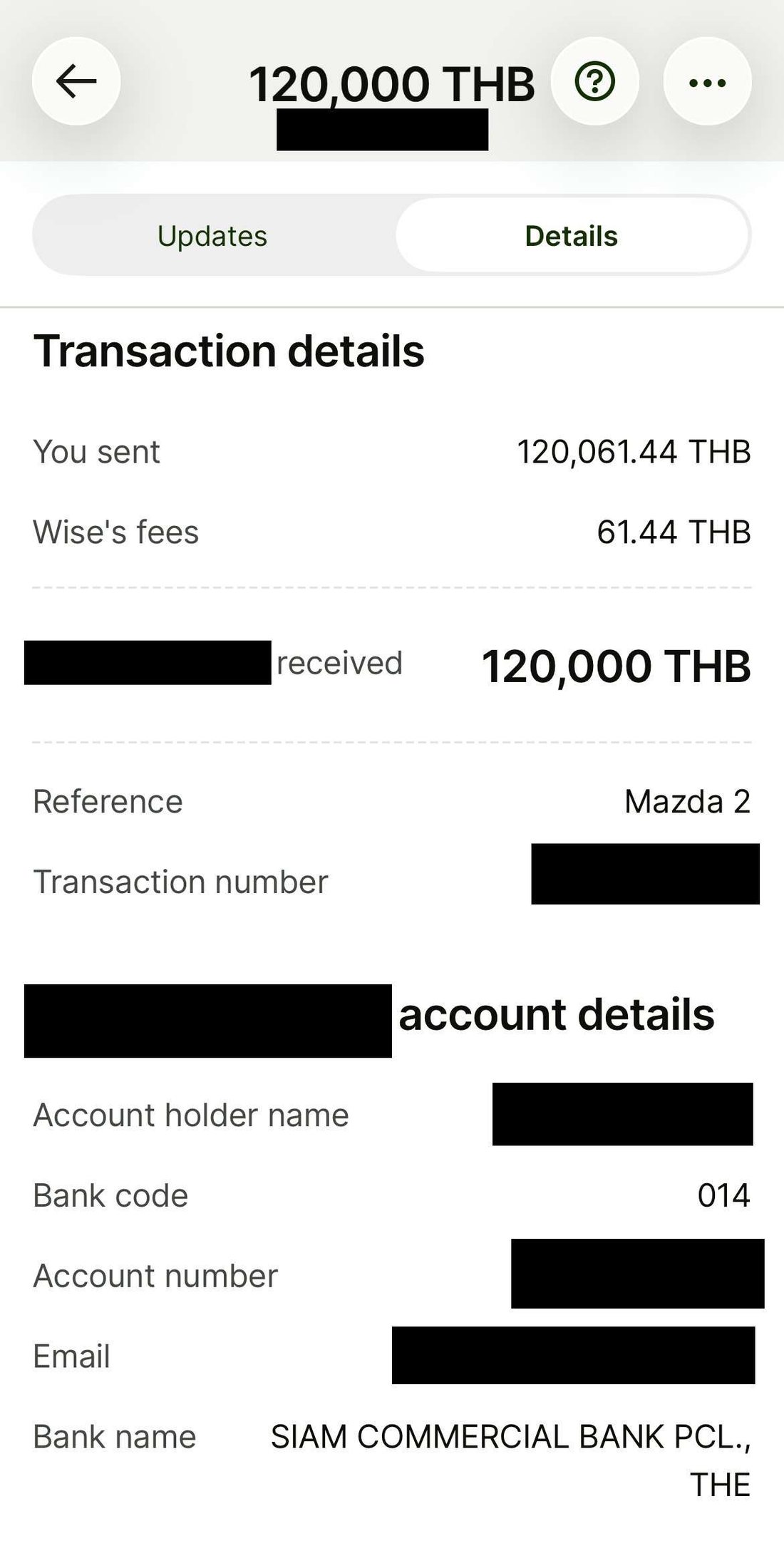
We bought a used car for 120,000 THB, and I sent it directly to the seller’s Thai account. I could not finance it. Car loans here generally want a work permit, a Thai bank account and often a Thai guarantor, and on a DTV I have none of those, so for me it was the whole amount at once. But “pay it all at once” and “hand over a brick of banknotes” turned out to be different problems. From next month our rent goes the same way, straight to our landlord’s account.
Wise charged me 61.44 THB to send that 120,000 THB from my baht balance to the seller’s Thai account. That is 0.051% of the payment — but the fee has a fixed component, so it will not stay at that percentage on a different amount. It is one receipt for one transfer, not a rate. Against carrying the equivalent in cash across a border, it was not a close call.
The four layers we actually use
| Layer | What it is for | Where it fails |
|---|---|---|
| Transfer to a Thai account | Big payments — a car, rent, anyone who gives you bank details | The recipient needs an account; you cannot receive this way |
| Multi-currency card | Anything that takes cards — Grab, supermarkets, online | Not accepted at stalls or by small vendors |
| Cash (baht) | Markets, tolls, and anyone informal | Bulky, and you need a good rate to get it |
| QR (PromptPay) | Everything, if you have a Thai account | Closed to us in the ordinary way |
What it costs to get yen into baht
This is the part people get wrong, because they compare exchange rates and ignore the fees, or compare fees and ignore the rate.
Here is what mine actually cost, in three steps:
| Step | Fee |
|---|---|
| Japanese online bank → multi-currency account, in yen | Free |
| Converting 100,000 yen to baht | 931 yen — about 0.9% |
| Sending baht on to a Thai bank account | 61.44 THB on 120,000 — one transfer, not a rate |
The middle row is the real cost. Moving yen out of my Japanese bank is free, and it feels like the whole transfer is free — but the conversion is where you pay. 931 yen on 100,000 yen, or about 0.93%. I move roughly that much every three weeks, which comes to somewhere around 16,000 yen a year in conversion fees. Not nothing, and worth knowing before you assume it is free.
There is a bigger problem with carrying 0.9% around as the number: it is not one number. Wise does not publish a fixed rate. Its pricing page for customers in Japan says only that the fee varies by currency and starts at 0.73%. On 8 August 2026 its own calculator quoted me three very different rates within a few minutes: 336 JPY on a 10,000 JPY transfer (~US$62) — 3.36%; 10,245 JPY on 1,000,000 JPY (~US$6,200) — 1.02%; and 129,394 JPY on 20,000,000 JPY (~US$124,000), which is 0.65% after a large-amount discount. The percentage falls as the amount rises. If you send small sums often, you are paying near the top of that range rather than the bottom.
The discount at the top end is published, and it is tiered rather than all-or-nothing: Wise says you “pay our standard fee on the initial portion” and that lower percentages “apply automatically only to amounts in higher threshold brackets”. For a profile registered outside the listed countries — Japan is one — the volume is tracked in USD, and the first bracket starts above 25,000 USD in a calendar month. (Checked 11 August 2026.) That is far above anything I move for ordinary living costs, but it changes the arithmetic if you are sending money for a house or a car.
Wise also shows a comparison against other providers inside the app, and I will give you the figures with the health warning attached: this is Wise’s own table, and I earn a commission if you open an account through my link. Read it as a starting point rather than an audit. On 8 August 2026, sending 1,000,000 JPY (~US$6,200) to a Thai bank account, my screen showed this.
| Service | Baht received | Difference |
|---|---|---|
| Wise | 207,378.42 THB (~US$6,300) | — |
| SMBC | 205,506.73 THB | −1,871.69 THB (~US$57) |
| MUFG | 204,584.44 THB | −2,793.98 THB (~US$85) |
| PayPal | 198,847 THB | −8,531.42 THB (~US$259) |
That is one route, one amount, one day, on the provider’s own comparison, and Wise publishes how it collects those figures. If the gap matters to you, get a quote from your own bank on the same day and compare the amount that actually lands, because that is the only number either of us can act on.
The third row is the cheap one, and it is the one that surprised me. Landing baht in a Thai account cost me 61.44 THB on a 120,000 THB transfer — about 0.05%, low enough that it stops being a decision. It is how the car got paid for and how the rent will be paid from next month.
One caveat on that 0.05%, because it is the kind of number people carry over to their own situation. A smaller transfer will not necessarily come out at the same percentage, and Wise does not publish a breakdown for this leg, so I cannot tell you how it scales. That is one receipt for one amount, not a rate. Check yours against the amount you are actually sending.
One more thing my app told me at the point of sending, which I have not found written down elsewhere: how much you can send in one go depends on which Thai bank is receiving it. On 8 August 2026 my screen showed a ceiling of 2,000,000 THB (~US$60,800) to Kasikornbank and Bangkok Bank, 1,499,999 THB to Siam Commercial Bank, and 500,000 THB (~US$15,200) to every other bank. That is what my account displayed on that day rather than a published rule I can point you to, so check your own before you plan a large payment around a particular bank. It is a small irony that the bank which would not open an account for me is also the one I can send the most to.
Where cash still wins, and where it hurt
Cards and apps do not cover everything here, and the gaps are expensive if you meet them unprepared.
Find a licensed exchange office and compare its live rate before each large exchange. On a scouting trip in April, before we moved, a local told me where to change money. That single piece of advice has probably saved me more than any app. The airport and tourist-strip counters I checked on that trip were noticeably worse. The one we use is V.K. Currency Exchange in Chiang Mai. They have paid me nothing, given me no preferential rate, and have no connection to this site. It is simply the shop a local sent me to. Find your equivalent before you need it, not on the day you need it.
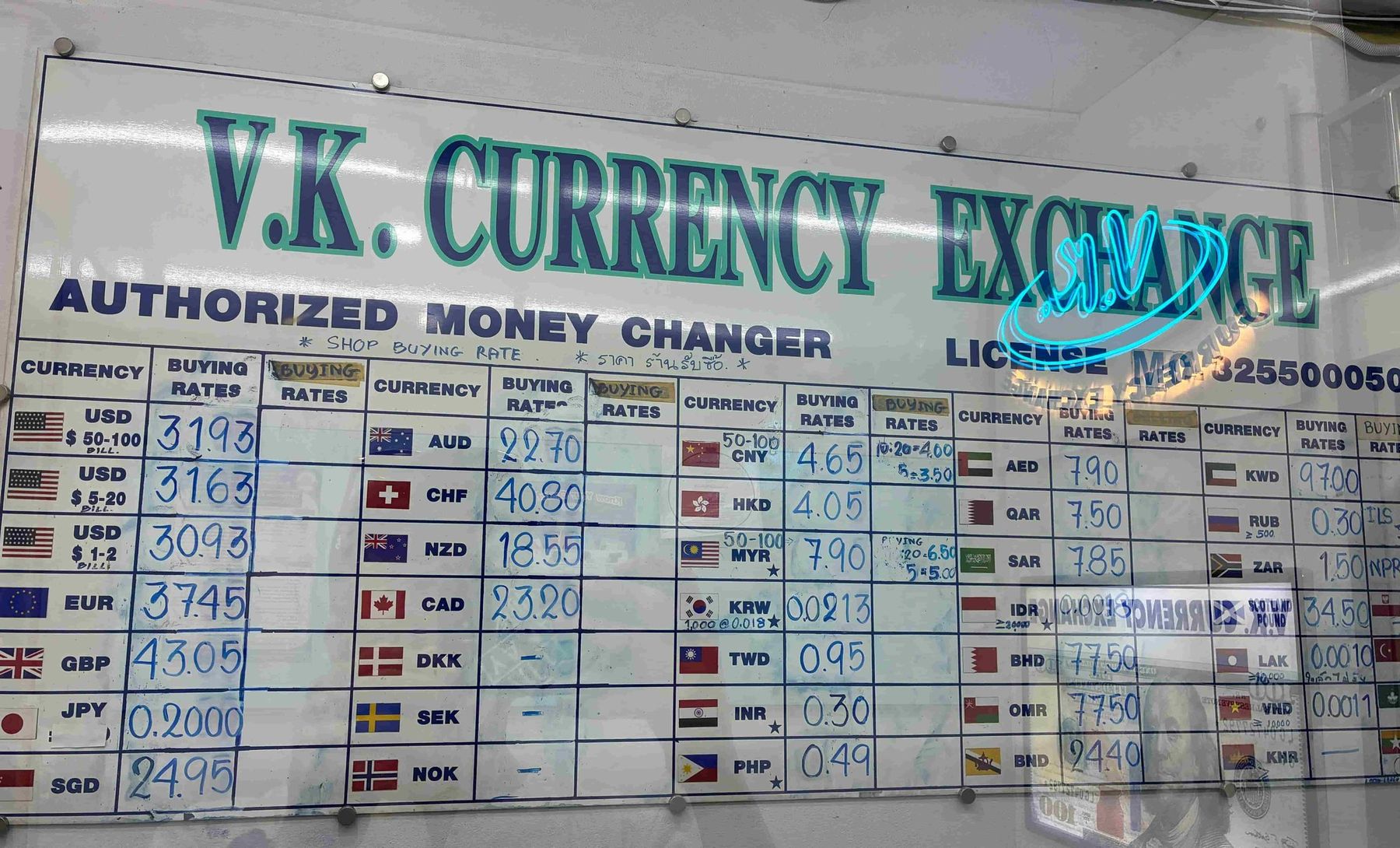
Here is what that actually bought me. On 21 April I changed 1,000,000 yen and received 200,000 THB — an effective rate of exactly 5.00 yen to the baht. Against a mid-market reference of 4.9521 for that day, what I received was 0.96% below it. That is a spread, not a commission anyone quoted me. I did not retain a primary-source mid-market quote for that day, so the 0.96% is a reconstruction and not something I can show you the source for.
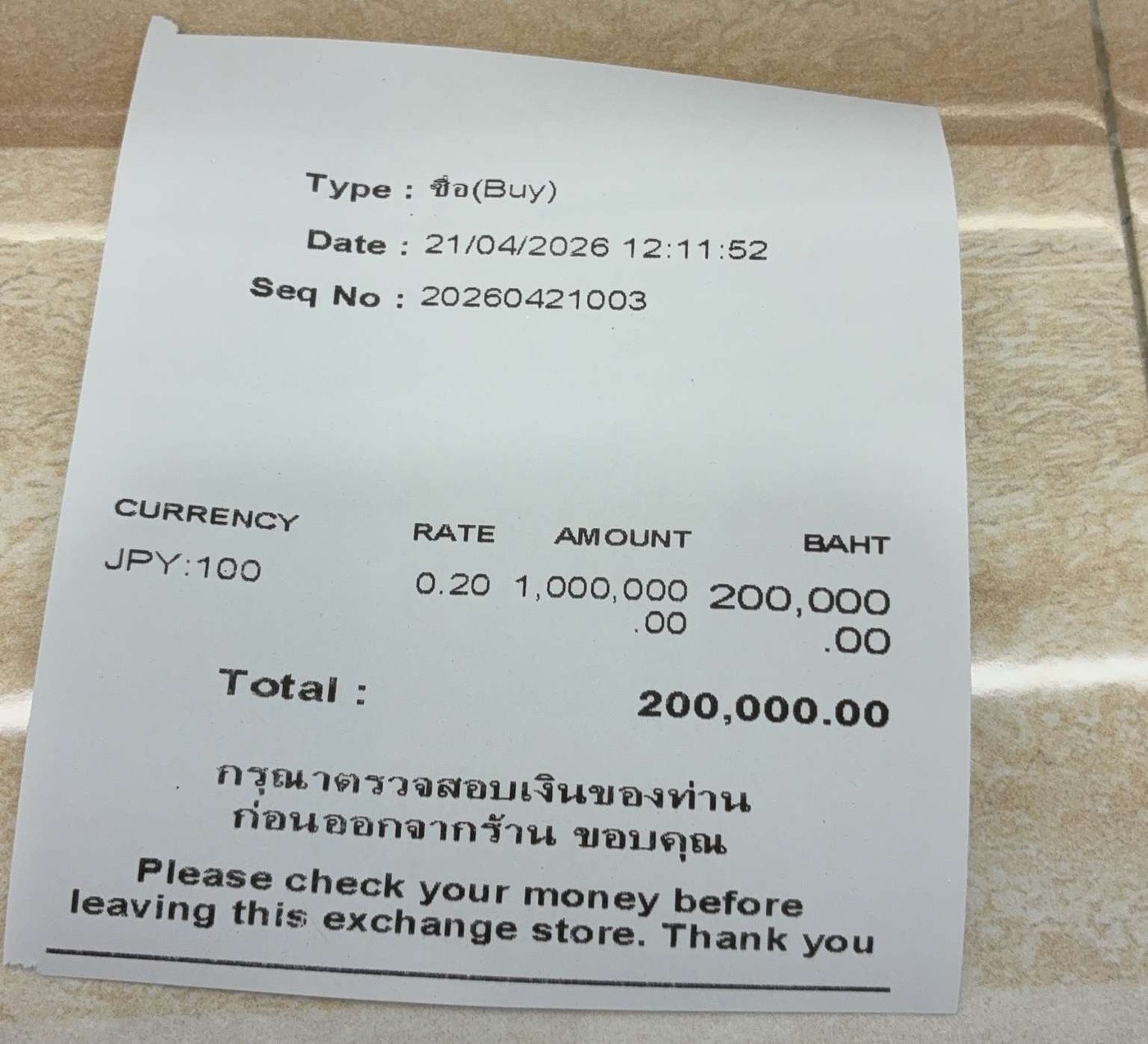
I expected that to look bad next to the app, and I cannot show you that it does. I did not get a one-million-yen quote from my multi-currency account that day, and the 0.93% I pay on a 100,000 yen conversion is not a figure I can stretch to ten times the amount — fees move with the size of the transfer. So I am not going to manufacture the comparison, and I am not going to give you a difference in baht.
And that is the useful part. The choice is about what the money has to do next. Cash for the market and the toll booth; a transfer for anything with a bank account behind it.
And here is the mistake I actually made. We paid 125,000 THB up front to move into our house — a 50,000 THB deposit plus three months’ rent — in cash. Physical notes, changed on that April trip and carried over. The look on the agent’s face suggested nobody had handed over that much paper in a while.
I did not need to. Our landlord has a Thai account. The same provider charged me 61.44 THB to move 120,000 THB two months later, and I never asked for a quote on 125,000 — so I am not going to put a number on the transfer I did not make. What I can tell you is that I chose the brick of banknotes over a transfer I had not even priced. I did it the hard way because I had assumed that not having a Thai account meant not being able to move money into Thailand at all — and that assumption was simply wrong. From next month the rent goes by transfer.
The three toll booths I hit wanted cash, because I had not set up an electronic pass. Thailand has them — Easy Pass, M-Pass, M-Flow — and that is a thing to sort out before a long drive rather than at the barrier. When our dog could not fly and we ended up driving 800 km from Bangkok, I had neither the pass nor notes in reach. If you drive out of Bangkok without one, have cash in your hand, not in your bag.
Grab is the exception that works. Rides and food are settled entirely in the app on a card — no cash, no QR, no Thai account. An 83 THB ride goes through exactly like a 2,807 THB hardware-store run.
What I would tell someone arriving next month
Treat bank-account access as part of your visa decision, but expect branch-level variation. It was not a paperwork problem I could solve on the ground — but the answer moved between branches and between staff, so do not read my outcome as a rule.
Do not confuse “I cannot open an account” with “I cannot move money here.” They are different problems, and mixing them up cost me a nervous afternoon carrying 125,000 THB in notes. Ask for bank details before you assume anything needs to be paid in cash.
Set up your multi-currency account before you fly. Identity verification is far easier while you still have a registered home address and your documents in one place. Doing it from a hotel in a new country is a bad first week.
Change enough cash for the informal edge, and no more. Markets, tolls, small vendors. The large payments almost certainly have an account behind them.
Assume you will be quoted different answers by different people. Keep a written record of every document you have handed over. This applies to banks, immigration and schools equally.
Do not plan around QR until you know your visa gets you an account. QR is what most day-to-day payment here runs on, and it is the part my visa has not got me access to.
- Moving yen out of my Japanese bank costs nothing — the fee lands on the conversion, at about 0.9%.
- You can pay into a Thai account without having one — my 120,000 THB car payment cost 61.44 THB to send. It is how the car was paid for and how the rent goes from next month. The fee has a fixed part, so check the figure against your own amount rather than mine.
- The card covers Grab, supermarkets and anything that takes cards. Markets, toll booths and small vendors still want cash — but between the card and the transfers, our household functions on a visa that cannot open a local account.
- Set it up before you fly. I verified my identity while I still had a registered address in Japan, and it cost me nothing to do it early.
→ Related: how I actually got the DTV visa, what a family of three spends here each month, and what long-stay health insurance costs.
FAQ
Can you open a Thai bank account on a DTV visa?
Every branch I tried in Chiang Mai in 2026 declined. Krungsri’s foreign currency deposit page excludes Tourist VISA customers, and the DTV is classified as a tourist-class visa. I have not found a rule covering every bank, so I cannot tell you it is impossible everywhere — only that I did not manage it. One thing that may explain the reluctance: the DTV asks you to prove 500,000 THB once, and a foreign account satisfies that, so the visa does not require you to hold the money in Thailand at all.
Which Thai visas let you open a bank account?
In our household, the visa tied to a Thai-balance requirement got there and my DTV did not. My wife’s education visa with a named guardian worked, on the third visit, because immigration checks a Thai account when she extends. That is one household’s result, not a list of eligible visas. Rules vary by branch and by staff member, so treat any single answer as provisional.
Can you use PromptPay QR without a Thai bank account?
Not the ordinary way. Registering for PromptPay needs a Thai bank account, and I could not use it through my Japanese accounts. There are routes in for visitors, but check the current status before you rely on one. Cross-border QR links work if you bank with a participating bank in one of several Asian countries. Visitor wallets are narrower than they look: Moreta’s help centre says Thailand QR has been paused for all users since 29 June, with an exception only for US and Canada passport holders and only for business QR codes — personal PromptPay QR is not supported for anyone, and personal codes are what you meet at market stalls. The page was last updated 29 June 2026; I checked it on 10 August 2026. What none of these does is pay money into a Thai individual’s bank account, which is the job this article is about.
Can you send money to Thailand without a Thai bank account?
Yes. Not having an account stops you holding baht here and using QR, but it does not stop you transferring into somebody else’s Thai account. We paid 120,000 THB for a car that way, and our rent goes the same way from next month.
What is the cheapest way to send money to Thailand?
For me, converting yen through a multi-currency account: free to fund from my Japanese bank, about 0.9% on the conversion, then 61.44 THB to send 120,000 THB on to a Thai account. That last fee has a fixed part, so a smaller transfer will be a higher percentage — check it against your own amount. For physical cash, a good in-town exchange office beat the airport counters and every card-withdrawal rate I was quoted.
Is a currency exchange office cheaper than an app?
In my case they were almost identical. Changing 1,000,000 yen at a licensed Chiang Mai exchange office got me 200,000 THB. My multi-currency account charges 0.93% on a 100,000 yen conversion, but I did not get a quote for a million yen that day and fees move with the amount, so I cannot give you a like-for-like at all. Choose by what the money needs to do, not by the fee.
Should I bring cash to Thailand?
Less than I did. Markets, motorway tolls and small vendors are cash. But large payments — deposits, vehicles, rent — usually have a bank account behind them, so ask before you assume. I carried 125,000 THB in notes for a deposit that a transfer would have moved for a fee I never even asked for.
Can you pay for Grab without a Thai bank account?
Yes. Grab settles in-app on a foreign card, which is why it ends up doing a lot of work in our household — rides, food and deliveries, without cash or QR.
Do you need a Thai phone number to open a bank account?
SCB asked my wife for an English-language document from the SIM provider at her second visit, so budget for it. One branch request is not enough to say every foreign applicant needs one, and requirements are not published consistently, but it is a cheap thing to have ready.

I split the year between Kamakura, Japan and Chiang Mai, Thailand, and write these guides from our own records, our own experience, and named sources. More about me.
Last updated: August 2026. Fees and bank policies change — these are the amounts and answers we were given in mid-2026.
→ More on this: all our money guides — what we pay, how we move it, and what our insurance covered.